

What Is a Separately Excited Generator and Why It Matters
Learn what a separately excited generator is, how it works, and its advantages in precision systems. Explore voltage control methods and real-world applications.
A separately excited generator is a type of DC generator where the field winding is powered by an external DC source, instead of using its own output. This design provides better control over voltage, making it essential for precision applications in modern power systems.
In this guide, you’ll learn how separately excited generators work, why they matter, and where they are used.
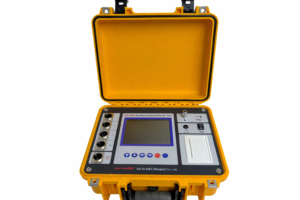
Click the image to know more about Three Phase Capacitance and Inductance Tester.
What Is a Separately Excited Generator?
A separately excited generator is a DC generator in which:
- The field winding is supplied by an independent DC power source
- The armature circuit operates separately from the field circuit
This means the magnetic field is not affected by load changes, allowing stable and controlled voltage output.
Separately Excited Generator Working Principle
The working principle is based on electromagnetic induction, just like other DC generators. However, the key difference is how the magnetic field is produced.
E \propto \Phi N
Where:
- E = generated voltage
- Φ = magnetic flux (controlled externally)
- N = rotational speed
Since the field current is externally controlled, the magnetic flux remains stable even when load changes.
Why Separately Excited Generators Matter
Separately excited generators are important because they provide:
1. Precise Voltage Control
The output voltage can be adjusted easily by changing the field current.
2. High Stability
Voltage remains stable under varying load conditions.
3. Independent Operation
The field circuit does not depend on the armature output.
4. Better Performance in Critical Systems
Ideal for systems where voltage accuracy is essential.
Advantages of Separately Excited DC Generators in Precision Systems
Separately excited generators are widely used in precision applications due to the following advantages:
✅ Excellent Voltage Regulation
Unlike self-excited generators, voltage does not drop significantly under load.
✅ Flexible Control
Engineers can control output voltage by adjusting the external excitation source.
✅ Stable Magnetic Field
Flux remains constant regardless of load fluctuations.
✅ Suitable for Automation
Easily integrated with control systems and automation equipment.
Generator Voltage Control Methods
Separately excited generators offer multiple ways to control voltage:
1. Field Current Adjustment
Changing the external DC supply adjusts the magnetic field strength.
2. Rheostat Control
A variable resistor is used to regulate field current.
3. Electronic Controllers
Modern systems use:
- AVR (Automatic Voltage Regulators)
- Digital control systems
These methods allow accurate and real-time voltage control.
Comparison with Self-Excited Generators
| Feature | Separately Excited Generator | Self-Excited Generator |
|---|---|---|
| Field Source | External DC supply | Own output |
| Voltage Control | Precise | Limited |
| Stability | High | Moderate |
| Complexity | Higher | Lower |
| Applications | Precision systems | General use |
Common Applications
Separately excited generators are used where accuracy and control are critical:
Laboratory Testing
- Voltage calibration
- Equipment testing
- Research applications
Industrial Systems
- DC motor drives
- Speed control systems
- Automation equipment
Power Systems
- Substation auxiliary systems
- Backup power control
Transportation
- Electric vehicles (EV systems)
- Railway traction systems
Testing and Maintenance
Proper testing ensures reliable operation.
Key Tests Include:
- Field current measurement
- Insulation resistance testing
- Voltage regulation testing
- Load performance testing
High-quality diagnostic tools, such as those provided by Wrindu, help engineers maintain system accuracy and prevent failures.
Challenges and Limitations
Despite many advantages, separately excited generators also have some drawbacks:
- Requires external power supply
- Higher system complexity
- Increased installation cost
However, in precision systems, the benefits usually outweigh these limitations.
Future Trends in Excitation Systems
Modern excitation systems are evolving with new technologies:
- Digital excitation control
- Smart monitoring systems
- AI-based voltage regulation
- Integration with renewable energy systems
Separately excited generators will continue to play a key role in high-precision and intelligent power systems.
Conclusion
A separately excited generator is essential in applications where voltage stability and control are critical. By using an external DC source for excitation, it ensures consistent performance under varying loads.
While it is more complex than self-excited generators, its advantages make it the preferred choice for laboratories, industrial automation, and modern power systems.
