

What Are the Challenges in Testing Converter and Rectifier Transformers?
Explore the key challenges in testing converter and rectifier transformers on-site. Learn about vector group complexity, multi-tap phase shift variation, and modern TTR-based testing solutions used to improve accuracy and reduce manual errors in field diagnostics.
Why Are Special Transformers Difficult to Test?
Special transformers are more complex because:
- They have unconventional vector groups
- They include phase-shifting windings
- They support multi-winding configurations
- They interact with power electronic systems
What Makes On-Site Testing More Complex?
On-site testing is challenging due to:
- Complex cabling arrangements
- Phase swapping requirements
- Tap-dependent behavior changes
- Manual calculation errors
Testing becomes time-consuming and error-prone.
What Are the Main Testing Methods?
1. Traditional single-phase testing
- Simple but requires manual calculations
- High risk of error
2. TTR-based testing (modern method)
- Automatic ratio + phase shift measurement
- Supports multi-tap testing
- Complies with IEC standards
3. Three-phase supply testing
- Accurate but complex setup
- Mostly used in labs
What Did Prototype Testing Show?
Experimental results showed:
- Phase shift remains stable across nominal taps
- Slight deviation occurs in extreme tap positions
- Measured values closely match theoretical values
This confirms the reliability of modern testing methods.
Why Is Phase Shift Deviation Important?
Even small deviations may:
- Reduce harmonic filtering efficiency
- Affect converter switching balance
- Impact system stability in low-pulse systems
Higher pulse systems are less sensitive.
What Is the Best Solution for On-Site Testing?
The most practical solution is:
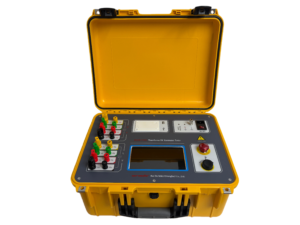
- A TTR tester with integrated phase angle measurement
- Automated vector group recognition
- Multi-tap analysis capability
This reduces human error and improves efficiency.
FAQs
Q1: Why are converter transformers harder to test?
Because they use non-standard vector groups and phase-shifting designs.
Q2: What is the biggest challenge in on-site testing?
Cable configuration and phase matching complexity.
Q3: Can software help in testing?
Yes, modern TTR software automates calculations and analysis.
Q4: What standard applies to these tests?
IEC 61378-1 is widely used.
Q5: What is the most reliable test method?
Automatic three-phase TTR testing with phase angle measurement.
