

Why Choose RDXZ-270kVA/270kV AC Series Resonance Test Device for Safe High-voltage Testing
Discover the RDXZ-270kVA/270kV AC series resonance test device for high-voltage cable, transformer, and GIS testing. Compact, energy-efficient, and multi-protected for safe insulation verification.
The RDXZ-270kVA/270kV AC Series Resonance Variable Frequency Withstand Voltage Test Device, manufactured by Rui Du Mechanical and Electrical (Shanghai), is designed for high-voltage testing of power cables, transformers, GIS, and substation systems. It combines compact design, energy efficiency, and multi-layered safety features, making it ideal for commissioning, acceptance testing, and preventive maintenance.
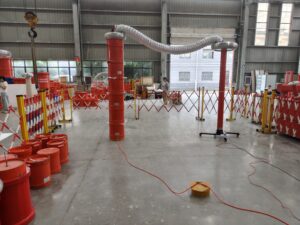
Click to know more about AC Series Resonance Variable Frequency Withstand Voltage Test Device.
What Makes the RDXZ-270kVA/270kV Device Stand Out?
How Does It Improve Testing Efficiency?
- Compact and lightweight design: High-voltage reactors weigh only 45kg each, facilitating transport and onsite assembly.
- Low input power requirement: Resonant circuits compensate for reactive losses, reducing power consumption compared to traditional AC test transformers.
- Modular reactor combinations: Series and parallel configurations match different cable lengths, transformer capacities, and voltage levels.
Why Is It Safer Than Traditional AC Testing?
The device integrates physical resonance characteristics with electronic protections, ensuring multiple layers of safety:
- Pre-set parameter limits: Soft protection prevents overvoltage or overcurrent before the test begins.
- Automatic detuning during flashover: Voltage drops instantly if the test object breaks down, avoiding sustained arcs.
- Overcurrent protection: Shuts off the power supply to protect reactors, transformers, and the variable frequency power module.
- Overvoltage protection: Voltage is rapidly reduced if the system exceeds preset limits, alerting operators with alarms.
How Does the Device Ensure Accurate Test Results?
- Adjustable frequency range: 30–300Hz allows precise tuning for cables and transformers.
- High-quality sine wave output: Low harmonic distortion minimizes stress on insulation.
- Automatic tuning and voltage regulation: Reduces manual steps and ensures consistent test conditions.
- Flexible testing capability: One system can cover 10kV–110kV cables, transformers up to 120MVA, and GIS equipment.
What Are Its Key Applications?
| Test Object | Voltage | Max Length / Capacity | Test Voltage |
|---|---|---|---|
| 10kV Cables | 10kV | up to 3km | ≤22kV |
| 35kV Cables | 35kV | up to 1km | ≤52kV |
| 110kV Cables | 110kV | up to 0.2km | ≤128kV |
| Transformers | ≤120MVA/110kV | — | ≤160kV (45–65Hz) |
| GIS / Substation | 110kV | — | ≤265kV |
What Are the Advantages Over Traditional AC Test Transformers?
- Energy-efficient: Only compensates for resonant losses instead of supplying full load power.
- Safe: Automatic detuning and multi-layer protections reduce risks during flashover.
- Portable: Modular reactors allow easy onsite assembly and series/parallel combination.
- Accurate: Adjustable frequency and high-quality sine wave output ensure reliable insulation testing.
- Versatile: Can test multiple types of equipment with a single system.
Are There Any Limitations?
- Not strictly a 50/60Hz test—some transformer applications require strict power frequency.
- Resonant tuning takes time, particularly for manual adjustments.
- Sensitive to deviations in load capacitance and environmental factors.
- Higher initial cost compared to a standard AC test transformer.
- Less suitable for purely inductive loads, ideal for capacitive loads like cables and GIS equipment.
FAQs
Q1: Can the device test long-distance cables?
Yes, up to 3km for 10kV cables and up to 0.2km for 110kV cables with adjustable reactor combinations.
Q2: Is it suitable for transformer testing?
Yes, it can test transformers up to 120MVA/110kV safely.
Q3: How quickly does it respond to flashover?
The system detunes and cuts off voltage within milliseconds to protect both equipment and operators.
Q4: Does it require high input power?
No, resonant technology minimizes input power while maintaining high test voltages.
Q5: Can it handle GIS or substation equipment?
Yes, it is designed for AC withstand testing of GIS, busbars, and other substation systems.
