

What Is an AC Resonance Test System
Learn what an AC Resonance Test System is and how series resonance is used for high-voltage testing of cables, transformers, and GIS equipment. Discover working principles, key components, advantages, and industrial applications in modern power systems testing.
AC Resonance Test Systems are widely used in high-voltage testing to verify the insulation strength of power equipment such as cables, transformers, GIS, and switchgear. The system uses the principle of series resonance to generate high AC voltage efficiently and safely.
Instead of relying on traditional high-capacity hipot sources, this method reduces power demand while still achieving high test voltage through resonance amplification.
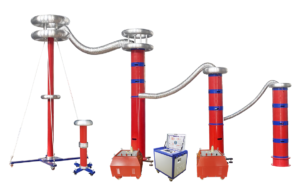
Click the image to know more about Series Resonance Withstand Voltage Test Device.
What Is Series Resonance in an AC Test System?
What does “series resonance” mean in electrical testing?
Series resonance occurs when inductive reactance equals capacitive reactance in a circuit. At this point:
- The circuit impedance becomes minimal
- The current reaches maximum value
- The voltage across the test object increases significantly
In simple terms, the system “amplifies” voltage using resonance conditions.
A typical AC resonance system includes:
- Variable frequency power supply
- Excitation transformer
- HV reactor
- Capacitive test object
- Voltage divider
Where Is an AC Resonance Test System Used?
What equipment requires AC resonance testing?
AC resonance systems are commonly used for high-voltage withstand testing of:
- Power cables (6kV–500kV XLPE cables)
- Large power transformers
- GIS (Gas Insulated Switchgear)
- SF6 switchgear systems
- Busbars and bushings
- Large generator systems
It is especially useful when testing high-capacitance equipment where traditional AC hipot systems are inefficient.
How Does an AC Resonance Test System Work?
How does resonance generate high voltage efficiently?
The system works by tuning frequency until resonance is achieved using the formula:
f = \frac{1}{2\pi\sqrt{LC}}
At resonance:
- L = reactor inductance
- C = test object capacitance
When resonance occurs:
- The output voltage is multiplied by a quality factor (Q)
- Q can range from tens to over 100
- High voltage is achieved with relatively low input power
This makes the system energy-efficient and suitable for field testing.
What Are the Main Features of an AC Resonance Test System?
Why is it preferred in modern high-voltage testing?
Key features include:
- Digital LCD display for real-time data
- Automatic and manual test modes
- Adjustable frequency and voltage control
- Built-in safety protection (overvoltage, overcurrent, discharge)
- Lightweight and portable design
- Real-time waveform monitoring
- Built-in data printing and recording
These features make it suitable for both laboratory and on-site testing.
What Are the Main Components of the System?
What parts make up an AC resonance test system?
1. Variable Frequency Power Supply
Adjusts output frequency and voltage, forming the control core of the system.
2. Excitation Transformer
Steps up voltage and isolates high and low voltage sides for safety.
3. High Voltage Reactor
Works with capacitance to achieve resonance and improve waveform quality.
4. High Voltage Divider
Measures output voltage accurately and ensures safe monitoring of HV levels.
What Are the Advantages of AC Resonance Testing?
Why use resonance instead of traditional AC hipot testing?
Main advantages:
- Lower power requirement for high voltage output
- High efficiency with reduced energy loss
- Compact and portable design
- Strong protection system for operator safety
- Suitable for very large capacitive loads
- Real-time monitoring and waveform display
It is especially useful for modern grid-scale equipment testing.
FAQs About AC Resonance Test Systems
Q1: Why is AC resonance better for cable testing?
Because long HV cables have high capacitance, resonance systems can generate required voltage without extremely large power sources.
Q2: Is AC resonance testing safe?
Yes. It includes multiple protection systems such as overvoltage, overcurrent, and fast discharge functions (typically within milliseconds).
Q3: What is the main principle of resonance testing?
It uses LC resonance conditions to amplify voltage efficiently while minimizing power consumption.
Q4: Can it replace traditional hipot testing?
In many high-capacitance applications (like long cables or GIS), yes—it is more efficient and practical.
Q5: What makes it suitable for field testing?
Its compact design, automatic control system, and strong safety protections make it ideal for on-site commissioning.
Conclusion
AC Resonance Test Systems use the principle of series resonance to perform high-voltage withstand testing efficiently and safely. They are widely applied in cables, transformers, GIS, and power systems, offering a modern alternative to traditional AC hipot testing.
With lower power demand, higher safety, and better adaptability, resonance testing has become a key solution for modern high-voltage engineering.
