

4-Wire Kelvin for EV Battery & Cable Testing
4-wire Kelvin method delivers accurate low-resistance testing for EV batteries, high-voltage cables & connectors, ensuring electric vehicle safety and operational performance.
As the electric vehicle (EV) industry continues to expand rapidly, electrical safety and performance reliability have become non-negotiable standards for OEMs, component suppliers, and assembly manufacturers. EV powertrain systems rely heavily on low-resistance components—including high-voltage batteries, power cables, and transmission connectors—where even minor resistance anomalies can trigger safety hazards, power loss, reduced battery life, or critical system failures.
Traditional 2-wire resistance testing is insufficient for EV applications, as it fails to eliminate lead resistance, contact resistance, and wiring interference, resulting in inaccurate low-resistance measurements. The 4-wire Kelvin method solves this pain point perfectly, delivering ultra-precise resistance readings to support strict quality control for EV batteries and cables, safeguarding the overall safety and operational efficiency of electric vehicles.
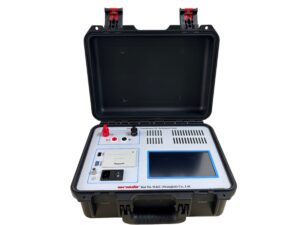
Click the image to know more about DC Resistance Tester.
Core Applications of 4-Wire Kelvin Testing in EV Systems
1. EV Power Battery Precision Testing
Power batteries are the “heart” of electric vehicles, and internal resistance is a key indicator of battery health, performance, and safety. The 4-wire Kelvin test is widely used to measure the internal resistance of battery cells, modules, and battery packs, detecting defects such as poor electrode contact, internal short circuits, material degradation, and substandard welding.
Unlike conventional testing methods, Kelvin testing isolates current-carrying leads and voltage-sensing leads, removing external interference to capture true low-resistance data. This allows manufacturers to screen out substandard batteries early in production, prevent thermal runaway risks, extend battery cycle life, and comply with global EV safety regulations.
2. EV High-Voltage Cable Resistance Testing
EV high-voltage cables transmit large currents between the battery, motor, and electronic control unit (ECU), requiring extremely low and stable resistance. Even slight increases in cable resistance—caused by inferior materials, poor crimping, or insulation damage—can lead to power attenuation, heat buildup, and potential fire risks.
The 4-wire Kelvin method enables accurate resistance testing of high-voltage cables, identifying micro-defects that standard tests miss. It supports batch testing in mass production, ensuring every cable meets OEM resistance specifications and maintaining stable power transmission for EV powertrains.
3. EV Connector & Terminal Contact Testing
Connectors and terminals are critical links in the EV electrical system, prone to elevated contact resistance due to oxidation, loose crimping, improper assembly, or mechanical wear. High contact resistance disrupts current flow, reduces driving range, and poses serious safety threats.
4-wire Kelvin testing precisely measures contact resistance at connector interfaces, flagging weak or faulty connections before vehicles hit the market. This is vital for automotive OEMs prioritizing safety, especially for high-voltage connection systems in electric passenger vehicles, commercial EVs, and new energy logistics vehicles.
Why 4-Wire Kelvin Testing Is Irreplaceable for EV Manufacturing
In the competitive EV industry, quality and safety directly shape brand reputation and market trust. The 4-wire Kelvin method stands out as a core quality control tool for several key reasons: it eliminates measurement errors caused by lead and contact resistance, delivering high-precision data for ultra-low resistance values; it supports automated, high-volume testing to align with fast-paced EV assembly lines; it proactively identifies hidden defects, cutting rework costs, scrap rates, and after-sales warranty risks; and it aligns with international automotive testing standards, ensuring products meet global regulatory requirements.
For deeper insights into related applications and advantages, explore our resources: Our Core Pillar Pages, 4-wire Kelvin Method for Power Utilities, Benefits of Kelvin Resistance Testing.
Long-Tail FAQ: 4-Wire Kelvin Testing for EV Battery & Cable
Q1: Why can’t 2-wire testing replace 4-wire Kelvin testing for EV battery internal resistance?
A: 2-wire testing combines battery internal resistance with lead and contact resistance, producing skewed readings for low-resistance EV batteries. 4-wire Kelvin testing separates current and voltage circuits, excluding external resistance to measure true internal resistance—critical for accurate battery health assessment and safety validation.
Q2: What resistance range does 4-wire Kelvin testing cover for EV high-voltage cables?
A: 4-wire Kelvin testing excels at measuring ultra-low resistance, typically ranging from milliohms (mΩ) to microohms (μΩ), which perfectly matches the low-resistance requirements of EV high-voltage cables. It detects subtle resistance changes that standard tools cannot, ensuring cable integrity.
Q3: Is 4-wire Kelvin testing suitable for mass EV production line testing?
A: Yes, it is fully compatible with automated production lines. 4-wire Kelvin testing can be integrated with automated test equipment (ATE) and in-circuit test systems for fast, repeatable batch testing, balancing precision and efficiency without slowing manufacturing speeds.
Q4: How does 4-wire Kelvin testing improve EV battery safety performance?
A: By delivering precise internal resistance data, Kelvin testing identifies faulty battery cells/modules with abnormal resistance early, preventing issues like thermal runaway, overheating, and short circuits. This reduces safety risks during vehicle charging, driving, and long-term use.
Q5: Does 4-wire Kelvin testing work for EV charging cable resistance detection?
A: Absolutely. EV charging cables also require stable low resistance, and the 4-wire Kelvin method accurately measures their resistance, checking for defects like poor terminal crimping and conductor damage to ensure safe, efficient charging performance.
Q6: What common issues affect 4-wire Kelvin test accuracy for EV components?
A: Key factors include poor probe contact, worn/dirty test probes, uncalibrated equipment, unstable test environments, and improper lead wiring. Regular calibration, probe maintenance, and standardized operation fix these issues to maintain testing precision.
Explore More Expert Resources:
