

What Is a CT Ratio Test and Why Is It Important?
Learn what a CT ratio test is, how it works, and why it ensures accurate metering and relay protection. Includes IEC 61869 and IEEE C57.13 standards.
Overview
A CT ratio test checks whether a current transformer (CT) delivers the correct secondary current based on its rated transformation ratio.
For example, a 1000:5 CT should output 5 amps on the secondary side when 1000 amps flow through the primary. If the CT does not match this ratio, meters read incorrectly and protection relays may fail to trip during faults.
Utilities, OEM manufacturers, and testing engineers rely on CT ratio testing to ensure safe and accurate power system operation.
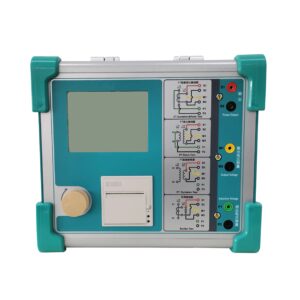
Click the picture to know more about Wrindu CT and PT Analyzer.
What Is a CT Ratio?
A CT ratio shows the relationship between primary current and secondary current.
Example:
-
Nameplate ratio: 600:5
-
Primary current: 600 A
-
Expected secondary current: 5 A
The CT reduces high primary current to a safe, measurable value. Engineers use this reduced current for metering and protection systems.
If the ratio drifts, the entire measurement chain becomes unreliable.
How Does a CT Ratio Test Work?
Engineers perform a CT ratio test in a clear and structured way:
-
Connect the CT analyzer to the CT terminals.
-
Inject a known current into the primary or secondary winding.
-
Measure the corresponding output current.
-
Compare the measured ratio with the nameplate value.
Modern CT analyzers calculate the ratio automatically and display:
-
Measured ratio
-
Ratio error (%)
-
Phase angle error
Digital instruments complete the test quickly and reduce human error.
Why Is a CT Ratio Test Important?
1. Ensures Metering Accuracy
Incorrect CT ratios lead to incorrect energy billing. Even small ratio errors can cause significant revenue losses over time.
2. Protects Power Systems
Protection relays depend on accurate current signals. If the CT ratio is wrong, relays may:
-
Trip unnecessarily
-
Fail to trip during faults
Both scenarios create serious risks for grid stability.
3. Confirms Manufacturing Quality
Manufacturers perform ratio tests before shipping CTs. This step confirms winding integrity and correct turns ratio.
4. Supports Commissioning and Maintenance
Engineers run ratio tests during:
-
Substation commissioning
-
Routine maintenance
-
After repair or rewinding
Regular testing prevents unexpected failures.
What Causes CT Ratio Errors?
Several issues can affect CT ratio accuracy:
-
Shorted winding turns
-
Insulation breakdown
-
Core damage
-
Mechanical deformation
-
Incorrect tap connections
A ratio test quickly reveals these problems before they affect system performance.
Which Standards Govern CT Ratio Testing?
International standards define acceptable ratio error limits and testing methods:
-
IEC 61869 – Defines accuracy classes and testing procedures for instrument transformers.
-
IEEE C57.13 – Specifies performance requirements for CTs in North America.
These standards classify CTs into accuracy classes such as 0.2, 0.5, 1.0, and protection classes like 5P and 10P.
When Should You Perform a CT Ratio Test?
You should perform a CT ratio test:
-
Before installing a new CT
-
After transportation or mechanical impact
-
After maintenance or repair
-
During periodic preventive maintenance
-
When metering data looks abnormal
Testing takes only minutes but protects the system for years.
Who Uses CT Ratio Testing?
CT ratio testing plays a key role in:
-
Power utilities
-
Substation engineers
-
Protection relay technicians
-
Transformer manufacturers
-
Industrial power plants
-
Renewable energy facilities
Any system that relies on accurate current measurement needs verified CT ratios.
What Equipment Do You Need?
Modern CT ratio testing equipment typically includes:
-
Built-in current source
-
High-precision measurement module
-
Automatic ratio calculation
-
Data storage and reporting
-
USB or PC communication interface
Advanced analyzers combine ratio testing with polarity, burden, and magnetization curve tests in one portable unit.
What Happens If You Skip CT Ratio Testing?
Skipping this test can result in:
-
Incorrect energy billing
-
Relay misoperation
-
Equipment damage during faults
-
Increased downtime
-
Safety hazards for personnel
A simple ratio verification prevents these costly issues.
Wrindu Expert Review
A CT ratio test confirms that a current transformer delivers the correct secondary current according to its rated transformation ratio. Accurate ratios protect revenue, ensure relay performance, and maintain grid stability.
Engineers should include CT ratio testing in every commissioning and maintenance program. It remains one of the fastest and most important checks in power system diagnostics.
