

How CT Saturation Affects Different Protection Applications
Learn how CT saturation affects differential, transformer, busbar, and overcurrent protection systems and why CT performance matters.
Why Does CT Saturation Matter in Protection Applications?
Current transformers (CTs) provide current signals for different protection systems.
Each protection application has different requirements for CT performance.
For example:
- Differential protection compares current differences.
- Overcurrent protection depends on current level detection.
- Distance protection uses current and voltage signals.
When CT saturation changes the current signal, different protection systems may experience different problems.
Therefore, engineers need to understand how CT saturation affects each application.
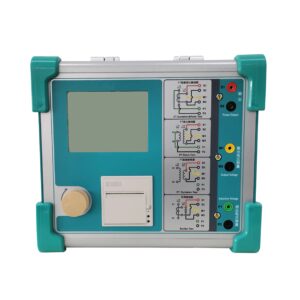
Click the image to know more about Wrindu CT and PT Analyzer.
How Does CT Saturation Affect Differential Protection?
Differential protection compares current entering and leaving protected equipment.
It is widely used for:
- Power transformers
- Generators
- Busbars
Under normal conditions, the current difference should remain very small.
Why Is CT Saturation a Concern for Differential Protection?
During an external fault, two CTs may not produce the same secondary current.
One CT may saturate earlier than another.
This difference can create an artificial current imbalance.
As a result:
- The relay may detect a false internal fault
- Protection settings may become unstable
- Unnecessary trips may occur
Therefore, CT performance is important for differential protection reliability.
How Does CT Saturation Affect Transformer Protection?
Transformer protection relies on accurate current information from CTs.
Common transformer protection functions include:
- Differential protection
- Overcurrent protection
- Earth fault protection
Why Do Transformer Protection Systems Need Good CT Performance?
Transformer faults require fast and accurate protection.
If CT saturation affects the current signal:
- Fault current information may become inaccurate
- Relay judgment may become slower
- Protection performance may decrease
Engineers should select CTs that match transformer protection requirements.
How Does CT Saturation Influence Busbar Protection?
Busbar protection requires accurate current comparison from multiple CTs.
A substation busbar may connect several feeders.
Each feeder uses CTs to provide current signals.
Why Is CT Matching Important in Busbar Protection?
During a fault outside the busbar area:
- All feeder CTs should provide consistent signals.
- The protection system should identify the fault location correctly.
If one CT saturates differently:
- Current comparison becomes inaccurate.
- The relay may receive incorrect information.
Therefore, CT characteristics are important in busbar protection design.
How Does CT Saturation Affect Overcurrent Protection?
Overcurrent protection detects abnormal current levels.
It depends mainly on current magnitude.
When CT saturation occurs:
- The secondary current may become lower than the actual fault current.
- The relay may receive an incorrect current value.
This may affect:
- Relay pickup operation
- Protection timing
- Fault clearance performance
How Does CT Saturation Influence Distance Protection?
Distance protection uses impedance calculation.
The relay calculates impedance based on:
- Current signal
- Voltage signal
A distorted CT current signal can affect impedance calculation.
Possible effects include:
- Incorrect fault distance estimation
- Protection zone errors
- Delayed operation
Therefore, CT performance also matters in transmission protection systems.
Why Do Protection Engineers Consider CT Application Before Selection?
A CT suitable for one application may not be suitable for another.
Engineers should consider:
- Protection type
- Fault level
- Relay requirements
- System voltage level
The same CT parameters may have different importance depending on the application.
How Should Engineers Evaluate CT Requirements for Different Applications?
Differential Protection
Engineers usually focus on:
- CT matching
- Saturation performance
- Accuracy during fault conditions
Transformer Protection
Engineers consider:
- Fault current capability
- Relay requirements
- CT characteristics
Busbar Protection
Engineers focus on:
- Multiple CT consistency
- Saturation behavior
- Current comparison accuracy
Overcurrent Protection
Engineers check:
- Current transformation accuracy
- Relay operating requirements
How Can Proper CT Application Improve Protection Reliability?
Correct CT application helps protection systems receive reliable signals.
Engineers should:
- Select suitable CT types
- Match CTs with relay requirements
- Consider system fault conditions
- Review application requirements
A suitable CT design reduces the influence of saturation on protection performance.
CT Saturation Application FAQs
Why is CT saturation important for differential protection?
Differential protection compares current differences, so inaccurate CT signals may affect relay decisions.
Can CT saturation affect transformer protection?
Yes. Saturated CT signals may reduce the accuracy of transformer protection functions.
Why do busbar protection systems require careful CT selection?
Busbar protection compares signals from multiple CTs, so inconsistent CT performance may affect protection judgment.
Does CT saturation affect overcurrent relays?
Yes. CT saturation can reduce the current signal received by the relay.
Are all CT applications affected by saturation in the same way?
No. Different protection applications have different requirements and sensitivity to CT saturation.
