

PCB Testing Laboratory Equipment: What Does a Transformer Oil Laboratory Need?
Explore PCB laboratory equipment, including GC-ECD, sample extraction, SPE cleanup, and supporting instruments for insulating oil analysis.
A laboratory that performs PCB testing in transformer oil needs specialized analytical equipment and sample preparation facilities.
Unlike routine transformer oil testing, PCB analysis requires a dedicated chromatographic system. A complete laboratory configuration may include GC-ECD, sample extraction equipment, cleanup devices, reference standards, and quality control materials.
This guide explains the main equipment requirements and the differences between PCB testing and routine transformer oil analysis.
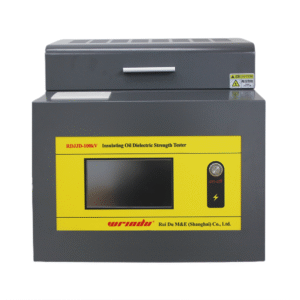
Click the image to know more about Wrindu Oil BDV Tester.
What Equipment Is Required for PCB Testing in Transformer Oil?
A typical PCB analytical laboratory needs the following equipment.
| Equipment | Main function | Requirement |
|---|---|---|
| Gas chromatograph with ECD | PCB separation and detection | Core analytical instrument |
| Automatic liquid sampler | Consistent sample injection | Recommended |
| Capillary column | Separates PCB compounds | Method-dependent |
| Nitrogen blowdown concentrator | Concentrates extracted samples | Sample preparation |
| SPE system | Removes interfering substances | Sample cleanup |
| Analytical balance | Measures sample mass | Sample preparation |
| Vortex mixer | Mixes samples and reagents | Sample preparation |
| Centrifuge | Separates sample components | Method-dependent |
| Fume hood | Controls exposure to chemical vapors | Safety facility |
| PCB reference standards | Calibration and quality control | Required for quantitative analysis |
The final equipment configuration must follow the selected analytical method.
Why Does PCB Testing Require Sample Preparation Equipment?
Transformer oil contains a large amount of mineral oil hydrocarbons. These substances can interfere with PCB analysis.
Therefore, laboratories normally prepare and clean the sample before chromatographic analysis.
Typical preparation stages include:
- Measuring the transformer oil sample.
- Extracting PCB compounds into a suitable solvent.
- Removing unwanted oil components.
- Cleaning the extract using an appropriate procedure.
- Concentrating the extract when required.
- Preparing the final solution for GC analysis.
The exact procedure depends on the selected standard and validated laboratory method.
Should a PCB Laboratory Choose GC-ECD or GC-MS?
GC-ECD is commonly selected for PCB quantitative analysis in insulating liquids.
GC-MS can provide additional compound identification information and may be used for confirmation or specific PCB congener analysis.
| Comparison | GC-ECD | GC-MS |
|---|---|---|
| Main purpose | Sensitive PCB detection | Compound identification and analysis |
| Detector | Electron capture detector | Mass spectrometer |
| PCB analysis | Commonly used | Method-dependent |
| Additional identification | More limited | Provides mass spectral information |
| Laboratory cost | Configuration-dependent | Generally higher equipment investment |
| Application | Routine PCB analysis | Confirmation and detailed analysis |
The laboratory should select the system based on the target PCB compounds, required reporting limits, standard, and available budget.
What Standards Should a PCB Testing Laboratory Follow?
Several standards are relevant to PCB analysis.
| Standard | Application |
|---|---|
| IEC 61619 | PCB determination in insulating liquids |
| ASTM D4059 | PCB analysis by gas chromatography |
| SN/T 1792-2014 | PCB determination in electrical insulating oil by gas chromatography |
The laboratory should verify that its instrument configuration, sample preparation, calibration, and quality control procedures comply with the selected method.
What Laboratory Facilities Are Needed for PCB Analysis?
PCB analysis involves solvents and potentially hazardous chemicals.
A laboratory should establish separate areas for sample preparation and instrument analysis where practical.
Important facilities include:
- Suitable chemical fume hoods.
- Solvent storage and waste management facilities.
- Appropriate glass sample containers.
- Laboratory ventilation.
- High-purity carrier gas supply.
- Chemical safety equipment.
- PCB-contamination control procedures.
For GC-ECD systems using a radioactive source such as nickel-63, local radiation safety and licensing requirements must be checked before purchase and operation.
Can Existing Transformer Oil Testing Equipment Be Used for PCB Analysis?
Routine oil testing equipment cannot directly measure PCB concentration.
For example:
| Existing equipment | Measurement | Can it detect PCB? |
|---|---|---|
| Oil BDV tester | Breakdown voltage | No |
| Oil moisture tester | Water content | No |
| Oil acid value tester | Acidity | No |
| Oil tan delta tester | Dielectric properties | No |
| DGA analyzer | Dissolved fault gases | No, unless separately configured and validated for PCB analysis |
A laboratory that already owns these instruments needs a separate PCB analytical solution.
How Can Wrindu Equip a Routine Transformer Oil Testing Laboratory?
Wrindu provides instruments for routine transformer oil condition monitoring.
The following equipment can support different laboratory test requirements:
| Product | Main test item | Product link |
|---|---|---|
| Oil Dielectric Strength Tester | Breakdown voltage | View product |
| Transformer Insulation Oil Acid Value Tester | Acid value | View product |
| New Insulating Oil Micro-Water Tester | Water content | View product |
| Transformer Tan Delta Tester | Dielectric dissipation factor | View product |
These products are designed for routine oil testing applications, not PCB analysis.
Contact Wrindu with your required test items, applicable standards, and laboratory configuration to request an equipment quotation.
