

Direct Connection vs. Clamp Coupling vs. Induction: Which Cable Locating Method Should You Use?
Compare direct connection, clamp coupling, and induction for underground cable locating. Learn how each method works and when to use it.
Underground cable locating equipment can introduce detection signals into a target cable in different ways. The three common methods are direct connection, clamp coupling, and induction.
Each method has different connection requirements and working conditions. Engineers should select the appropriate method according to cable accessibility, site conditions, and the presence of nearby cables.
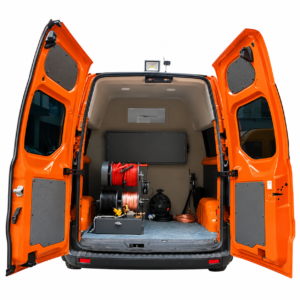
Click the image to know more about Wrindu RDCD-C Vehicle-Mounted Cable Fault Testing System.
What Is Direct Connection in Cable Locating?
Direct connection uses a transmitter lead to connect the signal output directly to the target cable.
The transmitter introduces a selected frequency into the cable. A receiver then detects the signal above ground and helps the operator trace the cable route.
Direct connection is suitable when engineers can access the target cable and establish the required electrical connection.
Main characteristics:
- Direct signal connection to the target cable.
- Suitable for tracing a selected cable.
- Requires an accessible connection point.
- Requires the operator to follow the equipment manual and electrical safety procedures.
What Is Clamp Coupling in Cable Detection?
Clamp coupling uses a transmitting clamp placed around an accessible cable. The clamp introduces a signal into the cable without requiring a direct electrical connection to its conductor.
This method is useful when the cable is accessible but making a direct electrical connection is inconvenient.
The operator should select a suitable clamp and ensure that it is correctly positioned around the target cable.
Main characteristics:
- Uses a transmitting clamp.
- Does not require direct electrical contact with the conductor.
- Requires physical access to the cable.
- Helps introduce a detection signal into the selected cable.
How Does Induction Work in Underground Cable Locating?
Induction introduces an electromagnetic signal into an underground cable without a direct electrical connection or a transmitting clamp.
The transmitter generates an electromagnetic field. This field induces a signal in nearby conductive cables, which the receiver can detect above ground.
Induction is useful when direct connection and clamp coupling are not practical.
However, nearby cables may also receive the induced signal. Engineers should check the detected route carefully when several cables run close together.
What Is the Difference Between the Three Cable Connection Methods?
| Comparison Item | Direct Connection | Clamp Coupling | Induction |
|---|---|---|---|
| Signal introduction | Direct electrical connection | Transmitting clamp | Electromagnetic induction |
| Direct conductor connection | Required | Not required | Not required |
| Clamp required | No | Yes | No |
| Cable access | Connection point required | Cable must be accessible for clamping | Direct cable access may not be required |
| Typical application | Selected cable tracing | Accessible cables without direct connection | Initial tracing or limited-access situations |
The three methods provide different ways to introduce a detection signal. The operator should select the method that matches the actual cable and site conditions.
Which Cable Locating Method Should Engineers Choose?
The following table provides a practical selection guide.
| Working Condition | Recommended Method | Reason |
|---|---|---|
| An accessible electrical connection point is available | Direct connection | Connects the transmitter directly to the target cable |
| The cable is accessible but direct connection is inconvenient | Clamp coupling | Introduces a signal through a transmitting clamp |
| Direct connection is not practical and the cable cannot be clamped | Induction | Introduces a signal without direct cable contact |
| Several cables run close together | Direct connection, when accessible | Helps introduce the signal into the selected cable |
The selection also depends on cable construction, grounding conditions, nearby conductive objects, and the transmitter instructions.
How Can Engineers Reduce Signal Interference During Cable Locating?
Several cables may receive electromagnetic signals during underground cable detection. This can make it difficult to distinguish the target cable from nearby circuits.
Engineers should:
- Connect the transmitter to the intended cable whenever practical.
- Select an appropriate active frequency.
- Check the receiver signal strength along the detected route.
- Compare the detected direction with available cable drawings.
- Repeat the detection from another position if the result is unclear.
Induction requires particular attention in areas containing multiple nearby cables because the signal may couple into more than one conductor.
Which Connection Methods Does the RDCD-III/R30 Support?
The WRINDU RDCD-III/R30 cable path detector supports three signal connection methods.
| Method | Supported |
|---|---|
| Direct connection | Yes |
| Clamp coupling | Yes |
| Induction | Yes |
The equipment also supports 10 active frequencies and 2 passive frequencies.
Its receiver provides signal strength, direction, burial depth, and position information to support underground cable route detection.
Frequently Asked Questions
Does clamp coupling require direct electrical contact with the cable?
No. Clamp coupling introduces the signal through a transmitting clamp placed around the accessible cable.
Can induction detect a cable without connecting a transmitter directly?
Yes. Induction introduces an electromagnetic signal without a direct electrical connection to the cable.
Which method is suitable for several cables in one trench?
Direct connection to the selected cable is generally preferable when a suitable connection point is available. It helps reduce uncertainty about which cable receives the transmitter signal.
Can the three connection methods be used with the RDCD-III/R30?
Yes. The RDCD-III/R30 supports direct connection, clamp coupling, and induction.
About Wrindu Cable Locating Equipment
Wrindu is a Chinese OEM manufacturer of electrical testing equipment and power testing solutions, established in 2014.
The RDCD-III/R30 cable path detector supports three signal connection methods for underground cable tracing. It is also integrated into the RDCD-C Vehicle-Mounted Cable Fault Testing System for field cable testing applications.
