

A Simple Guide to VLF Cable Testing and Diagnostics
Learn what VLF (Very Low Frequency) cable testing is, how it works, and why it is widely used for power cable diagnostics. Understand its advantages over AC testing, plus how PD and Tan Delta tests improve cable health assessment and grid reliability.
Ensuring the reliability of power grids is essential for modern infrastructure. One of the most trusted methods to check cable health is VLF (Very Low Frequency) testing. It helps identify insulation weaknesses, prevent unexpected power outages, and extend the life of cable systems.
But what exactly is it, and how does it work? Let’s break it down into simple terms.
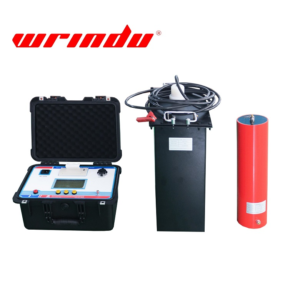
Click the picture to know more about Wrindu VLF HV Tester.
What is VLF Cable Testing and Why Do We Need It?
In the past, power cables were tested using standard 50/60 Hz AC voltage. However, because cables have strong capacitive properties, this method required too much energy and large, impractical equipment for field testing.
Over the last 30 years, VLF testing (usually at 0.1 Hz) has become the global standard. Because the frequency is so low, it requires significantly less power. This makes VLF testing equipment highly portable, efficient, and perfect for on-site diagnostics.
Where Did VLF Testing Come From?
VLF testing became widely adopted in the early 1990s to solve a specific problem in plastic-insulated cable systems (like early XLPE cables). During manufacturing back then, tiny water molecules accidentally got trapped inside the insulation.
Over time, the combination of electrical fields and heat caused these water molecules to grow into “water trees.” These water trees gradually damaged the insulation and turned into “electrical trees,” which rapidly caused total cable breakdown and unexpected blackouts.
VLF testing was introduced to safely trigger these hidden defects during the test rather than during normal operation, allowing teams to fix them before a real blackout occurred.
How Has Cable Testing Changed Today?
Today, manufacturing processes for XLPE cables have greatly improved, meaning “water trees” are rarely an issue anymore. However, VLF voltage testing is still incredibly important. Today, it is primarily used on newly installed cables to detect installation errors and ensure the system is completely safe before it is powered up.
What is the Difference Between Testing and Diagnostics?
While standard VLF testing focuses on finding existing defects by stressing the cable, cable diagnostics aims to evaluate the cable’s health without risking any damage to the system.
Modern diagnostics use two advanced methods alongside VLF:
-
Partial Discharge (PD) Measurement: Installation errors in cable accessories don’t always cause immediate failure but age the system quickly. PD measurement detects and locates these tiny internal sparks, showing which parts might fail in the future.
-
Tan Delta Measurement: This measures dielectric losses to check the overall aging of the insulation. High losses usually mean the insulation is degrading or moisture has entered the cable.
Frequently Asked Questions (FAQs)
What is the main advantage of VLF testing over standard AC testing?
VLF testing operates at a very low frequency (0.1 Hz), which requires much less power to test high-capacitance cables. This allows the testing equipment to be small, lightweight, and portable enough for field use.
Why do we still use VLF testing if modern cables are better made?
Even though modern cables rarely suffer from manufacturing defects like water trees, they are still prone to installation and handling errors. VLF testing is used on new installations to ensure everything was installed correctly before the cable goes live.
Can VLF testing damage a healthy cable?
No. VLF testing is designed to only cause a breakdown at the site of an already advanced, pre-existing defect. If the cable insulation is healthy, VLF testing will not damage it.
How do Tan Delta and Partial Discharge (PD) tests help?
They provide a deeper look into the cable’s future health. PD tests find specific installation faults in accessories, while Tan Delta tests measure the overall aging and moisture levels of the insulation—both without harming the cable.
