

CT Ratio Error and Phase Error: How Do They Affect CT Performance?
Learn what CT ratio error and phase displacement mean, their causes, effects on measurement and protection, and how engineers evaluate CT accuracy.
Why Do CT Errors Matter in Electrical Systems?
Current transformers (CTs) provide current signals for measurement devices and protection systems.
A CT should transfer the primary current into a secondary current with the correct value and phase relationship.
However, the conversion process always creates small differences between the actual output and the expected output.
The two important CT errors include:
- Ratio error
- Phase displacement error
These errors influence measurement accuracy and protection performance.
Therefore, understanding CT errors helps engineers select suitable transformers for different applications.
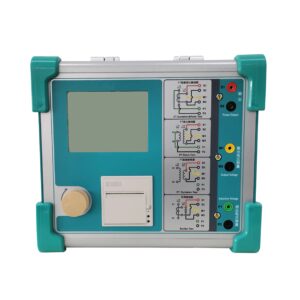
Click the image to know more about Wrindu CT and PT Analyzer.
What Is CT Ratio Error?
CT ratio error describes the difference between the actual transformation ratio and the rated transformation ratio.
For example:
A 1000/5 A CT should provide 5 A secondary current when the primary current reaches 1000 A.
If the actual secondary current differs from the expected value, the CT has ratio error.
A smaller ratio error means better current conversion accuracy.
What Factors Cause CT Ratio Error?
Several conditions can affect CT ratio performance.
CT Core Characteristics
The CT core controls the magnetic conversion process.
Changes in core properties may influence the relationship between primary and secondary current.
Secondary Circuit Load
The secondary circuit affects CT performance.
The total load includes:
- Protection relays
- Measuring instruments
- Secondary cables
- Connection points
A higher secondary load may increase CT error.
Operating Current Conditions
CT performance may change at different current levels.
Engineers should consider:
- Minimum operating current
- Rated current
- High fault current conditions
A CT that works well under normal conditions may show different performance under other conditions.
How Does CT Ratio Error Affect Power Measurement?
Measurement systems depend on accurate current values.
A ratio error can influence:
- Energy calculation
- Power monitoring
- Load analysis
For commercial metering applications, even a small current error may affect measurement results over long operating periods.
Therefore, engineers usually select higher accuracy CTs for precision measurement systems.
How Does CT Ratio Error Affect Protection Systems?
Protection systems use CT signals to detect abnormal conditions.
A large ratio error may affect:
- Relay current input
- Fault current calculation
- Protection response
For protection applications, engineers focus not only on ratio accuracy but also on CT performance during fault conditions.
What Is CT Phase Displacement Error?
CT phase displacement refers to the angle difference between the primary current and secondary current.
Ideally, both currents should maintain the same phase relationship.
However, the CT magnetic process creates a small phase difference.
This difference is called phase displacement.
Why Does CT Phase Displacement Occur?
Phase displacement mainly comes from CT internal characteristics.
Important factors include:
- Core magnetizing current
- CT design
- Secondary circuit conditions
- Operating point
These factors can change the phase relationship between primary and secondary currents.
How Does Phase Displacement Affect Power Measurement?
Power measurement depends on the relationship between voltage and current.
Phase error can affect:
- Active power calculation
- Power factor measurement
- Energy monitoring accuracy
Therefore, high-precision metering systems require CTs with low phase displacement.
How Does Phase Displacement Affect Protection Applications?
Some protection functions depend on current phase information.
Examples include:
- Directional protection
- Differential protection
- Power protection systems
Incorrect phase information may influence relay judgment.
Therefore, engineers should consider phase performance when selecting CTs for sensitive protection applications.
What Is the Difference Between Ratio Error and Phase Error?
Ratio error focuses on the difference in current magnitude.
It shows whether the CT provides the expected current value.
Phase displacement focuses on the difference in current angle.
It shows whether the CT maintains the correct phase relationship.
Both parameters describe different aspects of CT accuracy.
A CT may have good ratio performance but still have phase limitations.
Therefore, engineers should evaluate both parameters based on the application.
How Can Engineers Reduce CT Accuracy Problems?
Engineers can improve CT accuracy performance through proper system design.
Important methods include:
- Selecting suitable CT accuracy levels
- Matching CTs with application requirements
- Keeping secondary circuits within rated conditions
- Checking system changes before adding new equipment
A suitable CT selection process helps maintain reliable measurement and protection performance.
How Do Engineers Evaluate CT Ratio and Phase Performance?
Engineers compare CT performance with:
- Rated specifications
- Application requirements
- Accuracy requirements
Professional CT testing equipment can evaluate important characteristics and help confirm whether a CT still meets operating requirements.
Regular evaluation helps identify performance changes before they affect system operation.
CT Ratio Error and Phase Error FAQs
What is CT ratio error?
CT ratio error is the difference between the actual CT transformation ratio and the rated ratio.
What is CT phase displacement?
CT phase displacement is the angle difference between primary current and secondary current.
Can secondary burden affect CT errors?
Yes. A higher secondary burden can influence CT performance and increase measurement errors.
Why is phase error important in power measurement?
Phase error affects the relationship between current and voltage, which influences power and energy calculations.
Are ratio error and phase error the same?
No. Ratio error affects current magnitude accuracy, while phase error affects current angle accuracy.
