

What Causes High-Resistance Cable Faults?
Learn what causes high resistance cable faults and how HV surge and acoustic methods improve detection accuracy, speed fault location, and reduce underground cable repair time.
A high resistance cable fault often creates the most difficult situation in underground cable maintenance. The fault does not form a solid short circuit, so standard low-voltage testing may fail to detect it. Engineers must understand the root causes and use high-voltage surge and acoustic methods to locate the exact point. This article explains why high-resistance faults appear and how coordinated HV and acoustic testing improves fault detection efficiency.
What Is a High Resistance Cable Fault?
A high resistance cable fault occurs when insulation damage allows limited current leakage instead of a direct short circuit. The cable may still operate for a short time, but insulation stress continues to grow. Common symptoms include unstable insulation resistance, intermittent discharge, and weak fault signals during testing. These characteristics make detection more complex than low-resistance faults.
What Causes High Resistance Cable Faults in Underground Cables?
Several physical and electrical factors create high resistance cable fault conditions.
Insulation aging reduces dielectric strength and forms partial conductive paths.
Moisture ingress increases leakage current but does not always create a full breakdown.
Poor joints or terminations introduce local electric field concentration and carbonized channels.
Mechanical damage weakens insulation layers and produces intermittent discharge under voltage stress.
These causes often develop slowly, which makes early detection essential for preventive maintenance.
Why Do High Resistance Faults Require High-Voltage Surge Testing?
Low-energy signals cannot always trigger a visible response at the fault point. Engineers therefore apply controlled high-voltage impulses to force discharge at the defect location. The RDCD-II/535T Cable Test HV Signal Generator provides a stable surge source designed for high resistance cable fault detection and accurate location.
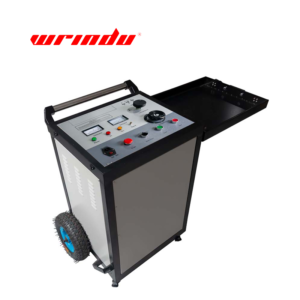
Click the picture to know more about Wrindu Cable Test HV Signal Generator.
This system delivers selectable impulse voltages of 0–32 kV, 0–16 kV, and 0–8 kV with uniform and controllable pulse output. A built-in energy storage capacitor system provides discharge energy up to 2048 J, which ensures clear fault activation. Real-time voltage measurement with 1.5-class accuracy helps operators maintain safe and repeatable testing conditions. Zero-start protection, automatic internal discharge, and selectable timing or manual impact modes improve operational safety in field environments from −20 °C to +50 °C.
With these features, HV surge testing successfully converts a hidden high resistance cable fault into a detectable discharge source.
How Does Acoustic Detection Help Locate the Exact Fault Point?
After HV surge activation, the fault produces sound and electromagnetic signals underground. Acoustic-magnetic detection captures these signals and guides engineers to the precise digging position. This coordinated method transforms rough HV activation into precise physical localization. Without acoustic confirmation, crews may still excavate the wrong area even after successful surge discharge.
The combination of HV surge generation and acoustic sensing therefore forms the most reliable workflow for high resistance cable fault location in real field conditions.
Why Is System Coordination Critical for High Resistance Fault Location?
No single device can solve complex underground faults alone. Accurate results require cooperation between HV signal generation, waveform sampling, and acoustic pinpointing. The HV generator activates the fault, while acoustic technology confirms the ground position. Coordinated operation reduces blind digging, shortens outage time, and increases first-time repair success. Strong system integration directly improves high resistance cable fault troubleshooting efficiency.
What Questions Do Wrindu Instrument Users Often Ask?
Q1: Why are high resistance cable faults hard to detect?
Because leakage current is small and unstable. Standard low-voltage tests may not show clear signals.
Q2: Why is high-voltage surge testing necessary?
Because HV impulses force visible discharge at the defect. This makes the fault detectable.
Q3: What role does the RDCD-II/535T play in fault location?
It provides controlled high-energy surge voltage for activation. This step enables accurate downstream detection.
Q4: Why combine HV surge with acoustic methods?
Because surge finds the defect and acoustics finds the exact point. Together they deliver precise location.
Q5: What is the main field benefit of this coordinated method?
Faster repair with less excavation. System cooperation improves reliability and reduces cost.
Wrindu Expert Review
A high resistance cable fault forms through insulation aging, moisture, poor joints, or mechanical stress, and it often hides from conventional testing. Controlled HV surge generation using systems like the RDCD-II/535T activates the defect, while acoustic detection identifies the exact ground position. This coordinated HV-acoustic workflow delivers accurate, efficient, and safe underground cable fault location, ensuring faster restoration and stronger long-term network reliability.
