

PCB Concentration in Transformer Oil: Limits, Units, and Test Results
Understand PCB concentration in transformer oil, including ppm, mg/kg, detection limits, US EPA classifications, and laboratory test reports.
What Is PCB Concentration in Transformer Oil?
PCB concentration refers to the amount of polychlorinated biphenyls present in a transformer oil sample.
Laboratories use quantitative chemical analysis to determine the concentration. The result is commonly reported in parts per million (ppm) or milligrams per kilogram (mg/kg).
PCB concentration is important because it helps determine the contamination level of insulating oil. It also supports equipment classification, handling, maintenance, and disposal decisions under applicable regulations.
For mass-based measurements:
For example, a result of 25 mg/kg means that each kilogram of oil contains 25 milligrams of PCB.
This conversion applies to mass-based concentration, not automatically to every measurement reported in mg/L.
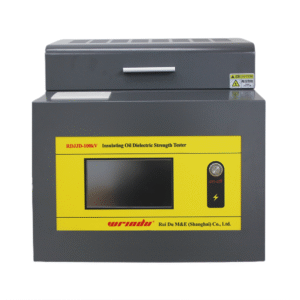
Click the image to know more about Wrindu Oil BDV Tester.
What PCB Concentration Is Considered High in Transformer Oil?
There is no single universal PCB concentration limit for every country and application. The applicable threshold depends on local regulations, equipment classification, and the purpose of the test.
In the United States, the EPA’s Toxic Substances Control Act (TSCA) regulations use 50 ppm as an important classification threshold for PCB-containing electrical equipment.
Under 40 CFR §761.2, mineral-oil-filled electrical equipment manufactured before July 2, 1979, with an unknown PCB concentration must be assumed to contain at least 50 ppm but less than 500 ppm for the specified classification.
The following table explains the commonly referenced US classification ranges:
| PCB concentration | US regulatory classification context |
|---|---|
| Below 50 ppm | Below the 50 ppm threshold |
| 50 to below 500 ppm | PCB-contaminated electrical equipment |
| 500 ppm or higher | PCB transformer classification threshold |
These ranges must be interpreted within the applicable TSCA definitions and exceptions. They should not be treated as universal international limits or as automatic disposal instructions.
For regulatory decisions, laboratories and equipment owners should consult the current applicable regulations.
What Is the Difference Between PCB ppm and mg/kg?
PCB concentration is often reported using ppm or mg/kg.
Both units express mass concentration when the result is based on the mass of the oil sample.
| Unit | Meaning | Example |
|---|---|---|
| ppm | Parts per million by mass | 50 ppm |
| mg/kg | Milligrams per kilogram | 50 mg/kg |
| µg/kg | Micrograms per kilogram | 50,000 µg/kg |
| mg/L | Milligrams per liter | Requires oil-volume information |
The relationship between mass-based units is:
A laboratory should clearly identify the measurement basis in its report. It should not directly compare mg/L with mg/kg without considering the oil density and conversion method.
How Do Laboratories Determine PCB Concentration?
Laboratories normally use gas chromatography to separate PCB compounds and quantify them against reference standards.
IEC 61619 specifies capillary column gas chromatography with an electron capture detector for PCB determination in non-halogenated insulating liquids. ASTM D4059 also provides a gas chromatography method for PCB analysis in insulating liquids.
The main quantitative steps are:
-
Prepare a PCB calibration standard.
-
Analyze the calibration solution.
-
Establish the calibration response.
-
Prepare and inject the transformer oil extract.
-
Identify the relevant PCB peaks.
-
Calculate the PCB concentration using the applicable method.
The result depends on the calibration model, reference mixture, sample preparation, and chromatographic conditions.
A laboratory must use the reference standards and calculation procedures specified by its selected method.
What Is the Difference Between Detection Limit and Quantification Limit?
The detection limit and quantification limit describe different analytical capabilities.
The detection limit indicates the lowest concentration that an analytical method can reliably distinguish from background noise under defined conditions.
The quantification limit indicates the lowest concentration that can be measured with acceptable quantitative performance under the method’s defined criteria.
| Term | Meaning | Practical interpretation |
|---|---|---|
| LOD | Limit of Detection | PCB presence can be detected |
| LOQ | Limit of Quantification | PCB concentration can be quantified |
| Reporting limit | Laboratory reporting threshold | Lowest concentration routinely reported under defined laboratory rules |
For example, assume a laboratory has the following validated reporting characteristics:
-
LOD: 0.5 mg/kg
-
LOQ: 1.5 mg/kg
These are illustrative values, not guaranteed performance specifications for IEC 61619 or ASTM D4059.
If a sample produces a signal below the LOD, the laboratory may report it as not detected. If the signal falls between the LOD and LOQ, the laboratory may report detection without a reliable quantitative value, depending on its reporting procedure.
A result below the detection limit does not necessarily mean that the oil contains absolutely zero PCB.
Why Can Two Laboratories Report Different PCB Concentrations?
Different laboratories may obtain different results from the same transformer oil because of differences in sampling, sample preparation, calibration, and analytical conditions.
Common causes include:
| Possible cause | Effect on the result |
|---|---|
| Non-representative sampling | Sample may not reflect the actual oil contamination |
| Cross-contamination | PCB concentration may appear higher |
| Incomplete extraction | PCB recovery may be lower |
| Inadequate sample cleanup | Interfering compounds may affect chromatographic results |
| Different reference standards | Quantification may produce different responses |
| Different chromatographic conditions | Peak separation and identification may change |
| Incorrect dilution factor | Final concentration may be miscalculated |
ASTM D4059 specifically notes that PCB isomer composition can affect electron-capture detector responses. It also requires appropriate comparisons with reference Aroclor chromatograms under comparable conditions.
Therefore, comparing two reports requires checking their analytical methods, reference standards, units, and reporting limits.
How Should PCB Test Results Be Interpreted for Transformer Maintenance?
PCB concentration results should be considered alongside equipment history, oil type, applicable regulations, and maintenance requirements.
| Test result situation | Recommended next step |
|---|---|
| PCB not detected | Review the method detection limit and sampling history |
| PCB detected below the LOQ | Follow the laboratory’s reporting and confirmation procedure |
| PCB quantified below the applicable regulatory threshold | Evaluate the result under local equipment and environmental requirements |
| PCB concentration reaches a regulatory threshold | Confirm classification and applicable handling requirements |
| Unexpectedly high result | Review sampling, contamination control, and analytical quality records |
A single concentration value does not determine the electrical condition of a transformer. PCB concentration and transformer oil dielectric performance are separate evaluation parameters.
For example, an oil sample may have an acceptable breakdown voltage but still contain PCB contamination. Likewise, a high PCB concentration does not directly indicate the transformer’s insulation breakdown voltage.
What Information Should Be Checked Before Accepting a PCB Test Report?
Before using a PCB test report for maintenance or regulatory decisions, check the following information:
-
Analytical standard and revision.
-
Sample identification and sampling date.
-
PCB concentration and reporting unit.
-
Detection and quantification limits.
-
Calibration and reference standard information.
-
Quality control results.
-
Laboratory accreditation and method scope, where required.
Conclusion
PCB concentration results must be interpreted using the correct units, analytical method, and regulatory framework. The 50 ppm threshold is important under US TSCA regulations, but it should not be applied automatically to equipment in other countries.
