

Self-Excited Generator Voltage Drop Causes
Learn the main causes of voltage drop in self-excited generators, including load effects, armature reaction, and excitation issues, with practical solutions.
A self-excited generator is widely used in industrial and standalone power systems because of its simple design and low cost. However, one of its most common performance issues is voltage drop, especially when the load increases.
This article explains the main causes of voltage drop in self-excited generators in a simple and practical way.
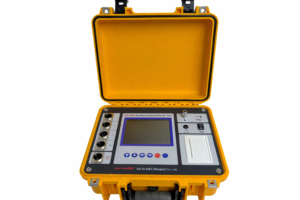
Click the image to know more about Three Phase Capacitance and Inductance Tester.
What Is Voltage Drop in a Self-Excited Generator?
Voltage drop refers to the reduction of output voltage when the generator goes from no-load to full-load condition.
In a healthy system, voltage should remain relatively stable. But in a self-excited generator, voltage often decreases due to its internal feedback structure.
\text{Voltage Regulation} = \frac{V_{no\text{-}load} – V_{full\text{-}load}}{V_{full\text{-}load}} \times 100
A higher value indicates a larger voltage drop and poorer regulation.
Why Do Self-Excited Generators Experience Voltage Drop?
The main reason is simple:
👉 The field current depends on the generator’s own output voltage.
So when voltage drops:
- Field current decreases
- Magnetic flux weakens
- Voltage drops further
This creates a negative feedback loop.
Does Load Increase Cause Voltage Drop?
Yes, load increase is one of the primary causes.
What happens under heavy load:
- Armature current increases
- Internal voltage losses (I × R) increase
- Terminal voltage decreases
- Field current also decreases
👉 Result: continuous voltage reduction
What Is the Role of Armature Reaction Effect?
The armature reaction effect is another major cause.
How it works:
- Armature current produces its own magnetic field
- This field distorts the main field flux
- Effective flux decreases
E \propto \Phi N
Since voltage depends on flux (Φ), any reduction leads to lower output voltage.
Can Weak Field Current Cause Voltage Drop?
Yes, weak excitation is a key factor.
Reasons for weak field current:
- Low residual magnetism
- High field circuit resistance
- Poor field winding condition
Result:
- Weak magnetic field
- Reduced voltage generation
Does Armature Resistance Affect Voltage?
Yes, internal resistance plays an important role.
Causes of voltage drop:
- Resistance in armature winding
- Brush contact resistance
- Commutator losses
Effect:
- More current → more voltage loss
- Reduced terminal voltage
Can Speed Reduction Cause Voltage Drop?
Yes, DC generator speed is directly related to voltage output.
If speed decreases:
- Induced EMF decreases
- Output voltage drops
E \propto N
Even small speed variations can significantly affect voltage stability.
Does Loss of Residual Magnetism Affect Voltage?
Yes, it is critical during startup and operation.
If residual magnetism is weak:
- Voltage build-up is slow or unstable
- Generator may fail under load
Causes:
- Long idle time
- Electrical faults
- Demagnetization
Can Incorrect Field Resistance Cause Voltage Drop?
Yes, field resistance must be within the correct range.
If resistance is too high:
- Field current becomes weak
- Voltage drops
If resistance is too low:
- Overexcitation
- Instability under load
How Do Brushes and Commutator Affect Voltage?
Poor brush contact leads to:
- Voltage instability
- Spark generation
- Power loss
Dirty or worn components increase resistance and reduce efficiency.
How Can Voltage Drop Be Reduced?
To improve performance:
1. Improve Excitation System
- Ensure strong residual magnetism
- Maintain correct field resistance
2. Reduce Armature Reaction
- Use compensating windings
- Improve design balance
3. Maintain Proper Speed
- Keep generator at rated RPM
4. Regular Maintenance
- Clean commutator
- Replace worn brushes
- Check wiring connections
5. Use Testing Equipment
Professional generator testing equipment helps detect:
- Voltage regulation issues
- Field weakness
- Armature faults
Conclusion
Voltage drop in self-excited generators is mainly caused by their dependence on internal excitation. Factors like load increase, armature reaction, weak field current, and speed variation all contribute to instability.
Understanding these causes helps engineers improve performance and maintain stable operation in real-world applications.
