

Why Does a Self-Excited Generator Fail to Build Voltage
Learn why a self-excited generator fails to build voltage. Discover common causes like residual magnetism loss and practical solutions for quick troubleshooting.
A self-excited generator is designed to build voltage using its own output. However, in some cases, the generator starts running but fails to generate voltage. This is a common issue in DC generator systems.
This guide explains the main reasons in a simple way and shows how to fix them.
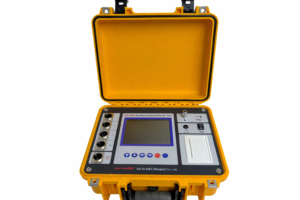
Click the image to know more about Three Phase Capacitance and Inductance Tester.
What Does “Fail to Build Voltage” Mean?
When a generator fails to build voltage:
- The machine rotates normally
- But the output voltage is zero or very low
This means the excitation process is not working properly.
How Does a Self-Excited Generator Normally Build Voltage?
A self-excited generator depends on:
- Residual magnetism
- Field current
- Positive feedback process
E \propto \Phi N
If any part of this process fails, voltage will not build up.
Is Loss of Residual Magnetism the Main Cause?
Yes, this is the most common reason.
Residual magnetism provides the initial magnetic field needed to start voltage generation.
What happens if it is lost?
- No initial voltage is produced
- No field current flows
- The generator cannot build voltage
How to fix it?
- Perform field flashing using an external DC source
- Restore magnetism in the field poles
Is the Field Circuit Open or Disconnected?
If the field circuit is broken:
- No current flows through the field winding
- No magnetic field is created
Possible causes:
- Loose wiring
- Broken connections
- Damaged field winding
Solution:
- Check continuity of the field circuit
- Repair or replace damaged parts
Is the Field Resistance Too High?
If the field resistance is too high:
- Field current becomes too small
- Magnetic flux is not strong enough
Result:
- Voltage cannot build up
Solution:
- Adjust the field rheostat
- Ensure resistance is within normal range
Is the Generator Running at the Correct Speed?
Speed directly affects voltage generation.
If the speed is too low:
- Induced voltage is very small
- The excitation process cannot continue
Solution:
- Increase the generator speed to rated value
Is the Generator Rotating in the Wrong Direction?
Incorrect rotation direction can reverse the magnetic effect.
Result:
- Residual magnetism does not support voltage build-up
- Voltage fails to increase
Solution:
- Check and correct the rotation direction
Are the Brushes and Commutator in Good Condition?
Poor contact between brushes and commutator can interrupt current flow.
Common issues:
- Worn brushes
- Dirty commutator
- Improper brush position
Solution:
- Clean the commutator
- Replace worn brushes
- Adjust brush alignment
Is There a Problem with Armature Connections?
Armature faults can prevent proper voltage generation.
Possible issues:
- Open circuit in armature winding
- Short circuit between conductors
Solution:
- Perform armature testing
- Repair or rewind if necessary
Is the Load Connected Too Early?
If load is connected before voltage builds up:
- It can suppress voltage rise
Solution:
- Start the generator without load
- Connect load only after voltage stabilizes
How Can You Prevent Voltage Build-Up Failure?
Follow these best practices:
- Maintain residual magnetism
- Perform regular inspection
- Keep brushes and commutator clean
- Check wiring and connections
- Use proper testing equipment
What Testing Methods Help Diagnose the Problem?
To find the exact cause, use:
- Field winding resistance test
- Insulation resistance test
- Open circuit test
- Voltage measurement
Accurate testing helps identify faults quickly and reduce downtime.
Conclusion
A self-excited generator fails to build voltage mainly due to problems in the excitation process. The most common causes include:
- Loss of residual magnetism
- Field circuit issues
- Incorrect speed or rotation
- Poor brush contact
By understanding these causes and applying proper maintenance and testing methods, you can quickly restore generator performance and ensure reliable operation.
