

What Are Self-Powered Relays and Why Are They Growing in Popularity
Discover why testing self-powered protection relays can be tricky. Learn how non-linear loads and pre-fault conditions affect accuracy, and explore the best testing solutions for modern smart grids.
For the past 40 years, self-powered relays have protected medium and low-voltage substations. In the past, they were only used for large transformers (over 800 kVA), while smaller ones used simple fuses. Today, utilities use them for transformers as small as 100 kVA.
Unlike traditional relays, self-powered relays do not need an external battery or an independent DC power grid. Instead, they pull the energy they need directly from the current flowing through the circuit’s current transformer (CT).
This setup offers two major benefits:
-
Lower Costs: Eliminating batteries and external power networks saves money.
-
Simpler Designs: The protection system becomes much easier to install and maintain.
As we move toward “Smart Grids” with rooftop solar panels and Electric Vehicle charging (including Vehicle-to-Grid or V2G technology), affordable protection is vital. High-voltage protection systems are too complex and expensive for smaller neighborhood grids. Because of this, self-powered relays are becoming the go-to choice for modern, distributed power networks.
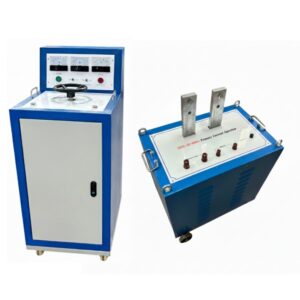
Click the picture to know more about Wrindu Primary Current Injector.
What Are the Biggest Challenges When Testing Self-Powered Relays?
While these devices save money, they can be a headache for technicians to test. Two main obstacles pop up during routine maintenance:
1. Why Doesn’t the Relay Read Injected Current Accurately?
When a technician injects a perfect 1 A sinusoidal current into the relay, the relay often reads a completely different number.
This happens because self-powered relays use integrated switch-mode power supplies. They act as a non-linear load, which heavily distorts the incoming current waveform. The resulting harmonics can confuse standard testing equipment, leading to inaccurate readings.
2. How Do Pre-Fault Conditions Impact Relay Performance?
Because these relays rely on line current for power, they remain turned off if there is no load on the line.
If a fault suddenly occurs on an empty line (like when closing a circuit breaker onto a fault), the relay must first boot up before it can trip. This means the actual time it takes to clear the fault is equal to the relay’s normal operating time plus its startup boot time.
How Can Technicians Solve These Relay Testing Problems?
To overcome these non-linear loads and startup delays, technicians need advanced testing equipment specifically engineered for self-powered devices.
A great example is the Wrindu RDSL-82-2000A. This test set is built to handle the unique burdens of self-powered, electromechanical, static, and numerical relays. It solves testing challenges through:
-
Adaptive Real-Time Control: High-performance loops adjust to non-linear loads instantly, ensuring the test set generates the correct current waveforms despite heavy distortion.
-
Harmonic Management: It prevents the harmonics generated by the relay from disrupting the test instrument’s internal control circuits.
-
High Power Output: It delivers enough power to both run the relay’s internal power supply and inject the precise test current simultaneously.
-
Pre-Fault Simulation: The instrument can simulate a pre-fault load state. This injects just enough current to keep the relay active and booted up before the timing test begins, giving an accurate reading of the actual trip time.
FAQs
Why does my test set show 1 A but the self-powered relay registers a different value?
Self-powered relays feature switch-mode power supplies that create a non-linear load. This load distorts the test current waveform and generates harmonics, which causes standard test sets or the relay itself to display inaccurate current measurements.
What happens when a self-powered relay switches onto a fault with zero pre-load?
If there is no current flowing through the line before a fault, the relay is completely unpowered and inactive. When the fault occurs, the relay takes a brief moment to power up before it can execute a trip command. This adds a delayed “startup time” to the overall clearing time.
How does a pre-fault state help when testing relays?
A pre-fault feature on a test set injects a steady, low-level load current into the relay before the actual fault test. This keeps the relay powered on and active, eliminating any boot-up delays so you can accurately measure its true operating speed.
Can standard relay test sets effectively test self-powered relays?
Standard test sets often struggle because they cannot handle the heavy harmonic distortion and high power demands required to power the relay’s internal circuitry. For accurate results, you need a specialized test set with real-time adaptive algorithms, like the SVERKER 900.
