

Which Gas Chromatography Detector Is Used for Transformer Oil Analysis?
Compare FID, TCD, and ECD gas chromatography detectors. Learn their working principles, target gases, and applications in transformer oil analysis.
Which Detectors Are Used in Gas Chromatography?
Gas chromatography (GC) uses a detector to measure compounds after the column separates them.
Different detectors respond to different chemical properties. A laboratory must select the detector according to the target compounds and analytical method.
Three detector types are particularly relevant when comparing transformer oil DGA and PCB analysis.
| Detector | Full name | Main detection principle | Typical application |
|---|---|---|---|
| FID | Flame Ionization Detector | Measures ions formed when organic compounds burn in a hydrogen-air flame | Hydrocarbon gases |
| TCD | Thermal Conductivity Detector | Measures changes in thermal conductivity between the carrier gas and sample | Permanent and inorganic gases |
| ECD | Electron Capture Detector | Measures changes in electron capture current | Halogen-containing compounds, including many PCBs |
These detectors do not have interchangeable functions. Their sensitivity and selectivity depend on the target compound and instrument configuration.
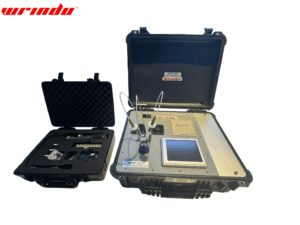
Click the image to know more about Wrindu portable Oil DGA Tester.
How Does a Flame Ionization Detector (FID) Work?
An FID burns the sample in a hydrogen-air flame. Organic compounds produce ions during combustion, and the detector measures the resulting electrical current.
FID is commonly used to measure hydrocarbon gases such as methane, ethane, ethylene, and acetylene.
| Parameter | FID characteristics |
|---|---|
| Detection principle | Ion formation in a flame |
| Typical targets | Hydrocarbons |
| Common DGA gases | CH₄, C₂H₆, C₂H₄, C₂H₂ |
| Main advantage | Sensitive detection of many organic compounds |
| Main limitation | Does not directly respond well to H₂, O₂, N₂, CO, or CO₂ |
Some DGA systems use a methanizer before the FID to convert CO and CO₂ into methane for measurement.
Therefore, a laboratory should check whether the system includes a methanizer before assuming that its FID configuration can measure CO and CO₂.
How Does a Thermal Conductivity Detector (TCD) Work?
A TCD measures the difference in thermal conductivity between the carrier gas and the sample gas.
It can detect several permanent gases that an FID cannot measure directly.
| Parameter | TCD characteristics |
|---|---|
| Detection principle | Thermal conductivity difference |
| Typical targets | Permanent and inorganic gases |
| Common DGA gases | H₂, O₂, N₂, CO, CO₂ |
| Main advantage | Detects gases that do not respond to FID |
| Main limitation | Usually less sensitive than more selective detectors for certain trace compounds |
TCD performance depends on carrier gas selection, detector design, and operating conditions.
A DGA system may combine TCD and FID to cover different gas groups.
How Does an Electron Capture Detector (ECD) Work?
An ECD uses an electron source to generate a stable electron current inside the detector.
Electronegative compounds capture electrons and reduce the measured current. Many halogen-containing compounds produce a strong ECD response.
PCB compounds contain chlorine atoms, which makes ECD suitable for many PCB analytical methods.
| Parameter | ECD characteristics |
|---|---|
| Detection principle | Electron capture |
| Typical targets | Electronegative compounds |
| Common application | PCB analysis |
| Main advantage | High sensitivity for many halogenated compounds |
| Main limitation | Limited selectivity for compounds that do not capture electrons effectively |
An ECD response does not automatically identify a specific PCB compound. The analytical column, retention time, reference standards, and validated method also matter.
What Is the Difference Between FID, TCD, and ECD?
The following table summarizes their practical differences.
| Comparison | FID | TCD | ECD |
|---|---|---|---|
| Detection mechanism | Flame ionization | Thermal conductivity | Electron capture |
| Hydrocarbon detection | Yes | Yes, with different sensitivity | Limited |
| Hydrogen detection | No direct response | Yes | Not a standard application |
| Oxygen and nitrogen detection | No direct response | Yes | Not a standard application |
| CO and CO₂ detection | Requires suitable conversion configuration | Yes | Not a standard application |
| PCB analysis | Not the usual detector | Not the usual detector | Commonly used |
| Typical laboratory use | DGA hydrocarbons | DGA permanent gases | PCB analysis |
The table describes common applications rather than every possible GC configuration.
Why Do DGA Systems Often Combine FID and TCD?
DGA requires measurement of gases with different chemical properties.
FID responds strongly to many hydrocarbon gases, while TCD can measure hydrogen and other permanent gases.
A combined configuration allows a laboratory to analyze a broader range of DGA gases.
For example:
| Target gas | Typical detector configuration |
|---|---|
| Hydrogen (H₂) | TCD |
| Oxygen (O₂) | TCD |
| Nitrogen (N₂) | TCD |
| Methane (CH₄) | FID |
| Ethane (C₂H₆) | FID |
| Ethylene (C₂H₄) | FID |
| Acetylene (C₂H₂) | FID |
| Carbon monoxide (CO) | TCD or FID with suitable methanizer |
| Carbon dioxide (CO₂) | TCD or FID with suitable methanizer |
The exact detector arrangement depends on the DGA method and instrument design. Laboratories should confirm the target gas list against the manufacturer’s specifications.
Can an ECD Replace FID or TCD in a DGA System?
No. ECD does not provide a direct replacement for the usual FID and TCD functions in DGA.
FID and TCD measure different groups of gases. ECD mainly responds to compounds with suitable electron-capturing properties.
A PCB analytical system and a DGA system therefore need different analytical configurations.
Adding an ECD to an existing GC does not automatically establish a validated PCB testing capability.
Which GC Detector Should a Laboratory Choose for PCB or DGA Testing?
The laboratory should start with its required analytical service.
| Laboratory application | Detector selection | Additional requirements |
|---|---|---|
| DGA hydrocarbon analysis | FID | Suitable columns and gas calibration |
| DGA permanent gas analysis | TCD | Suitable carrier gas and gas separation |
| Combined DGA analysis | FID + TCD | Compatible GC configuration |
| PCB analysis | ECD or another validated detector | PCB extraction, cleanup, reference standards, and validated method |
| Detailed PCB identification | GC-MS where appropriate | Suitable mass spectral library and analytical procedure |
For PCB testing, ASTM D4059 and IEC 61619 provide relevant analytical method references. For DGA, laboratories can refer to ASTM D3612 and IEC 60567.
What Should Engineers Check Before Purchasing a Gas Chromatography System?
Wrindu engineers recommend checking the following technical information before selecting a GC system:
-
Target compounds and required detection ranges.
-
Detector type and detector configuration.
-
Analytical column specifications.
-
Sample extraction method.
-
Calibration gas or reference standards.
-
Sample preparation requirements.
-
Data processing and reporting functions.
-
Applicable analytical standards.
Do not select a GC system based only on the number of detectors. The complete analytical method determines whether the system can perform the required test.
