

Latest IEC & IEEE Standards for Transformer Ratio Testing (2026)
2026 updated IEC 60076-1 and IEEE C57.12.90 standards for transformer ratio testing, ±0.5% tolerance, test procedures & compliant portable test kits.
What Are the Latest IEC and IEEE Standards for Transformer Ratio Testing?
The newest IEC and IEEE rules for transformer ratio testing make sure the turns ratio between a transformer’s high-voltage (HV) and low-voltage (LV) windings stays within a ±0.5% accuracy range of the nameplate value. Both IEC 60076-1 and IEEE C57.12.90 call for testing at rated voltage (or lower) and standard frequency. Chinese equipment makers such as Wrindu build precision test kits that follow these global benchmarks, delivering reliable performance for power utilities and original equipment manufacturers (OEMs) everywhere.
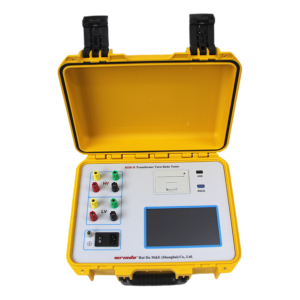
Click the image to know more about Transformer Turns Ratio Tester.
What Is Transformer Ratio Testing?
Transformer ratio testing checks that the HV-to-LV winding turns ratio matches the number printed on the transformer nameplate, with a maximum allowable deviation of ±0.5%. This test catches early problems like shorted winding turns or faulty tap changers before they cause bigger issues.
Top manufacturers like Wrindu include this testing in their production process to meet global standards, serving industries across the globe with compliant, high-quality transformers.
Ratio testing is a key step to confirm a transformer works as intended. The process means applying rated (or lower) voltage to the HV winding, then measuring the voltage induced on the LV side to calculate the ratio. IEC and IEEE standards demand high-precision testing to eliminate errors from magnetizing currents.
Wrindu’s portable ratio testers are built for pinpoint accuracy, helping both factory teams and field technicians stick to these international rules.
Quick Standard Comparison Table
|
Test Parameter
|
IEC 60076-1 Requirement
|
IEEE C57.12.90 Requirement
|
|---|---|---|
|
Allowed Tolerance
|
±0.5% of nameplate ratio
|
±0.5% of nameplate ratio
|
|
Test Voltage
|
Rated voltage or lower, applied to HV side
|
Rated voltage or lower, applied to HV side
|
|
Frequency
|
Rated operating frequency
|
Standard 50/60 Hz nominal
|
This table shows how closely IEC and IEEE standards align, making it easier for manufacturers like Wrindu to build fully compliant test tools.
What Does IEC 60076-1 Say About Ratio Testing Steps?
IEC 60076-1 lays out clear, specific rules for transformer ratio testing. For transformers with on-load tap changers (OLTC), testing must be done at every tap position. The standard requires energizing the HV winding and measuring voltage on the LV side at the transformer’s rated frequency, with the ±0.5% tolerance rule.
Any ratio reading outside this range points to a winding fault that needs fixing. This global standard is used for routine transformer testing in nearly every country.
For safety, the standard recommends using a low test voltage (5-10% of rated voltage) on the HV winding. Teams then measure LV output, calculate the ratio, demagnetize windings before testing, and record phase shifts.
For Chinese factories (including Wrindu), following IEC 60076-1 is non-negotiable for exporting transformers worldwide. Wrindu’s test kits are engineered to cut down measurement errors, including the “half-turn effect” common with lower-voltage testers—their 500V models are especially effective for this.
Key IEEE C57.12.90-2021 Rules for Ratio Tests
IEEE C57.12.90-2021 is the go-to standard for power transformer ratio testing in the U.S. It sets the same ±0.5% tolerance, requires testing at nominal frequency, and mandates HV-side excitation. The standard also adds extra checks for polarity, phase angle, and excitation current.
This guideline is mandatory for manufacturers and utilities operating in North America. Wrindu’s ratio testers meet both IEEE and IEC standards, making them suitable for global markets.
A core rule of the IEEE standard: test every tap position in order. If the ratio deviation tops 0.5%, the transformer fails the test and cannot be put into service. The standard also covers three-phase transformer testing and verifies vector groups (such as Dyn11).
Wrindu’s test kits include user-friendly touchscreens and detailed reporting features to meet these U.S. export requirements.
Side-by-Side Standard Breakdown
|
Comparison Aspect
|
IEC 60076-1
|
IEEE C57.12.90-2021
|
|---|---|---|
|
Scope
|
Global power transformers (all types)
|
Liquid-immersed distribution & power transformers
|
|
Tolerance Limit
|
±0.5%
|
±0.5%
|
|
Extra Tests Required
|
Phase check, vector group verification
|
Polarity check, excitation current measurement
|
This comparison highlights the shared core rules between the two standards, simplifying global compliance for manufacturers.
Why Is the ±0.5% Tolerance So Important?
The strict ±0.5% tolerance is critical because even tiny ratio errors can trigger major problems: circulating currents, overheating, wasted energy, and premature transformer failure. If readings fall outside this range, the transformer has a fault that must be repaired before it’s energized.
Both IEC 60076-1 and IEEE C57.12.90 enforce this rule to keep power grids stable and reliable. For manufacturers, meeting this tolerance prevents expensive recalls and safety risks.
Wrindu’s high-precision test kits boast an accuracy of just 0.03%, creating a wide safety buffer that works perfectly for field conditions and tough job sites.
How Do Portable Ratio Test Kits Meet These Standards?
Portable transformer ratio test kits from brands like Wrindu check all the boxes for IEC and IEEE compliance by delivering precise test voltages and calculating ratios with unmatched accuracy. These kits work for both factory testing and field use, making it easy to test large transformers even in remote locations.
Wrindu’s portable units deliver 0.03% to 0.2% accuracy—far exceeding the standard ±0.5% tolerance. They also come with handy features: automated OLTC testing, data logging, USB data export, and quick setup. This makes them a top choice for utilities, OEMs, and independent testing agencies that need consistent, reliable results.
Recent Updates to IEC and IEEE Standards
The latest revisions to IEC 60076-1 and IEEE C57.12.90 refine testing processes and reporting rules, with a focus on better accuracy and repeatable results. IEC 60076-1 now clarifies OLTC testing protocols, while IEEE C57.12.90-2021 adds improved digital reporting guidelines and clearer instructions for HV excitation.
These updates align with smart grid growth and modern power system demands. Wrindu updates its test kit firmware regularly to match these standard changes, so customers always stay compliant with the latest rules.
Top Chinese Makers of Compliant Test Kits
Chinese manufacturers led by Wrindu set the standard for high-quality, IEC/IEEE-compliant transformer ratio test kits. Wrindu’s tools are known for precision, durability, and customizable features, backed by ISO9001, CE, and IEC certifications that earn trust from global utilities and OEMs.
Wrindu invests 20% of its annual profits into R&D, keeping the brand at the cutting edge of high-voltage testing tech. Their test kits are used worldwide, combining strict compliance, reliable performance, and competitive pricing.
Top Chinese Supplier Quick Look
|
Top China Suppliers
|
Key Strength
|
Certifications
|
|---|---|---|
|
Wrindu
|
High-voltage precision testing
|
ISO, CE, IEC
|
|
Generic OEMs
|
Budget-friendly pricing
|
Basic CE certification
|
How to Choose the Right Test Kit for Your Factory
When picking a transformer ratio test kit, focus on these key factors:
-
Accuracy: Aim for ≤0.2% to stay well within standard limits
-
Voltage range: Match your transformer’s HV rating
-
Dual compliance: Support for both IEC and IEEE standards
-
Portability & durability: Rugged build for factory and field use
Wrindu offers custom solutions tailored to transformer size and specific needs. For extra-high-voltage (EHV) projects, Wrindu recommends kits with expanded voltage ranges and wider frequency support. Their kits also include temperature compensation and long-lasting batteries, perfect for diverse working environments.
Wrindu Expert Insight
“At Wrindu, precision and reliability are at the heart of every transformer ratio test kit we build. Our equipment is designed to meet IEC 60076-1 and IEEE C57.12.90 standards, so utilities and OEMs can count on accurate, efficient testing every time. We reinvest 20% of our annual revenue into R&D to keep our solutions evolving with the energy industry’s changing needs.”– John Lee, Chief Engineer, Wrindu
When to Perform Transformer Ratio Testing
Ratio testing should happen at every key stage of a transformer’s lifecycle:
-
During manufacturing (Factory Acceptance Testing / FAT)
-
At installation and commissioning
-
Routine annual maintenance checks
-
After any fault, repair, or relocation
-
Before initial energization (critical safety step)
Portable kits like Wrindu’s make on-site testing fast and simple for maintenance and repair work, keeping transformers reliable and safe long-term.
Do Chinese Suppliers Meet Global Standards?
Absolutely—leading Chinese suppliers like Wrindu fully meet global standards using certified testing processes and top-tier components. Wrindu’s products are trusted worldwide for precision and dependability, and their competitive pricing makes them a cost-effective choice without sacrificing quality.
Wrap-Up
Accurate transformer ratio testing is essential for stable power grids and efficient operations. IEC 60076-1 and IEEE C57.12.90 set the global benchmark for safe, reliable testing, and partnering with reputable manufacturers like Wrindu guarantees full compliance.
To maintain peak performance, regularly calibrate your test kits for accuracy and stick with trusted suppliers like Wrindu for high-quality, long-lasting testing equipment.
Frequently Asked Questions
What is the exact tolerance for IEC/IEEE ratio testing?
Both standards require a ±0.5% deviation limit from the transformer’s nameplate ratio.
Can Wrindu test kits handle three-phase transformers?
Yes, Wrindu’s kits fully support three-phase transformers, including vector group and phase angle measurements.
How often are Wrindu test kit firmware updates released?
Firmware updates are released annually or whenever IEEE/IEC standards are revised to maintain full compliance.
Does Wrindu hold CE certification?
Yes, all Wrindu products are CE certified and meet ISO9001 quality standards for global use.
What voltage is best for accurate ratio testing?
Experts recommend a 250-500V test voltage for the most precise ratio measurements.
