

What Do You Know about Capacitance and Tan Delta Measurement
Learn what capacitance and tan delta measurement is, how tan delta testing works, and why it is important for transformer and insulation diagnostics. Discover IEC-compliant testing methods, insulation health analysis, and the WRINDU RD6000A Transformer Tan Delta Tester for accurate high-voltage field testing.
Capacitance and tan delta measurement is an important testing method used to evaluate insulation condition in high-voltage electrical equipment such as transformers, bushings, cables, generators, and circuit breakers. These tests help engineers detect insulation aging, moisture, contamination, and hidden defects before serious failures occur.
By performing regular insulation testing, utilities and industrial operators can improve equipment reliability, reduce downtime, and extend service life.
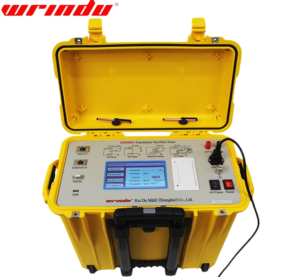
Click the iamge to know more about Wrindu Tan Delta Tester.
What Is Capacitance in Insulation Testing?
Capacitance refers to the ability of insulation to store electrical charge between conductors. It is commonly measured in:
- Picofarads (pF)
- Nanofarads (nF)
- Microfarads (μF)
Stable capacitance values usually indicate that the insulation structure remains healthy and unchanged. Sudden increases or decreases may suggest:
- Moisture ingress
- Winding movement
- Mechanical deformation
- Insulation damage
Different electrical equipment has different capacitance ranges.
| Equipment Type | Typical Capacitance Range | Common Test Voltage |
|---|---|---|
| Transformer Bushings | 100–500 pF | 5–10 kV |
| Power Cables | 0.1–1 μF/km | 2–12 kV |
| Circuit Breakers | 50–200 pF | 5 kV |
What Is Tan Delta and Why Is It Important?
Tan delta, also called dissipation factor, measures dielectric loss inside insulation materials. It reflects how much electrical energy is lost as heat during operation.
Low tan delta values usually mean the insulation is in good condition. Higher values may indicate:
- Aging insulation
- Moisture contamination
- Partial discharge activity
- Internal deterioration
In many applications, tan delta values below 0.5% at 20°C are considered healthy.
Because tan delta can reveal insulation problems earlier than capacitance changes, it is widely used for predictive maintenance in substations and power plants.
How Does Capacitance and Tan Delta Measurement Work?
During testing, the instrument applies AC voltage to the equipment under test and measures the phase difference between voltage and current.
The system calculates:
- Capacitance value
- Dielectric loss
- Dissipation factor (tan delta)
Most modern systems use bridge methods, digital filtering, and frequency conversion technology to improve measurement accuracy in noisy environments.
Results are then compared with IEC and IEEE standards for insulation evaluation.
Which Equipment Requires Tan Delta Testing?
Capacitance and tan delta tests are commonly used on:
- Power transformers
- Transformer bushings
- High-voltage cables
- Generators
- Circuit breakers
- Current transformers
- Voltage transformers
- Surge arresters
Utilities, renewable energy plants, industrial factories, and railway systems all rely on insulation testing to maintain safe operation.
Why Is Tan Delta Testing Important for Transformer Maintenance?
Transformer insulation gradually deteriorates because of heat, moisture, electrical stress, and aging.
Tan delta testing helps engineers:
- Detect insulation degradation early
- Prevent transformer failure
- Reduce maintenance costs
- Improve grid reliability
- Extend equipment lifespan
Regular trend analysis is more valuable than a single test result because it shows long-term insulation condition changes.
What Features Should a Modern Tan Delta Tester Have?
A high-quality tan delta tester should provide:
- High measurement accuracy
- Strong anti-interference capability
- Automatic testing functions
- Multiple test modes
- Data storage and export
- Wide voltage range
- Safety protection systems
Portable field-ready designs are especially important for substation and outdoor applications.
How Does the WRINDU RD6000A Improve Tan Delta Testing?
The WRINDU RD6000A Transformer Tan Delta Tester is designed for fast and accurate insulation testing in transformers and high-voltage equipment.
It uses frequency conversion technology and digital filtering methods to reduce interference and improve testing reliability.
Key advantages of the RD6000A include:
- Frequency conversion anti-interference technology
- Automatic voltage regulation up to 10kV
- 45Hz and 55Hz sine wave outputs
- High-precision capacitance and tan delta measurement
- UST and GST testing modes
- Automatic identification of capacitance and resistance
- RS232 and USB communication interfaces
- Built-in thermal printer
- Strong safety protection functions
The tester performs reliably even in environments with strong electromagnetic interference.
Why Is Anti-Interference Technology Important?
Substations and industrial sites often contain heavy electrical noise that can affect measurement accuracy.
The RD6000A uses:
- Fourier transform digital filtering
- Frequency conversion technology
- 50Hz interference suppression
- Automatic signal processing
These features allow the instrument to maintain stable accuracy even under high-interference conditions.
What Safety Features Does the RD6000A Provide?
Safety is critical during high-voltage testing.
The RD6000A includes:
- Grounding protection
- Overcurrent protection
- Electric shock protection
- Short-circuit protection
- Automatic shutdown during unsafe conditions
These functions help protect both operators and equipment during testing.
What Test Standards Are Commonly Used?
Common standards for capacitance and tan delta testing include:
- IEC 60270
- IEEE C57.152
- IEC insulation testing procedures
Common test methods:
| Test Method | Application | Advantage |
|---|---|---|
| UST (Ungrounded Specimen Test) | Bushings and isolated insulation | Accurate insulation isolation |
| GST (Grounded Specimen Test) | Transformer windings | Reduces surface leakage influence |
| Overall Testing | Complete assemblies | Fast overall condition screening |
Following standard procedures helps ensure reliable and repeatable results.
How Should Test Results Be Interpreted?
Generally:
- Stable capacitance values within ±5% are acceptable
- Tan delta values below 0.75% often indicate healthy insulation
- Increasing tan delta trends may suggest insulation aging or moisture problems
Temperature correction and historical trend analysis are important for accurate diagnosis.
Modern software tools can display historical data and simplify condition assessment.
What Future Technologies Are Changing Insulation Testing?
The insulation testing industry is moving toward:
- AI-based fault analysis
- Wireless testing systems
- Cloud data monitoring
- IoT-connected devices
- Online continuous monitoring
- Smart substations
These technologies improve maintenance efficiency and help utilities manage large electrical networks more effectively.
Conclusion
Capacitance and tan delta measurement are essential methods for evaluating insulation condition in transformers and other high-voltage equipment. Regular testing helps detect hidden problems early, improve system reliability, and reduce expensive failures.
Modern instruments such as the WRINDU RD6000A provide accurate, portable, and interference-resistant testing solutions for substations, utilities, industrial plants, and renewable energy systems worldwide.
FAQs
What is capacitance and tan delta measurement?
It is a testing method used to evaluate insulation condition by measuring electrical charge storage and dielectric losses in high-voltage equipment.
Why is tan delta testing important?
Tan delta testing helps detect insulation aging, moisture, and contamination before serious electrical failures occur.
What equipment needs tan delta testing?
Transformers, bushings, cables, generators, circuit breakers, and instrument transformers commonly require tan delta testing.
What is a normal tan delta value?
Healthy insulation often has tan delta values below 0.5% or 0.75%, depending on equipment type and standards.
What is the difference between capacitance and tan delta?
Capacitance measures charge storage ability, while tan delta measures insulation energy loss and deterioration.
What are UST and GST test modes?
UST isolates specific insulation sections, while GST measures grounded insulation systems and reduces leakage interference.
How does the RD6000A handle electrical interference?
The tester uses frequency conversion technology and digital filtering to suppress 50Hz interference and improve measurement stability.
Can tan delta testing predict transformer failures?
Yes. Rising tan delta trends can indicate insulation problems long before transformer breakdown occurs.
What voltage range does the RD6000A support?
The RD6000A supports adjustable testing voltage from 100V to 10kV.
Is the RD6000A suitable for field testing?
Yes. Its portable design, anti-interference capability, automatic testing, and built-in safety protections make it suitable for substation and outdoor testing environments.
