

How to Calculate Impedance in AC Circuits: A Complete Beginner-Friendly Guide
Learn how to calculate impedance in AC circuits using simple formulas and practical examples. Discover impedance equations for series and parallel RLC circuits, measurement techniques, impedance analyzers, and real-world electrical applications.
Impedance is one of the most important concepts in AC electrical circuits. It represents the total opposition to alternating current and combines both resistance and reactance. Understanding how to calculate impedance helps engineers, technicians, and students analyze circuit performance, troubleshoot problems, and design reliable electrical systems.
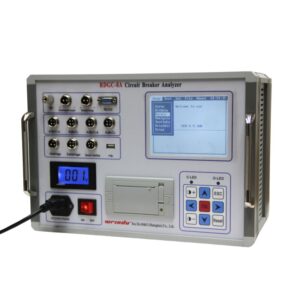
Click the image to know more about Circuit Breaker Comprehensive Tester.
What Is Impedance in an AC Circuit?
Impedance is the total opposition that a circuit presents to alternating current (AC).
Unlike resistance, which remains constant, impedance changes with frequency because it includes reactance from inductors and capacitors.
Impedance consists of two parts:
- Resistance (R) – Opposes current regardless of frequency.
- Reactance (X) – Changes with frequency and is created by inductors and capacitors.
The basic impedance formula is:
Z=\sqrt{R^2+X^2}
Where:
- Z = Impedance (Ω)
- R = Resistance (Ω)
- X = Total Reactance (Ω)
The total reactance is calculated as:
X=X_L-X_C
Where:
- XL = Inductive Reactance
- XC = Capacitive Reactance
How Do You Calculate Impedance Step by Step?
Calculating impedance is straightforward when you know the circuit values.
Step 1: Measure Resistance
Use a multimeter to determine the resistance value (R).
Step 2: Determine Frequency
Identify the AC frequency.
Typical values include:
- 50 Hz in many countries
- 60 Hz in North America
Step 3: Calculate Inductive Reactance
For inductors:
X_L=2\pi fL
Where:
- f = Frequency (Hz)
- L = Inductance (H)
Step 4: Calculate Capacitive Reactance
For capacitors:
X_C=\frac{1}{2\pi fC}
Where:
- C = Capacitance (F)
Step 5: Find Total Reactance
Subtract capacitive reactance from inductive reactance.
Step 6: Calculate Impedance
Substitute the values into the impedance equation to find the total circuit impedance.
For phase-angle calculations, engineers often use the complex form:
Z = R + jX
How Do You Calculate Impedance in a Series RLC Circuit?
In a series RLC circuit, resistance, inductance, and capacitance are connected in a single path.
The impedance is calculated using:
Z=\sqrt{R^2+(X_L-X_C)^2}
This formula is commonly used in:
- Resonant circuits
- Filters
- Power systems
- Electronic equipment
As frequency changes, the reactance values change, causing the total impedance to vary.
How Do You Find Impedance in a Parallel Circuit?
Parallel circuits require a different approach.
The total impedance can be calculated using:
\frac{1}{Z}=\sqrt{\left(\frac{1}{R}\right)^2+\left(\frac{1}{X}\right)^2}
Many engineers prefer using admittance (Y), where:
Y = 1/Z
Software tools such as MATLAB can simplify impedance calculations for complex parallel circuits.
Which Instruments Are Used to Measure Impedance?
Several instruments can directly measure impedance.
LCR Meters
LCR meters apply a test signal and measure voltage and current to determine impedance at a selected frequency.
Oscilloscopes
When used with a function generator, oscilloscopes can measure phase shift and calculate impedance.
Impedance Analyzers
These instruments provide highly accurate measurements for:
- Electronic components
- Power systems
- Research laboratories
- Material testing
Vector Network Analyzers (VNAs)
VNAs are widely used in RF and microwave applications where impedance matching is critical.
What Are the Common Impedance Formulas for Different Circuits?
| Circuit Type | Formula | Main Factor | Typical Application |
|---|---|---|---|
| Series RLC | Z = √(R² + (XL − XC)²) | Frequency-dependent reactance | Filters and resonant circuits |
| Parallel RLC | Uses reciprocal impedance calculation | Admittance | Power supplies and resonators |
| Pure Resistive Circuit | Z = R | No reactance | DC and low-frequency AC circuits |
| Transmission Line | Z₀ = √(L/C) | Characteristic impedance | PCB traces, antennas, cables |
For series circuits:
Ztotal = Z1 + Z2 + Z3
For parallel circuits, reciprocal addition is required.
How Do Advanced Impedance Analysis Methods Work?
Advanced impedance testing often uses phase relationships between voltage and current.
Phasor Diagrams
Phasor diagrams visually show phase angles and help engineers understand impedance behavior.
Smith Charts
RF engineers use Smith charts to analyze impedance matching and transmission line performance.
Transformer Impedance Calculations
Transformer impedance can be converted between primary and secondary sides using:
Z_s=\left(\frac{N_s}{N_p}\right)^2 Z_p
Where:
- Zs = Secondary impedance
- Zp = Primary impedance
- Ns = Secondary turns
- Np = Primary turns
Cable Impedance Analysis
Cable impedance depends on:
- Conductor geometry
- Dielectric material
- Frequency
- Velocity factor
How Does Wrindu Support Impedance Testing?
Wrindu (RuiDu Mechanical and Electrical (Shanghai) Co., Ltd.) is a global manufacturer of electrical testing and diagnostic equipment.
Established in 2014, Wrindu designs and produces testing solutions for:
- Transformers
- Circuit breakers
- Surge arresters
- Batteries
- Cables
- Protection relays
- Insulation systems
Its products are used worldwide and comply with ISO9001, IEC, and CE standards to support accurate and reliable electrical testing.
What Are the Latest Trends in Impedance Testing?
The impedance analyzer market continues to grow as industries demand better diagnostic tools.
Current trends include:
- Renewable energy grid monitoring
- EV battery impedance testing
- Smart grid applications
- PCB impedance control
- High-frequency component testing
Many semiconductor manufacturers now consider 50-ohm impedance control a key requirement in circuit board design.
Which Impedance Measurement Instruments Are Most Popular?
| Product | Key Advantage | Rating | Application |
|---|---|---|---|
| Keysight E4990A | Wide frequency range and high accuracy | 4.9/5 | RF components and materials |
| Hioki IM3570 | Portable and battery-focused | 4.7/5 | Batteries and fuel cells |
| Wayne Kerr 6500B | Precision measurements and automation | 4.8/5 | Transformers and inductors |
| Omicron MI600 | Portable power system testing | 4.6/5 | Substations and cables |
These instruments help engineers quickly identify impedance issues in real-world applications.
What Benefits Can Impedance Testing Provide?
Many organizations have reported significant improvements after implementing regular impedance testing.
Examples include:
- A utility company reduced transformer downtime by 40% after identifying impedance abnormalities.
- A solar power plant improved system efficiency by 12% by correcting impedance mismatches.
- A battery manufacturer increased testing speed by 25% through impedance spectroscopy.
Regular testing can improve:
- Equipment reliability
- Energy efficiency
- Maintenance planning
- Fault detection
- Overall system performance
What Technologies Power Modern Impedance Analyzers?
Modern analyzers use advanced measurement techniques such as:
Auto-Balancing Bridge Method
Compares a known reference impedance with an unknown impedance.
RF Reflection Method
Measures standing wave behavior to determine transmission line impedance.
Digital Signal Processing (DSP)
Extracts phase and amplitude information from noisy signals to improve measurement accuracy.
What Is the Future of Impedance Measurement?
The future of impedance testing is becoming smarter and more automated.
Emerging technologies include:
- AI-based fault prediction
- Cloud-connected testing systems
- Remote impedance monitoring
- Smart grid integration
- Quantum-level impedance standards
By 2028, AI-powered analyzers are expected to predict equipment failures based on impedance signatures before faults occur.
FAQs About Impedance Calculation and Measurement
Q1: How do I calculate impedance in an AC circuit?
A: Calculate resistance and reactance first, then use the formula Z = √(R² + X²) to determine total impedance.
Q2: What is the difference between impedance and resistance?
A: Resistance opposes current flow and remains constant, while impedance includes resistance and frequency-dependent reactance.
Q3: How do you calculate impedance in a series RLC circuit?
A: Use the formula Z = √(R² + (XL − XC)²), where XL is inductive reactance and XC is capacitive reactance.
Q4: How do you measure impedance without an impedance analyzer?
A: You can use an oscilloscope, signal generator, and a known resistor to calculate impedance from voltage and current measurements.
Q5: What is impedance at resonance?
A: At resonance, inductive reactance equals capacitive reactance (XL = XC), so the circuit impedance becomes purely resistive.
Q6: How do you measure speaker impedance accurately?
A: Apply a sine-wave signal and measure AC voltage and current across different frequencies.
Q7: Why does impedance change with frequency?
A: Inductive and capacitive reactance depend on frequency, causing total impedance to increase or decrease as frequency changes.
Q8: How do transmission lines use characteristic impedance?
A: Characteristic impedance helps ensure proper signal transfer and minimizes reflections in cables, antennas, and PCB traces.
Q9: Which instrument is best for measuring impedance in power systems?
A: Portable impedance analyzers and LCR meters are commonly used for field testing, while laboratory analyzers provide higher accuracy.
Q10: Why is impedance testing important in electrical maintenance?
A: Impedance testing helps detect equipment deterioration, identify hidden faults, improve reliability, and reduce unexpected downtime.
