

Why Is Frequency Domain Dielectric Response Testing Better Than Traditional Tan Delta Measurement?
Discover the differences between frequency domain dielectric response testing and traditional tan delta measurement. Learn why FDS provides deeper transformer insulation condition analysis.
Why Are Engineers Looking Beyond Traditional Tan Delta Testing?
Transformer insulation testing plays a critical role in preventing unexpected failures and improving power system reliability.
For many years, tan delta (dielectric loss factor) testing has been widely used to evaluate insulation condition. It helps engineers identify problems such as:
- Insulation aging
- Contamination
- Moisture influence
- Dielectric deterioration
However, modern power systems require more detailed information because transformers are becoming:
- Larger in capacity
- More expensive
- More critical to grid operation
- Expected to operate for longer periods
A single tan delta value at power frequency may not fully describe the condition of complex insulation systems.
This is why many utilities are adopting Frequency Domain Dielectric Response (FDS/DFR) testing as an advanced diagnostic technology.
The RDGYB-JD1000 Frequency Domain Dielectric Response Insulation Diagnostic Analyzer combines FDS and PDC technologies to provide comprehensive insulation analysis for transformers, bushings, cables, and other high-voltage equipment.
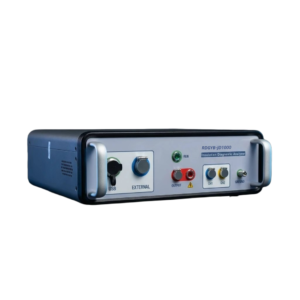
Click the image to know more about Wrindu Frequency Domain Dielectric Response Insulation Diagnostic Analyzer.
What Is Traditional Tan Delta Testing?
How Does Tan Delta Measurement Evaluate Transformer Insulation?
Tan delta, also called dielectric loss factor or power factor, measures the energy loss of insulation material when AC voltage is applied.
A healthy insulation system behaves like a good capacitor with very small energy loss.
When insulation deteriorates, the loss increases because of:
- Moisture
- Aging products
- Carbonization
- Contamination
- Oil degradation
A higher tan delta value usually indicates poorer insulation condition.
Traditional tan delta testing normally measures insulation performance at a specific frequency, commonly near power frequency:
- 50 Hz
- 60 Hz
The result provides an important indication of insulation quality.
However, it only represents insulation behavior at one operating point.
Why Can Single-Frequency Tan Delta Testing Have Limitations?
Can One Tan Delta Value Show the Complete Transformer Insulation Condition?
Not always.
Transformer insulation is a complex system consisting of:
- Cellulose paper
- Pressboard
- Transformer oil
- Bushings
- Other insulating materials
Different insulation problems affect different frequency ranges.
For example:
- Moisture mainly affects low-frequency dielectric response
- Surface contamination may influence higher-frequency behavior
- Aging products may change polarization characteristics
A single 50 Hz tan delta measurement may indicate that insulation is abnormal, but it may not explain:
- Where the problem comes from
- How serious the problem is
- Whether moisture is present
- Whether aging is developing
Frequency Domain Dielectric Response testing provides a wider view by measuring insulation behavior over a broad frequency range.
How Does Frequency Domain Dielectric Response Testing Work?
Why Does FDS Provide More Information Than Tan Delta Testing?
Frequency Domain Spectroscopy measures dielectric properties at multiple frequencies.
Instead of asking:
“How much dielectric loss does the insulation have at one frequency?”
FDS asks:
“How does insulation behavior change across different frequencies?”
During testing, the analyzer measures:
- Capacitance
- Dielectric loss
- Polarization response
- Frequency characteristics
The resulting curve provides information about the internal insulation condition.
The RDGYB-JD1000 supports frequency measurements from 0.1 mHz to 10 kHz, allowing detailed analysis of insulation characteristics.
What Are the Main Differences Between FDS and Tan Delta Testing?
How Do FDS and Tan Delta Compare in Transformer Diagnosis?
| Comparison Item | Tan Delta Testing | Frequency Domain Dielectric Response Testing |
|---|---|---|
| Measurement method | Single or limited frequency | Multiple frequency analysis |
| Main output | Dielectric loss value | Complete dielectric response curve |
| Moisture evaluation | Limited | Quantitative moisture assessment |
| Aging diagnosis | General indication | More detailed analysis |
| Frequency range | Usually power frequency | Very low frequency to high frequency |
| Insulation model analysis | Limited | Advanced insulation modeling |
| Condition assessment | Basic | Comprehensive |
Tan delta remains a useful diagnostic method, but FDS provides additional information for deeper condition evaluation.
Why Is Moisture Detection Better With FDS Technology?
Can FDS Detect Transformer Moisture More Accurately Than Tan Delta?
Moisture is one of the most important factors affecting transformer insulation life.
A transformer may have acceptable tan delta values but still contain moisture inside cellulose insulation.
This happens because most transformer moisture is stored in solid insulation materials rather than oil.
FDS analysis can evaluate:
- Cellulose moisture content
- Oil conductivity
- Moisture distribution characteristics
The RDGYB-JD1000 uses advanced analysis models to estimate insulation moisture conditions and evaluate uneven moisture distribution.
This helps maintenance teams identify risks before insulation damage becomes severe.
How Does FDS Identify Insulation Aging Problems?
Can Frequency Response Show Early Insulation Degradation?
Yes.
Transformer insulation aging is a gradual process.
Before a major failure occurs, insulation may experience:
- Increased polarization losses
- Chemical changes
- Reduced dielectric performance
FDS can identify abnormal changes in dielectric response curves.
By comparing:
- Historical test results
- Factory data
- Previous maintenance records
engineers can monitor insulation aging trends.
This supports condition-based maintenance instead of only scheduled maintenance.
Why Is Temperature Correction Important for Both FDS and Tan Delta Testing?
How Does Temperature Affect Dielectric Test Results?
Temperature has a significant influence on insulation characteristics.
A warmer transformer usually shows different dielectric behavior compared with a cooler transformer.
Without correction, engineers may incorrectly judge insulation condition.
Advanced FDS systems apply temperature correction models to normalize results.
The RDGYB-JD1000 uses temperature correction based on the Arrhenius equation to improve evaluation accuracy.
Can FDS Improve Transformer Maintenance Decisions?
Why Do Utilities Prefer More Detailed Insulation Diagnosis?
Traditional maintenance often follows fixed schedules:
- Test every few years
- Replace equipment after a certain operating period
This approach may cause two problems:
- Healthy equipment may be replaced too early.
- Developing problems may remain undetected.
FDS helps utilities make decisions based on actual insulation condition.
With detailed diagnostic information, engineers can decide whether to:
- Continue operation
- Increase monitoring frequency
- Perform drying treatment
- Repair insulation
- Replace equipment
How Does RDGYB-JD1000 Support Advanced Transformer Insulation Analysis?
What Features Make RDGYB-JD1000 Suitable for Field Testing?
The RDGYB-JD1000 is designed for professional transformer insulation diagnosis.
Key features include:
Integrated FDS and PDC Technology
The system combines frequency-domain and time-domain analysis methods.
Wide Measurement Range
It supports:
- Voltage measurement up to 10 kV (optional)
- Frequency range from 0.1 mHz to 10 kHz
Moisture and Oil Condition Evaluation
The software can analyze:
- Cellulose moisture content
- Insulation liquid conductivity
- Dielectric loss
- Uneven moisture distribution
Field-Friendly Design
The instrument provides:
- Portable structure
- Noise-resistant measurement
- Automatic analysis software
What Does a Real Transformer Bushing Test Show?
Can FDS Provide Reliable Results in High-Voltage Substations?
A field comparison test on a 220kV transformer bushing demonstrated the practical application of frequency domain dielectric response testing.
The test evaluated:
- Bushing capacitance
- Dielectric loss
- Cellulose moisture
- Oil condition
The results showed that frequency domain analysis could provide reliable insulation condition evaluation.
The test also highlighted the importance of low-frequency measurement stability and interference resistance during field diagnosis.
When Should Engineers Choose FDS Instead of Traditional Tan Delta Testing?
Is FDS Necessary for Every Transformer Test?
Not every routine inspection requires advanced analysis.
However, FDS is especially valuable for:
- Aging transformers
- High-voltage transformers
- Critical grid equipment
- Transformers with unknown history
- Equipment showing abnormal tan delta results
- Moisture-related concerns
For important assets, FDS provides additional information that helps reduce operational risks.
FAQs
What is the difference between FDS and tan delta testing?
Tan delta testing measures dielectric loss at a specific frequency, while FDS analyzes insulation behavior across multiple frequencies to provide more detailed condition information.
Is FDS replacing tan delta testing?
No. Tan delta remains an important insulation test method. FDS provides additional diagnostic information and deeper analysis capability.
Can FDS measure transformer moisture content?
Yes. FDS can estimate cellulose moisture content and evaluate moisture distribution in oil-paper insulation systems.
Which test is better for aging transformer diagnosis?
For aging transformers, FDS generally provides more detailed information because it analyzes polarization behavior and frequency-dependent insulation characteristics.
Why is low-frequency testing important in transformer insulation diagnosis?
Low-frequency measurements are sensitive to polarization effects and moisture-related changes in oil-paper insulation systems.
Can FDS testing be used for transformer bushings?
Yes. FDS technology is commonly used for transformers, bushings, inductors, and instrument transformers with oil-paper insulation.
What equipment is used for frequency domain dielectric response testing?
A specialized dielectric response analyzer, such as the RDGYB-JD1000, is used to perform FDS and insulation condition analysis.
Conclusion
Tan delta testing remains a valuable method for insulation evaluation, but modern power systems require deeper information.
Frequency Domain Dielectric Response testing provides:
- Multi-frequency analysis
- Moisture assessment
- Aging evaluation
- Better insulation understanding
- More reliable maintenance decisions
For utilities managing critical transformers, FDS technology provides a powerful tool to move from traditional testing toward intelligent condition-based maintenance.
The RDGYB-JD1000 helps engineers obtain more complete insulation information and improve transformer reliability throughout the equipment lifecycle.
