

What Do the Seven Key Gases in Transformer Oil DGA Results Mean?
Learn what the seven key gases in transformer oil DGA indicate, how hydrogen, methane, acetylene, and other gases relate to transformer faults.
What Are the Seven Key Gases in Transformer Oil DGA?
Dissolved Gas Analysis (DGA) measures gases that form when electrical and thermal stress decomposes transformer oil and solid insulation.
Engineers use gas concentrations and their changes over time to assess transformer condition. Seven key gases provide important information about possible electrical and thermal faults.
| Gas | Chemical formula | Main monitoring purpose |
|---|---|---|
| Hydrogen | H₂ | Partial discharge and electrical faults |
| Methane | CH₄ | Low-temperature thermal and electrical faults |
| Ethane | C₂H₆ | Low-temperature oil overheating |
| Ethylene | C₂H₄ | Higher-temperature oil overheating |
| Acetylene | C₂H₂ | High-energy electrical discharge |
| Carbon monoxide | CO | Cellulose insulation decomposition |
| Carbon dioxide | CO₂ | Cellulose insulation ageing and decomposition |
These gases do not indicate seven completely separate fault types. Engineers must evaluate their combinations, concentrations, and generation rates.
IEC 60599:2022 provides guidance for interpreting dissolved and free gases in mineral-oil-filled electrical equipment.
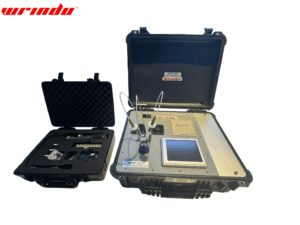
Click the image to know more about Wrindu portable Oil DGA Tester.
What Does Hydrogen in Transformer Oil Indicate?
Hydrogen (H₂) can form during partial discharge and other electrical or thermal processes.
A rising hydrogen concentration may indicate electrical activity inside a transformer. However, hydrogen alone cannot identify the exact fault location or mechanism.
Engineers should compare hydrogen with methane, acetylene, and other measured gases.
What Does Methane in Transformer Oil Indicate?
Methane (CH₄) mainly helps engineers assess low-temperature thermal decomposition and some electrical discharge conditions.
Its concentration may increase when transformer oil experiences local overheating.
A laboratory should evaluate methane together with ethane and ethylene to understand the thermal gas pattern.
What Does Ethane in Transformer Oil Indicate?
Ethane (C₂H₆) can form when transformer oil undergoes thermal decomposition.
It often contributes to the assessment of lower-temperature oil heating.
Engineers should not use ethane alone to estimate the exact temperature of a transformer fault.
What Does Ethylene in Transformer Oil Indicate?
Ethylene (C₂H₄) is an important indicator of thermal decomposition at higher temperatures.
A rising ethylene concentration may suggest more severe oil overheating than a pattern dominated by lower-temperature hydrocarbon gases.
Engineers should compare ethylene with methane, ethane, and acetylene before identifying a possible fault type.
What Does Acetylene in Transformer Oil Indicate?
Acetylene (C₂H₂) is an important indicator of high-energy electrical discharge, particularly arcing.
A sudden increase in acetylene deserves prompt investigation.
However, engineers should also review transformer switching operations, previous test results, and possible external sources before reaching a conclusion.
What Do Carbon Monoxide and Carbon Dioxide Indicate in Transformer Oil?
Carbon monoxide (CO) and carbon dioxide (CO₂) help engineers assess the condition of cellulose-based insulation.
Transformer paper and pressboard can release these gases during thermal decomposition and ageing.
| Gas | Main indication | What engineers should review |
|---|---|---|
| CO | Cellulose decomposition | CO concentration and generation rate |
| CO₂ | Cellulose ageing and decomposition | CO₂ concentration and CO₂/CO relationship |
The CO₂/CO ratio can provide additional information, but it does not independently establish the condition of paper insulation.
Engineers should also consider transformer design, loading, oil preservation systems, and operating history.
How Do Engineers Identify Transformer Faults from DGA Results?
Engineers use several interpretation methods to evaluate DGA results.
| Method | Main purpose | Typical application |
|---|---|---|
| Key Gas Method | Evaluates characteristic gas patterns | Initial fault assessment |
| IEC Ratio Method | Compares selected gas ratios | Thermal and electrical fault classification |
| Duval Triangle | Uses three hydrocarbon gas proportions | Identification of oil-related fault patterns |
| Total Dissolved Combustible Gas (TDCG) | Evaluates combined combustible gas concentration | General condition monitoring |
Each method has a different scope. Engineers should select the method according to the applicable standard and available gas measurements.
IEC 60599:2022 provides interpretation guidance, while IEEE C57.104 provides guidance for DGA interpretation in mineral-oil-immersed transformers.
Why Should Engineers Compare DGA Results Over Time?
A single DGA result provides a snapshot of transformer condition. Consecutive results help engineers identify whether gas concentrations remain stable or increase.
For example:
| Test period | Hydrogen | Acetylene | Engineering observation |
|---|---|---|---|
| Test 1 | 80 ppm | 0 ppm | Initial reference |
| Test 2 | 110 ppm | 0 ppm | Hydrogen increased |
| Test 3 | 180 ppm | 2 ppm | Both gases increased |
Illustrative data only, not diagnostic or alarm thresholds.
Engineers should review sampling intervals, gas generation rates, operating conditions, and measurement uncertainty before making maintenance decisions.
Which Standards Apply to Transformer Oil DGA Testing?
The following standards provide important guidance for DGA testing and interpretation.
| Standard | Main purpose |
|---|---|
| IEC 60567 | Sampling of gases and analysis of free and dissolved gases |
| IEC 60599:2022 | Interpretation of dissolved and free gases |
| ASTM D3612-02(2026) | Analysis of gases dissolved in electrical insulating oil by gas chromatography |
| IEEE C57.104 | Interpretation of gases generated in oil-immersed transformers |
ASTM D3612-02(2026) covers three procedures for extracting and measuring dissolved gases in insulating oil.
ASTM Store+1
How Can a DGA Gas Chromatograph Support Transformer Maintenance?
A DGA gas chromatograph separates and measures dissolved gases in transformer oil.
The instrument provides quantitative gas results that engineers can use for fault assessment and condition monitoring.
Wrindu recommends combining regular DGA testing with transformer loading records, maintenance history, and other insulation condition tests. This approach helps engineers build a more complete picture of transformer health.
