

How Can Laboratories Ensure Reliable Transformer Oil Gas Chromatography Results?
Learn how transformer oil laboratories improve GC testing accuracy through sampling control, calibration, blank tests, reference standards, and quality assurance.
Why Is Quality Control Important in Transformer Oil Gas Chromatography?
Gas chromatography results support transformer condition assessments and maintenance decisions.
However, an instrument cannot guarantee accurate results by itself. Sampling errors, gas loss, calibration problems, and contamination can affect the final report.
Wrindu engineers recommend controlling the complete testing process, from sample collection to result verification.
A laboratory quality control program should cover five main areas:
-
Sample collection and handling.
-
Instrument condition.
-
Calibration and reference standards.
-
Analytical quality control.
-
Result review and reporting.
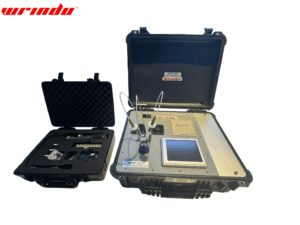
Click the image to know more about Wrindu portable Oil DGA Tester.
How Can Laboratories Prevent Errors During DGA Sample Collection?
DGA analysis requires careful sample handling because dissolved gases can escape from transformer oil.
Air can also enter the sample and change the measured gas composition.
Laboratories should follow IEC 60567 and the applicable sampling procedure.
| Potential problem | Possible effect | Recommended control |
|---|---|---|
| Air entering the sample | Changes gas composition | Use suitable airtight sampling equipment |
| Gas leakage | Reduces measured gas concentration | Check sample containers and connections |
| Incorrect sample identification | Links results to the wrong transformer | Use unique sample IDs |
| Long or unsuitable storage | Changes sample integrity | Follow method-specific holding requirements |
| Improper sample transfer | Causes gas loss | Use an approved transfer procedure |
Record the transformer ID, sampling location, date, and sampling personnel for every sample.
The laboratory should also document any unusual sampling conditions.
Why Does a DGA Gas Chromatograph Need Regular Calibration?
Calibration establishes the relationship between detector response and known gas concentrations.
Without a valid calibration, the system may produce incorrect quantitative results.
DGA laboratories commonly use certified gas mixtures with known concentrations.
| Calibration item | Purpose |
|---|---|
| Certified gas standard | Provides known gas concentrations |
| Calibration curve | Establishes detector response |
| Calibration verification | Checks whether the current response remains acceptable |
| Calibration records | Tracks instrument performance over time |
| Calibration acceptance criteria | Defines whether the instrument can proceed with testing |
The laboratory should select gas standards that cover the target gases and expected concentration ranges.
Do not use a calibration range that excludes the concentrations expected in actual transformer samples.
How Do Blank Samples Help Detect Laboratory Contamination?
A blank sample helps identify contamination from solvents, containers, sampling accessories, or the analytical system.
The laboratory can use different types of blanks depending on the analytical method.
| Blank type | Main purpose |
|---|---|
| Reagent blank | Checks contamination from preparation reagents |
| Method blank | Checks contamination introduced during the complete preparation procedure |
| Instrument blank | Checks background signals from the analytical system |
| Carryover blank | Checks whether the previous sample affects the next analysis |
A blank result should meet the laboratory’s acceptance criteria before the associated sample results proceed to final reporting.
PCB analysis and DGA analysis may require different blank procedures because they use different sample preparation and measurement methods.
Why Should Laboratories Use Duplicate Samples and Reference Materials?
Duplicate samples help laboratories evaluate repeatability.
Reference materials help verify whether the analytical system can recover or measure known concentrations within defined acceptance limits.
| Quality control item | What it checks | Expected outcome |
|---|---|---|
| Duplicate sample | Repeatability | Results meet the laboratory’s precision criteria |
| Certified reference material | Measurement accuracy | Result agrees with the certified value within stated uncertainty |
| Spiked sample | Analytical recovery | Recovery meets method-specific limits |
| Calibration check | Instrument response | Response remains within acceptance limits |
| Blank sample | Background contamination | No unacceptable target signal |
The laboratory should establish acceptance limits based on the analytical method, validation data, and accreditation requirements.
Do not apply one universal recovery percentage or repeatability limit to every gas and PCB method.
How Can Laboratories Check DGA Gas Chromatograph Performance?
Routine instrument checks help identify performance changes before they affect a large number of samples.
Wrindu engineers recommend maintaining an instrument performance checklist.
| Instrument component | Inspection item | Possible problem |
|---|---|---|
| Gas supply | Pressure and gas purity | Unstable detector response |
| Carrier gas line | Leakage and flow stability | Retention time changes |
| Injection system | Sample transfer consistency | Poor repeatability |
| Chromatographic column | Separation performance | Overlapping peaks |
| Detector | Baseline and response | Signal drift |
| Temperature control | Stable operating temperature | Retention time variation |
| Data system | Integration and calculation settings | Incorrect peak quantification |
The laboratory should compare instrument performance with its validated method and manufacturer’s operating requirements.
A stable baseline alone does not prove that the entire analytical method produces accurate results.
What Is the Difference Between DGA Method Validation and Instrument Calibration?
These two activities serve different purposes.
Instrument calibration establishes the response between known concentrations and instrument signals.
Method validation evaluates whether the complete analytical procedure performs adequately for its intended purpose.
| Validation parameter | What it evaluates |
|---|---|
| Accuracy | Agreement with an accepted reference value |
| Precision | Agreement between repeated measurements |
| Linearity | Relationship between concentration and instrument response |
| Detection limit | Lowest level the method can reliably detect |
| Quantification limit | Lowest level the method can quantify with acceptable performance |
| Recovery | Amount of target compound recovered during preparation |
| Selectivity | Ability to distinguish target compounds from interference |
Not every parameter applies in the same way to every analytical method.
For example, recovery testing has particular importance in PCB sample extraction and cleanup. DGA testing also requires suitable controls for gas extraction and measurement.
Which Standards Should Transformer Oil Laboratories Follow?
Laboratories should select standards according to the analytical service they provide.
| Standard | Testing area | Main purpose |
|---|---|---|
| IEC 60567 | DGA | Gas sampling and analysis |
| IEC 60599:2022 | DGA | Gas result interpretation |
| ASTM D3612-02(2026) | DGA | Dissolved gas analysis by gas chromatography |
| IEC 61619 | PCB | PCB determination by capillary column gas chromatography |
| ASTM D4059 | PCB | PCB analysis in insulating liquids |
These standards address different parts of the testing process.
A laboratory should confirm the current edition, method scope, and applicable accreditation requirements before offering a test service.
ASTM Store+1
How Should Laboratories Review and Report Gas Chromatography Results?
The laboratory should review the chromatogram and quality control records before issuing a final report.
A complete report should identify the sample, analytical method, target compounds, results, and measurement units.
For DGA reports, engineers should also check gas concentrations and compare them with previous results when available.
For PCB reports, laboratories should include the PCB reporting basis, analytical method, reporting limit, and relevant quality-control information.
| Report item | DGA report | PCB report |
|---|---|---|
| Sample identification | Required | Required |
| Analytical method | Required | Required |
| Target compounds | Dissolved gases | PCB compounds or defined PCB measurement |
| Measurement unit | Usually µL/L or ppm by volume | Usually mg/kg or ppm by mass |
| Reporting limit | Method-dependent | Method-dependent |
| Quality control | Calibration and analytical checks | Calibration, blanks, recovery, and analytical checks |
| Interpretation | Transformer fault assessment | PCB contamination assessment |
DGA ppm and PCB ppm do not represent the same measurement basis. DGA commonly reports gas concentration by volume, while PCB analysis commonly reports concentration by mass.
This distinction is important when laboratories compare analytical reports.
How Can Laboratories Improve the Traceability of Transformer Oil Test Results?
Traceability connects each reported result to its original sample, instrument, method, and quality control records.
Laboratories should maintain:
-
Unique sample identification numbers.
-
Sampling and receipt records.
-
Instrument identification and maintenance history.
-
Calibration certificates and verification records.
-
Analytical method versions.
-
Raw chromatograms and integration records.
-
Quality control results.
-
Final reports and approval records.
ISO/IEC 17025:2017 provides general requirements for the competence of testing and calibration laboratories.
Accreditation should cover the specific analytical activity and method. A laboratory should not claim that all its tests fall within its accreditation scope simply because it holds an ISO/IEC 17025 certificate.
What Equipment Does a Transformer Oil Laboratory Need for Reliable Testing?
Different laboratory services require different instruments.
| Testing requirement | Equipment | Main function |
|---|---|---|
| Dissolved gas analysis | DGA gas chromatograph | Measures dissolved fault gases |
| PCB analysis | GC-ECD or another validated analytical system | Determines PCB concentration |
| Breakdown voltage | Oil BDV tester | Measures dielectric breakdown voltage |
| Moisture content | Karl Fischer titrator | Measures water content |
| Acidity | Transformer oil acid value tester | Measures acid number |
| Dielectric properties | Transformer oil tan delta tester | Measures dielectric dissipation factor |
Wrindu provides equipment for routine transformer oil condition monitoring, including:
These instruments measure different oil properties. They do not replace dedicated DGA or PCB analytical systems.
For laboratories planning to expand their testing services, Wrindu engineers recommend defining the target tests, required standards, sample throughput, and reporting requirements before selecting equipment.
