

PCB Congeners and Aroclors in Transformer Oil: What Is the Difference?
Learn the difference between PCB congeners and Aroclors in transformer oil. Understand PCB chemical structures, commercial mixtures, and their importance in laboratory analysis.
Polychlorinated biphenyls (PCBs) are a group of synthetic organic chemicals that were historically used in some electrical insulating liquids.
PCB compounds do not have only one chemical structure. They consist of multiple related compounds known as PCB congeners, which differ in the number and position of chlorine atoms attached to a biphenyl structure.
Aroclors are commercial PCB mixtures that contain different combinations of these congeners.
Understanding the difference between PCB congeners and Aroclors helps electrical engineers, environmental laboratories, and transformer maintenance professionals understand PCB composition and analytical requirements.
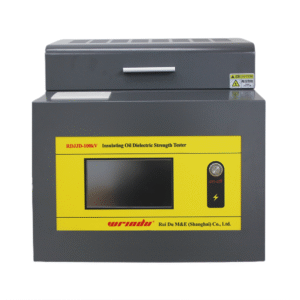
Click the image to know more about Wrindu Oil BDV Tester.
What Are PCB Congeners?
PCB congeners are individual chemical compounds within the polychlorinated biphenyl family. Each congener consists of two connected benzene rings with one or more hydrogen atoms replaced by chlorine atoms. The position and number of chlorine atoms determine the structure of each congener. There are 209 theoretically possible PCB congeners, based on different chlorine substitution patterns. PCB congeners are commonly classified according to the number of chlorine atoms in their molecular structures.
| PCB group | Number of chlorine atoms | General classification |
|---|---|---|
| Monochlorobiphenyl | 1 | Low-chlorinated PCB |
| Dichlorobiphenyl | 2 | Low-chlorinated PCB |
| Trichlorobiphenyl | 3 | Low-chlorinated PCB |
| Tetrachlorobiphenyl | 4 | Medium-chlorinated PCB |
| Pentachlorobiphenyl | 5 | Medium-chlorinated PCB |
| Hexachlorobiphenyl | 6 | Higher-chlorinated PCB |
| Heptachlorobiphenyl | 7 | Higher-chlorinated PCB |
| Octachlorobiphenyl | 8 | Higher-chlorinated PCB |
| Nonachlorobiphenyl | 9 | Higher-chlorinated PCB |
| Decachlorobiphenyl | 10 | Highest-chlorinated PCB |
The classification describes the number of chlorine atoms in each molecule. It does not directly indicate the PCB concentration in transformer oil.
What Are Aroclors in PCB-Containing Transformer Oil?
Aroclors are commercial mixtures of different PCB congeners. They were manufactured with different chlorine contents and chemical compositions for industrial applications, including electrical insulating liquids. Common historical Aroclor designations include:
| Aroclor type | Approximate chlorine content by weight |
|---|---|
| Aroclor 1242 | 42% |
| Aroclor 1254 | 54% |
| Aroclor 1260 | 60% |
| Aroclor 1016 | Approximately 41% |
These percentages describe the approximate chlorine content of the commercial PCB mixture, not the PCB concentration in a transformer oil sample. For example, Aroclor 1254 is a PCB mixture with approximately 54% chlorine by weight. It does not mean that transformer oil containing this mixture has a PCB concentration of 54%. This distinction is important when interpreting historical equipment documents and laboratory reports.
How Are PCB Congeners Different from Aroclors?
PCB congeners and Aroclors describe different levels of PCB composition. A PCB congener refers to one specific chemical compound. An Aroclor refers to a commercial mixture containing multiple PCB congeners.
| Comparison | PCB congeners | Aroclors |
|---|---|---|
| Definition | Individual PCB compounds | Commercial PCB mixtures |
| Chemical composition | One specific molecular structure | Multiple PCB congeners |
| Number | 209 possible congeners | Multiple commercial mixture types |
| Identification | Congener number or chemical structure | Commercial mixture designation |
| Chlorine content | Determined by molecular structure | Approximate mixture composition |
| Analytical purpose | Identifies individual PCB compounds | Helps characterize historical PCB mixtures |
Aroclors are therefore not individual PCB molecules. They are mixtures made up of different PCB congeners.
Why Do Different Aroclor Types Have Different PCB Compositions?
Different Aroclor products were manufactured with different degrees of chlorination.
Their compositions vary according to the number and distribution of chlorine atoms across the PCB congeners.
For example:
-
Aroclor 1242 contains a mixture of relatively lower-chlorinated PCB compounds.
-
Aroclor 1254 contains a higher proportion of more heavily chlorinated compounds.
-
Aroclor 1260 contains a mixture with a higher average chlorine content.
These differences affect the chemical and physical properties of the mixtures.
They also affect chromatographic behavior and detector responses during laboratory analysis.
Therefore, laboratories should use appropriate reference standards when analyzing PCB mixtures.
Why Does PCB Congener Identification Matter in Transformer Oil Analysis?
PCB congener identification provides more detailed chemical information than simply reporting total PCB concentration.
Different PCB mixtures may have different congener profiles.
This information can help laboratories investigate the composition of PCB contamination and compare analytical findings with historical reference materials.
Congener identification may be useful for:
-
Characterizing PCB mixtures in historical insulating liquids.
-
Investigating unknown PCB contamination.
-
Comparing different PCB-containing samples.
-
Supporting environmental assessment.
-
Evaluating complex PCB mixtures that do not match a single commercial reference pattern.
However, identifying an Aroclor-like pattern does not always prove that the original commercial mixture was used directly.
Environmental changes, mixing, and chemical degradation can alter the original congener profile.
Can Transformer Oil Contain More Than One Aroclor Type?
Yes. A transformer oil sample may contain PCB mixtures from more than one historical source. For example, different insulating liquids may have been mixed during equipment maintenance or oil replacement. A sample may therefore contain a combination of PCB congener profiles rather than matching one original Aroclor reference mixture. Laboratories should evaluate the chromatographic pattern and analytical data rather than automatically assigning one Aroclor designation. When the mixture is complex or weathered, additional congener-specific analysis may be necessary.
What Is the Difference Between Total PCB and Individual PCB Congener Analysis?
Total PCB analysis and individual congener analysis answer different analytical questions.
| Comparison | Total PCB analysis | Individual congener analysis |
|---|---|---|
| Main objective | Determines overall PCB concentration | Identifies and measures individual congeners |
| Reported information | Total PCB content | Individual congener concentrations |
| Main use | General contamination assessment | Detailed chemical characterization |
| Analytical requirements | Suitable validated quantitative method | Congener-specific separation and identification |
| Data interpretation | Overall PCB concentration | Individual compound distribution |
The appropriate analytical approach depends on the laboratory’s reporting requirements and the purpose of the investigation. A total PCB concentration result does not necessarily provide a complete picture of the individual congener composition.
What Should Laboratories Consider When Analyzing PCB Mixtures?
Laboratories should consider the composition of the PCB mixture when selecting reference standards and interpreting analytical results.
Important factors include:
| Factor | Why it matters |
|---|---|
| PCB mixture composition | Different mixtures contain different congeners |
| Reference standards | Supports reliable compound identification and quantification |
| Analytical separation | Helps distinguish individual compounds |
| Calibration | Supports accurate concentration calculations |
| Sample matrix | May affect analytical performance |
| Reporting requirements | Determines whether total PCB or congener-specific data are needed |
A laboratory should follow a validated analytical procedure and use suitable reference materials for its intended measurement.
What Transformer Oil Testing Equipment Does Wrindu Provide?
Wrindu is a China OEM manufacturer of high-voltage electrical testing equipment and transformer testing solutions.
Established in 2014, Wrindu provides product design, R&D, manufacturing, and OEM/ODM services. Its manufacturing facility covers more than 50,000 m², with 6 production lines and over 200 employees.
Wrindu provides instruments for routine transformer oil condition testing, including:
-
Oil breakdown voltage testers.
-
Karl Fischer moisture testers.
-
Oil acid value testers.
-
Transformer oil tan delta testers.
These instruments measure electrical and chemical properties of insulating oil. They do not identify individual PCB congeners or determine Aroclor composition.
PCB congener analysis requires dedicated chromatographic laboratory methods and appropriate reference standards.
Frequently Asked Questions About PCB Congeners and Aroclors
How many PCB congeners are possible?
There are 209 theoretically possible PCB congeners, each with a different chlorine substitution pattern.
Is Aroclor a single PCB compound?
No. Aroclor is a commercial mixture containing multiple PCB congeners.
Does Aroclor 1254 mean that transformer oil contains 54% PCB?
No. The number 54 refers to the approximate chlorine content of the Aroclor mixture by weight, not the PCB concentration in the oil.
Can a laboratory identify individual PCB congeners?
Yes. A suitable validated chromatographic method can separate and identify individual PCB congeners when the required analytical standards and procedures are available.
Can different Aroclor mixtures exist in the same transformer oil sample?
Yes. Mixing of insulating liquids or historical maintenance activities may produce samples containing different PCB mixture profiles.
