

Frequency Domain Dielectric Response Testing: How Can Utilities Detect Transformer Insulation Problems Earlier?
Learn how frequency domain dielectric response testing helps utilities detect transformer insulation problems, evaluate moisture content, and improve power equipment reliability.
Why Is Early Transformer Insulation Diagnosis Important?
Power transformers are among the most valuable assets in electrical substations. Their reliable operation directly affects grid stability, industrial production, and power supply safety.
Although transformers are designed for decades of service, their insulation system gradually deteriorates because of:
- Thermal aging
- Moisture absorption
- Oil degradation
- Electrical stress
- Long-term operation under high voltage
The insulation system is usually the weakest part of a transformer. Once serious insulation degradation occurs, it may lead to partial discharge, winding failure, unexpected shutdown, or even transformer damage.
Traditional insulation tests, such as insulation resistance measurement and tan delta testing, provide important information. However, these methods often evaluate insulation conditions at limited frequencies or single measurement points.
So, how can engineers obtain deeper information about transformer insulation health?
Frequency Domain Dielectric Response (FDR/FDS) testing provides a more comprehensive solution by analyzing insulation behavior across a wide frequency range.
The RDGYB-JD1000 Frequency Domain Dielectric Response Insulation Diagnostic Analyzer combines Frequency Domain Spectroscopy (FDS) and Polarization/Depolarization Current (PDC) technologies to evaluate insulation conditions, including moisture content, oil conductivity, and aging characteristics.
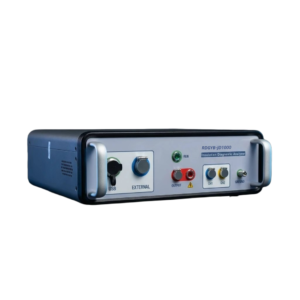
Click the image to know more about Wrindu Frequency Domain Dielectric Response Insulation Diagnostic Analyzer.
What Is Frequency Domain Dielectric Response Testing?
Frequency Domain Dielectric Response testing is an advanced insulation diagnostic method that measures dielectric properties of electrical insulation at different frequencies.
Unlike traditional insulation tests that provide only one value, FDS creates a complete insulation response curve.
During testing, the instrument applies AC voltage signals at multiple frequencies and measures:
- Capacitance changes
- Dielectric loss (tan δ)
- Polarization characteristics
- Frequency-dependent insulation behavior
The results help engineers understand the internal condition of transformer insulation materials.
For oil-paper insulation systems, FDS can provide information about:
- Cellulose moisture content
- Insulation oil conductivity
- Insulation aging condition
- Uneven moisture distribution
The RDGYB-JD1000 integrates FDS and PDC technologies to provide both frequency-domain and time-domain analysis capabilities.
Why Can Traditional Insulation Tests Miss Hidden Transformer Problems?
Can a Single Insulation Resistance Value Fully Represent Transformer Health?
Many maintenance teams still use insulation resistance testing as a basic diagnostic method.
The test is simple and fast, but it has limitations.
A single insulation resistance value may be affected by:
- Ambient temperature
- Surface contamination
- Humidity
- Test voltage
- Measurement time
For example, two transformers may show similar insulation resistance values, but their internal insulation conditions can be completely different.
One transformer may have healthy dry insulation, while another may contain moisture inside the paper insulation system.
The difference may not be obvious from a simple resistance measurement.
Frequency Domain Dielectric Response testing solves this problem by analyzing insulation characteristics over a wide frequency range.
How Does Frequency Response Reveal Transformer Insulation Problems?
Why Does Frequency Range Provide More Information About Insulation Condition?
Different insulation problems affect different frequency regions.
Low-frequency measurements are especially sensitive to:
- Moisture in cellulose insulation
- Polarization effects
- Aging products in oil-paper systems
Higher-frequency measurements provide information about:
- Geometrical capacitance
- Surface effects
- Local insulation conditions
By analyzing the complete frequency response curve, engineers can identify abnormal insulation behavior that may not appear in conventional tests.
The RDGYB-JD1000 supports a frequency range from 0.1 mHz to 10 kHz, allowing detailed analysis of insulation characteristics.
How Does Moisture Affect Transformer Insulation Performance?
Why Is Moisture One of the Most Dangerous Factors in Oil-Paper Insulation?
Moisture is one of the main causes of transformer insulation aging.
In oil-paper insulation systems, water can exist in:
- Transformer oil
- Cellulose paper
- Pressboard insulation
Even a small increase in paper moisture can significantly reduce insulation life.
Moisture can cause:
- Reduced dielectric strength
- Faster cellulose aging
- Increased dielectric loss
- Higher risk of insulation failure
Traditional oil sampling methods only evaluate moisture in oil. However, most transformer moisture is stored in cellulose insulation.
Frequency Domain Dielectric Response testing can estimate cellulose moisture content by analyzing dielectric behavior.
The RDGYB-JD1000 uses advanced analysis models to evaluate:
- Average moisture content
- Uneven moisture distribution
- Oil conductivity
How Does FDS Help Detect Uneven Moisture Distribution?
Can Transformer Insulation Have Local Moisture Problems?
Yes.
Moisture is not always evenly distributed inside a transformer.
Some areas may contain higher moisture levels because of:
- Temperature differences
- Aging processes
- Insulation structure
- Long-term operation conditions
Uneven moisture distribution is especially important for equipment with complex insulation structures, such as bushings and instrument transformers.
The RDGYB-JD1000 provides analysis of uneven moisture distribution, helping engineers identify localized insulation problems.
This information allows maintenance teams to make better decisions:
- Continue operation
- Increase monitoring frequency
- Perform drying treatment
- Plan replacement
Why Is Temperature Correction Important in Dielectric Response Testing?
Can Temperature Change Transformer Insulation Test Results?
Yes.
Transformer insulation characteristics are strongly influenced by temperature.
A transformer tested at 10°C and another tested at 40°C may show different dielectric response curves even when insulation conditions are identical.
Without temperature correction, engineers may misunderstand the insulation condition.
Advanced FDS systems use temperature correction models to convert measurement results to standard temperature conditions.
The RDGYB-JD1000 provides temperature correction based on the Arrhenius equation to improve diagnosis accuracy.
How Does RDGYB-JD1000 Improve Field Transformer Testing?
Why Do Utilities Need Portable and Reliable Dielectric Response Equipment?
Substation testing environments are often challenging.
Engineers may face:
- Strong electromagnetic interference
- Limited testing time
- Difficult site conditions
- Large transformer installations
The RDGYB-JD1000 is designed for field applications with:
- Portable structure
- Strong noise immunity
- Multi-frequency measurement
- Automatic analysis software
The system provides measurement results including:
- Insulation system geometry
- Cellulose moisture content
- Insulation liquid conductivity
- Dielectric loss values
What Are the Main Advantages of Frequency Domain Dielectric Response Testing?
Why Are More Utilities Choosing FDS for Transformer Condition Assessment?
Compared with traditional insulation diagnostic methods, FDS provides several advantages.
1. More Complete Insulation Information
Instead of one measurement value, FDS provides a complete insulation response curve.
2. Moisture Evaluation Capability
It can estimate moisture levels inside cellulose insulation.
3. Better Aging Assessment
The technology helps identify insulation degradation trends.
4. Reduced Risk of Unexpected Failure
Early detection allows utilities to plan maintenance before serious damage occurs.
5. Supports Condition-Based Maintenance
Engineers can move from time-based maintenance to condition-based maintenance strategies.
Field Example: How Can FDS Testing Evaluate Transformer Bushings?
What Can a Frequency Domain Test Reveal During a Transformer Bushing Inspection?
A field comparison test was performed on a 220kV transformer bushing using frequency domain dielectric response technology. The test evaluated:
- Capacitance
- Dielectric loss
- Cellulose moisture content
- Oil conductivity
The results showed that frequency domain testing could provide consistent insulation condition evaluation.
The test report demonstrated that FDS analysis could effectively evaluate key insulation parameters and identify differences in measurement stability under low-frequency conditions.
This shows the practical value of FDS technology in high-voltage equipment maintenance.
How Can Frequency Domain Dielectric Response Testing Improve Transformer Maintenance Strategy?
Is FDS Testing Useful for Both New and Aging Transformers?
Yes.
For new transformers, FDS testing can provide:
- Initial insulation condition records
- Factory acceptance information
- Baseline data for future comparison
For aging transformers, it helps:
- Detect moisture increase
- Monitor insulation deterioration
- Support repair decisions
- Extend service life
By combining accurate measurement with advanced analysis software, utilities can improve transformer reliability while reducing unnecessary maintenance costs.
FAQs
What is frequency domain dielectric response testing?
Frequency domain dielectric response testing is an insulation diagnostic method that measures dielectric characteristics at different frequencies to evaluate transformer insulation condition.
What problems can FDS testing detect in transformers?
FDS testing can help detect:
- Moisture in cellulose insulation
- Oil conductivity changes
- Insulation aging
- Uneven moisture distribution
- Abnormal dielectric behavior
Is FDS better than traditional tan delta testing?
FDS provides more detailed information because it evaluates insulation behavior across multiple frequencies, while traditional tan delta testing usually focuses on limited frequency measurements.
How long does transformer FDS testing take?
Testing time depends on frequency range and equipment settings. Advanced multi-frequency technology can reduce testing time during field inspections.
Can FDS testing be used for transformer bushings?
Yes. Frequency domain dielectric response testing is widely used for oil-paper insulated equipment including transformers, bushings, inductors, and instrument transformers.
What frequency range is used in dielectric response testing?
The RDGYB-JD1000 supports a frequency range from 0.1 mHz to 10 kHz for detailed insulation analysis.
Why is moisture measurement important for transformer insulation?
Because moisture accelerates cellulose aging and reduces transformer insulation life. Early moisture detection helps prevent insulation failure.
Conclusion
Frequency Domain Dielectric Response testing provides a deeper understanding of transformer insulation condition compared with traditional single-point insulation tests.
By analyzing dielectric behavior across multiple frequencies, engineers can evaluate moisture content, oil condition, aging characteristics, and insulation abnormalities.
For utilities seeking reliable transformer condition monitoring, the RDGYB-JD1000 Frequency Domain Dielectric Response Insulation Diagnostic Analyzer provides an advanced solution for improving maintenance decisions and extending equipment service life.
