

How to Perform Insulation Resistance Testing on a Motor
Learn how to perform insulation resistance testing on motors using a megohmmeter. Understand test procedures, safety rules, and how to interpret results for reliable motor maintenance.
Is “Meggering a Motor” the Correct Term?
Strictly speaking, “Megger” is a registered trademark, not a verb. However, in the electrical industry, the term is commonly used to mean performing an insulation resistance test on a motor. In practice, what you are really doing is using a megohmmeter to check insulation condition.
Why Should You Test Motor Insulation Resistance?
Motor insulation is designed to be strong and reliable, especially in new equipment. However, over time, it naturally degrades due to factors such as heat, vibration, moisture, dust, oil, and chemical exposure.
These conditions can gradually create tiny cracks or weak points in the insulation. Once this happens, leakage current can begin to flow, reducing insulation resistance and increasing the risk of failure.
Regular testing helps you:
- Detect early insulation deterioration
- Prevent unexpected motor breakdowns
- Reduce downtime and repair costs
- Improve operational safety
Good insulation means high resistance, while poor insulation means lower resistance. Tracking this over time is more important than a single reading.
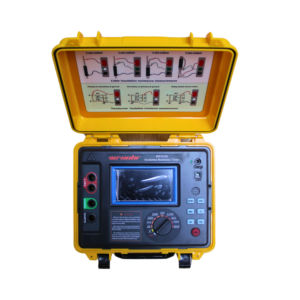
Click the image to know more about Wrindu IR Tester.
What Equipment Is Needed for Motor Insulation Testing?
What Do You Need to Perform the Test?
To test a motor’s insulation resistance, you typically need:
- A megohmmeter (insulation resistance tester)
- Proper test leads
- Safety grounding equipment
Modern testers apply a controlled DC voltage and measure the resulting leakage current. The device then calculates resistance in ohms or megohms using Ohm’s Law.
How Should You Connect a Megohmmeter to a Motor?
How Do You Test an AC Motor?
For AC motors, the motor should be isolated from the supply. In many cases, it is recommended to disconnect the motor from connected circuits such as starters or control equipment.
This helps ensure you are measuring only the motor insulation and not parallel paths that may distort results.
How Do You Test DC Motors or Generators?
For DC machines:
- Lift the brushes before testing
- Test armature, field coils, and other components separately
- Ensure all connections are properly isolated
This allows you to identify which part of the machine may have insulation issues.
Why Should You Never Test an Energized Motor?
Can You Test a Live Motor?
No. Under no circumstances should an insulation resistance test be performed on energized equipment.
Applying test voltage to a live system can:
- Damage the test instrument
- Create dangerous electrical hazards
- Produce inaccurate results
Always fully de-energize and isolate the motor before testing.
How Should You Interpret Insulation Resistance Results?
What Do Motor Insulation Readings Mean?
Insulation resistance values are influenced by temperature, humidity, and motor condition. Because of this, absolute values are less important than trends over time.
Industry standards such as IEEE guidelines for rotating machinery recommend focusing on:
- Gradual changes in insulation resistance
- Consistent test records over time
- Comparison with previous readings
A steady decline in resistance is often an early warning sign of insulation deterioration.
What Is the Most Important Rule in Motor Testing?
The most important principle is periodic testing. Regular measurements allow you to build a history of motor condition, making it easier to detect developing faults before failure occurs.
Why Is Preventive Testing Better Than Emergency Repair?
Routine insulation testing helps you:
- Extend motor service life
- Avoid unexpected shutdowns
- Plan maintenance efficiently
- Reduce overall operating costs
Without regular testing, insulation failure may only be discovered after serious damage has already occurred.
FAQs About Motor Insulation Resistance Testing
How often should a motor be insulation tested?
Testing frequency depends on operating conditions, but many facilities perform tests during scheduled maintenance or every few months in harsh environments.
What is a good insulation resistance value for a motor?
There is no universal fixed value. New motors typically show very high resistance, but the key factor is maintaining stable readings over time.
Can humidity affect insulation test results?
Yes. High humidity can reduce insulation resistance temporarily, which is why environmental conditions should always be recorded during testing.
What causes a sudden drop in insulation resistance?
A sudden drop may indicate moisture ingress, contamination, winding damage, or severe insulation breakdown.
Is insulation testing destructive to the motor?
No. A megohmmeter test is non-destructive when performed correctly and within rated voltage limits.
