

Why Do Short and Long Cables Show Different Tan Delta Results?
Learn why short and long cables show different Tan Delta results. Explore the effects of capacitance, leakage, and surface contamination, and how Wrindu Tan Delta Tester ensures accurate readings.
When performing Tan Delta testing on cables, it’s common to see varying results between short and long cables. Understanding why these differences occur is essential for accurate diagnostics and maintenance. The main factors at play are capacitance, leakage currents, and surface versus insulation leakage. In this article, we’ll explore these factors and explain how guard wires can help ensure more reliable test results.
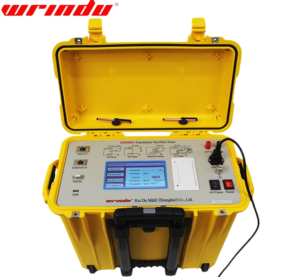
Click the iamge to know more about Transformer Tan Delta Tester.
What Is the Effect of Capacitance and Leakage on Tan Delta Measurements?
Capacitance is a fundamental property of cables that affects Tan Delta measurements. Cables act like capacitors, with the insulation material between the conductors serving as the dielectric. The larger the cable, the more capacitance it has, which leads to higher current flowing through the insulation during testing. As a result, longer cables tend to show higher capacitance values, which can influence the Tan Delta readings.
In shorter cables, the capacitance is lower, meaning less current flows through the insulation during the test. This typically results in lower Tan Delta values for short cables, as there is less leakage current to measure.
How Does Surface Leakage Differ from Insulation Leakage?
One of the key reasons why short and long cables show different Tan Delta values is the way leakage currents occur in cables. Surface leakage and insulation leakage can both contribute to the test results, but they behave differently.
-
Surface leakage happens when moisture, dirt, or contaminants on the surface of the cable allow current to leak across the insulation. This is often more pronounced in short cables, where surface area relative to length is higher. The higher surface area increases the chances of leakage, especially if the cable has been exposed to environmental conditions like humidity or dirt.
-
Insulation leakage, on the other hand, happens inside the insulation material itself, due to the breakdown of the dielectric material. This type of leakage is more consistent in longer cables where the insulation is subject to higher voltages over greater distances, leading to more pronounced dielectric loss.
How Does Guard Wire Usage Help in Tan Delta Testing?
In cases of surface leakage, especially in short cables, the use of a guard wire can significantly improve the accuracy of Tan Delta testing. A guard wire is a conductive wire that surrounds the test cable and effectively isolates the surface of the cable from the measurement process. This helps to eliminate surface leakage currents from the test results, allowing for a more accurate assessment of the insulation’s health.
The Wrindu Tan Delta Tester is compatible with guard wires, making it easier to obtain reliable results even when testing shorter cables with significant surface leakage. Guard wires also help reduce the effects of environmental factors, ensuring that the test results reflect only the actual condition of the insulation material, not the surface contamination.
Why Do Short and Long Cables Show Different Tan Delta Results?
-
Short cables typically show higher surface leakage, leading to higher Tan Delta values. This is because the surface area of short cables is relatively larger compared to their length, increasing the likelihood of surface leakage.
-
Long cables, with larger capacitance and more extensive insulation, tend to show lower Tan Delta values as they primarily reflect insulation leakage rather than surface effects.
Common Questions from Operators
Does the length of the cable always affect Tan Delta readings?
Yes, the length of the cable affects the capacitance and the type of leakage observed. Longer cables tend to have more insulation leakage, while shorter cables often show higher surface leakage.
How can I reduce the impact of surface leakage during testing?
Using a guard wire can significantly reduce the effect of surface leakage. Wrindu testers are designed to work seamlessly with guard wires, helping to isolate surface effects from your readings.
Can environmental conditions cause discrepancies between short and long cables?
Yes, environmental factors like humidity, temperature, and dirt can have a more significant impact on short cables due to their higher surface-to-length ratio. Ensuring dry and clean testing conditions helps improve accuracy.
Wrindu Tan Delta Tester: Optimized for Accurate Measurements
The Wrindu Tan Delta Tester is engineered to handle the unique challenges of testing both short and long cables. With advanced features like guard wire compatibility, temperature compensation, and humidity detection, Wrindu’s technology ensures accurate Tan Delta measurements regardless of the cable length or environmental conditions.
