

Battery Electrolyte Testing: Hydrometer vs. Digital Tester
Learn the differences between digital battery hydrometers and traditional glass hydrometers. Discover how digital specific gravity testers improve battery maintenance with higher accuracy, automatic temperature compensation, and safer operation.
When maintaining flooded lead-acid batteries, checking the electrolyte’s specific gravity (acid density) is the best way to know the battery’s charge level. A fully charged battery usually has a reading of around 1.265, while a discharged one drops to about 1.100.
For a long time, people used traditional glass hydrometers because they are cheap. However, modern factories and power industries now prefer digital testers with automatic temperature correction because they are safer and much faster.
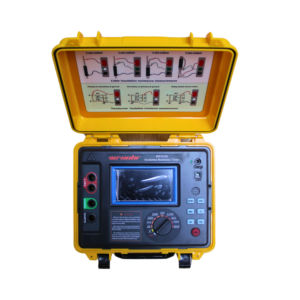
Click the image to know more about Wrindu IR Tester.
What Are the Downsides of Using a Traditional Hydrometer?
A manual hydrometer uses a floating piece inside a glass tube to measure acid density. While it is inexpensive and does not need batteries, it has clear weak points for regular industrial use:
-
Safety Risks: Workers must manually drop and suck up strong acid, which can easily spill and cause burns.
-
Reading Errors: It is easy to misread the small lines on the float, leading to inaccurate data.
-
Fragile Design: Because they are made of glass, these tools break easily in busy work environments, meaning you have to replace them often.
Because of these flaws, hydrometers are mostly used today for basic training or quick, occasional backyard checks.
Why Are Digital Testers a Better Choice?
Digital specific gravity testers use advanced light or electrical sensors to read acid density instantly without messy suction. They outperform old tools in several ways:
-
High Accuracy: Digital tools give exact readings down to $\pm0.001$, catching tiny changes that a human eye would miss.
-
Automatic Temperature Adjustment: Battery acid density changes with temperature. Digital testers fix this automatically, giving you consistent data in hot or cold weather.
-
Easy Data Saving: You can save readings with one click and send them to a phone or computer via Bluetooth, making record-keeping simple.
For power plants, solar farms, and backup power systems, digital testers keep operations running smoothly and prevent unexpected power failures.
Why Must Battery Management Teams Keep Acid Levels Balanced?
The density of the acid tells you the health of each battery cell. A small drop of 0.010 in specific gravity means the cell has lost about 20% of its power capacity.
If the cells inside a battery bank have different density levels, it means some cells are degrading or failing. This imbalance damages the healthy cells and shortens the lifespan of the whole system. Using a digital tester helps teams find weak cells early so they can fix them before the whole power system shuts down.
Which Tool Should Your Factory or Maintenance Team Choose?
The right tool depends on how many batteries you need to test and how accurate you need to be:
-
For Fast Production and Regular Maintenance: If you manage battery assembly lines or large power grids, digital testers are the only logical choice. They work five times faster than manual tools and connect easily to cloud tracking systems.
-
For Low-Cost Spot Checks: If you only need to check a backup battery once in a while in a remote area without power, a cheap hydrometer can still do the basic job.
In short, switching to digital testing saves time, protects workers, and keeps industrial systems reliable over the long term.
Frequently Asked Questions (FAQs)
Can digital testers fully replace old glass hydrometers?
Yes, especially for businesses. Digital testers are safer because workers do not touch the acid, they are five times faster, and they provide digital logs for quality control.
What is the best temperature for testing battery specific gravity?
The standard testing temperature is $25^\circ\text{C}$ ($77^\circ\text{F}$). At this temperature, a healthy, fully charged battery reads between 1.265 and 1.280. Digital testers adjust for temperature automatically, while manual tools force you to do math calculations.
What should I do if one battery cell has a much lower reading than the others?
A low reading means that specific cell is failing or damaged. You should try an equalization charge to balance the battery bank. If the reading stays low after charging, you will likely need to replace that single cell to protect the rest of the system.
How often should industrial battery banks be tested?
For critical systems like data centers or power grids, it is best to do a quick check every month after the batteries are fully charged. A complete, detailed test of every single cell should be done every three to six months.
Do digital tester manufacturers offer custom options for large factories?
Yes. Professional test equipment manufacturers (such as Wrindu) offer wholesale options and custom builds. They can add special software, CE-certified hardware, or cloud syncing features to match the exact needs of power companies and assembly plants.
