

Motor Tan Delta Testing: How It Protects Insulation and Extends Motor Life
Learn how Tan Delta testing helps monitor motor insulation, detect early deterioration, and extend motor life. Wrindu provides advanced Tan Delta Test Sets for predictive maintenance of industrial motors, generators, and transformers.
The Tan Delta Test is a reliable way to check motor insulation health and prevent failures. By measuring dielectric losses in motor insulation, the test evaluates how well a motor resists leakage current under high voltage. Detecting early issues helps engineers reduce downtime, cut maintenance costs, and extend motor service life.
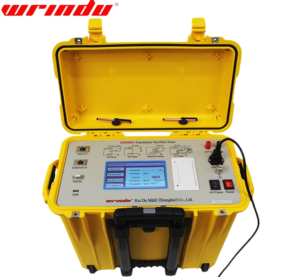
How the Tan Delta Test Works
Tan Delta, also called dissipation factor or loss angle, measures the phase difference between voltage applied to the motor winding and the resulting current. Perfect insulation would produce a 90° phase shift, but real insulation introduces small resistive losses, which cause a shift. The tangent of this shift, known as “tan δ,” shows how much energy is lost as heat. Low tan δ means insulation is healthy, while rising values indicate aging, contamination, or partial discharge.
During testing, voltage is gradually increased and results are plotted as a “tan delta vs voltage” curve. Stable curves indicate uniform insulation, while sharp increases highlight weak spots. Tan Delta testing is non-destructive and ideal for predictive maintenance.
Why Tan Delta Testing Is Important
Motors face thermal, mechanical, and environmental stress, which can degrade insulation over time. Without monitoring, this can lead to failures, short circuits, or costly downtime. Tan Delta testing provides early warning, allowing maintenance teams to act before serious damage occurs. Repeated measurements track insulation trends, helping schedule rewinds only when necessary and avoiding unnecessary repairs.
Advanced Test Technology
Modern Tan Delta Test Sets combine precise high-voltage sources with smart measurement circuits to detect small insulation losses. Features like automatic temperature correction, digital storage, multi-frequency analysis, and partial discharge detection allow engineers to locate weak points and assess remaining insulation life accurately.
Wrindu, a global leader in electrical testing, provides advanced Tan Delta and insulation testers trusted by utilities, industrial plants, and research institutions. With ISO9001, IEC, and CE certifications, Wrindu tools help engineers optimize insulation performance for safe and reliable high-voltage operations.
Global Trends
Demand for Tan Delta testing is growing in motors, wind turbines, and industrial machines. Many companies now include it in predictive maintenance programs. Smart systems with IoT and cloud integration allow continuous monitoring, trend analysis, and early failure prediction, aligning with Industry 4.0 strategies.
Tan Delta vs Other Motor Insulation Tests
| Test | Purpose | Advantage | Limitation | Typical Use |
|---|---|---|---|---|
| Tan Delta | Measures insulation losses | Detects early aging | Requires high voltage | Predictive maintenance |
| Polarization Index (PI) | Measures insulation resistance ratio | Quick field check | Less sensitive to contamination | Routine inspection |
| Partial Discharge | Detects local defects | Precise defect location | Complex equipment | Factory acceptance testing |
| Insulation Resistance | Measures total leakage | Fast and simple | Less trend-sensitive | Basic inspection |
Tan Delta complements other tests, providing a full picture of insulation health.
Benefits and ROI
Facilities using Tan Delta testing report up to 40% fewer unexpected motor failures. For example, a plant detected moisture in a stator early, avoiding over $250,000 in repairs and downtime. Regular testing reduces breakdowns, extends motor life, and increases operational reliability.
Integrating Tan Delta into Maintenance
Establish a baseline for new or refurbished motors, then retest periodically. Rising tan δ trends may indicate minor re-varnishing or drying is needed. Steep increases suggest urgent inspection or partial rewinding to prevent failure.
Future Trends
Tan Delta testing is moving toward automation, online monitoring, and AI-driven analytics. Continuous data collection from motor terminals combined with operational data allows predictive maintenance with high precision. This supports energy efficiency, sustainability, and reliable operations.
FAQs
Q1: What is a good Tan Delta value for motor insulation?
A1: Generally, tan δ values below 0.5% indicate healthy insulation. Values above 1% require closer inspection. Trends over time are more important than single readings.
Q2: Can the Tan Delta Test detect partial discharge?
A2: Indirectly. Rising tan δ values can signal partial discharge activity. Combined testing with partial discharge equipment gives a more complete diagnosis.
Q3: Is the Tan Delta Test safe for motors?
A3: Yes. It is non-destructive and applies controlled voltage within safe limits, so it does not harm insulation.
Q4: What equipment is needed for motor Tan Delta testing?
A4: A Tan Delta Test Set with a high-voltage source, precision measurement circuits, and calibration capabilities is required. Modern systems may include digital storage, multi-frequency analysis, and partial discharge detection.
Q5: How does Tan Delta testing improve motor maintenance?
A5: By detecting insulation degradation early, maintenance teams can take corrective action before failure, schedule repairs efficiently, and avoid unnecessary rewinds.
Q6: How often should motors be tested with Tan Delta?
A6: Testing frequency depends on motor usage and environmental conditions. Typically, annual or semi-annual tests are recommended, or after major load cycles.
Q7: What is the difference between Tan Delta and Polarization Index for motors?
A7: Tan Delta measures AC dielectric losses and detects moisture or contamination. Polarization Index uses DC to evaluate insulation resistance over time. Both tests complement each other.
Q8: Can Tan Delta trends predict motor failure?
A8: Yes. Rising tan δ values over time indicate insulation weakening, allowing predictive maintenance before catastrophic failure.
Q9: Can Tan Delta testing be done in the field?
A9: Yes. Portable Tan Delta Test Kits allow on-site testing, reducing downtime and avoiding transportation of motors to a lab.
Q10: Why is Tan Delta important for industrial motors?
A10: It ensures insulation reliability, prevents unexpected breakdowns, supports predictive maintenance programs, and extends motor service life.
