

Why Does Low Frequency Measurement Accuracy Matter in Dielectric Response Testing?
Learn why low frequency measurement accuracy affects transformer insulation diagnosis and how FDS technology improves moisture detection, aging evaluation, and test reliability.
Why Is Low Frequency Testing Important for Transformer Insulation Diagnosis?
Transformer insulation failures rarely happen suddenly. In many cases, insulation degradation develops slowly over years because of:
- Moisture absorption
- Thermal aging
- Oil oxidation
- Electrical stress
- Long-term operation
The challenge for maintenance engineers is identifying these hidden problems before they become serious failures.
Traditional insulation tests, such as insulation resistance and power frequency tan delta testing, provide useful information. However, some early insulation problems are more visible at very low frequencies.
Frequency Domain Dielectric Response (FDS) testing uses a wide frequency range to analyze insulation behavior. Low-frequency measurements are especially valuable because they provide information about slow polarization processes related to:
- Moisture movement
- Aging effects
- Conductive losses
- Insulation structure changes
The RDGYB-JD1000 Frequency Domain Dielectric Response Insulation Diagnostic Analyzer supports a frequency range from 0.1 mHz to 10 kHz, enabling detailed insulation condition evaluation.
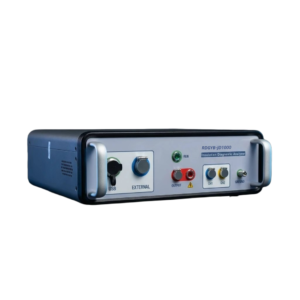
Click the image to know more about Wrindu Frequency Domain Dielectric Response Insulation Diagnostic Analyzer.
What Happens Inside Transformer Insulation at Low Frequencies?
Why Are Low Frequencies More Sensitive to Insulation Problems?
Electrical insulation is not a perfect material.
When voltage is applied, different processes occur inside insulation:
- Electronic polarization
- Molecular polarization
- Interfacial polarization
- Conductive movement
Fast processes appear at higher frequencies.
Slow processes become visible at lower frequencies.
Low-frequency measurements provide more time for charges and moisture-related polarization effects to develop.
Therefore, changes caused by:
- Water content
- Aging products
- Oil conductivity
- Interface polarization
can become easier to identify.
Why Can Low Frequency Testing Detect Transformer Moisture?
How Does Moisture Influence Low Frequency Dielectric Response?
Moisture is one of the most important factors affecting oil-paper insulation.
Water molecules increase the ability of charges to move inside insulation.
At low frequencies:
- Polarization effects become stronger.
- Dielectric loss increases.
- Response curves change significantly.
This makes low-frequency analysis valuable for evaluating:
- Cellulose moisture content
- Insulation aging condition
- Oil-paper insulation quality
The RDGYB-JD1000 uses dielectric response analysis models to evaluate cellulose moisture content and insulation liquid characteristics.
Why Is Low Frequency Measurement More Difficult Than High Frequency Measurement?
What Challenges Affect Low Frequency FDS Testing?
Low-frequency measurement requires higher measurement stability because the signals are much slower and weaker.
Common challenges include:
Electromagnetic Interference
High-voltage substations contain many sources of electrical noise:
- Transformers
- Switchgear
- Transmission lines
- Control equipment
External interference can affect measurement signals.
Long Measurement Time
Low-frequency signals require longer measurement periods.
Small Current Measurement
Dielectric response testing often measures very small currents, making noise control important.
Environmental Influence
Temperature and humidity changes may influence results.
Therefore, a reliable FDS analyzer must have strong filtering and noise resistance.
How Does Measurement Accuracy Affect Transformer Diagnosis Results?
Can Small Measurement Errors Change Insulation Evaluation?
Yes.
Dielectric response diagnosis depends on analyzing curve patterns and calculated parameters.
Small measurement errors at low frequencies may influence:
- Moisture estimation
- Oil conductivity evaluation
- Aging assessment
For example, incorrect low-frequency data may cause:
- Incorrect curve fitting
- Wrong insulation condition judgment
- Unnecessary maintenance actions
High accuracy and stable low-frequency measurement are therefore essential.
The RDGYB-JD1000 provides high measurement accuracy and strong noise immunity for testing in high-voltage and extra-high-voltage substations.
How Does Electromagnetic Interference Affect FDS Results?
Why Must Dielectric Response Equipment Have Strong Anti-Interference Capability?
High-voltage substations are challenging environments for sensitive electrical measurements.
External interference may create:
- Unstable curves
- Abnormal data points
- Incorrect dielectric loss values
Low-frequency measurements are especially vulnerable because:
- Signal levels are small.
- Testing duration is longer.
- External noise has more opportunity to affect results.
Advanced dielectric response analyzers use:
- Filtering technology
- Stable AC output
- Noise reduction algorithms
to improve measurement reliability.
The RDGYB-JD1000 provides clean AC voltage output and filtering technology to improve measurement stability in high-interference environments.
What Is the Relationship Between Frequency Range and Insulation Diagnosis?
Why Does a Wider Frequency Range Provide Better Analysis?
Different frequency regions reveal different insulation information.
High Frequency Region
Provides information about:
- Geometrical capacitance
- Insulation structure
- Fast polarization processes
Medium Frequency Region
Helps evaluate:
- Dielectric loss behavior
- Material characteristics
Low Frequency Region
Provides information about:
- Moisture
- Conductive losses
- Slow polarization effects
A wide frequency range allows engineers to build a complete picture of insulation condition.
The RDGYB-JD1000 supports frequency measurements from 0.1 mHz to 10 kHz, covering a wide diagnostic range.
How Does Low Frequency Accuracy Improve Moisture Assessment?
Why Is Reliable Moisture Evaluation Dependent on Low Frequency Data?
Transformer moisture assessment often relies on dielectric response modeling.
The analysis software compares measured curves with insulation models to estimate:
- Moisture content
- Oil conductivity
- Insulation condition
If low-frequency data is inaccurate:
- The model fitting may become unstable.
- Moisture estimation may become unreliable.
High-quality low-frequency measurements improve confidence in diagnosis results.
The RDGYB-JD1000 combines measurement technology and insulation databases to provide moisture and insulation condition analysis.
What Does a Real Field Test Show About Low Frequency Stability?
Why Is Field Performance More Important Than Laboratory Results?
Laboratory testing provides controlled conditions.
However, actual substations include:
- Strong electromagnetic fields
- Complex grounding conditions
- Large electrical equipment nearby
A comparison test was performed on a 220kV transformer bushing using frequency domain dielectric response technology.
The test compared dielectric response measurement results under practical field conditions.
The report showed that low-frequency measurement stability and interference resistance are important factors affecting reliable diagnosis.
How Does Multi-Frequency Technology Improve Testing Efficiency?
Can Low Frequency Testing Be Fast Enough for Field Applications?
Traditional low-frequency measurements may require long testing times.
Modern FDS systems improve efficiency through:
- Multi-frequency measurement technology
- Optimized test procedures
- Advanced software analysis
The RDGYB-JD1000 applies multi-frequency measurement technology to reduce measurement time while maintaining diagnostic capability.
This helps engineers complete field testing more efficiently.
Why Is Low Frequency Accuracy Important for Aging Transformer Assessment?
Can Low Frequency Data Reveal Early Aging Signs?
Transformer aging changes the physical and chemical properties of insulation materials.
Aging may cause:
- Increased dielectric losses
- Changed polarization behavior
- Reduced insulation performance
Low-frequency dielectric response analysis helps identify these gradual changes.
By comparing results over time, utilities can monitor:
- Aging trends
- Insulation deterioration speed
- Remaining service condition
How Does RDGYB-JD1000 Support Reliable Low Frequency Testing?
What Features Improve Low Frequency Measurement Performance?
The RDGYB-JD1000 is designed for advanced insulation diagnostics.
Key advantages include:
Wide Frequency Measurement Range
Supports:
- 0.1 mHz–10 kHz
Integrated FDS and PDC Technology
Provides both:
- Frequency-domain analysis
- Time-domain polarization analysis
Strong Noise Immunity
Suitable for:
- High-voltage substations
- High-interference environments
Accurate Temperature Correction
Improves comparison between different testing conditions.
Advanced Software Analysis
Provides:
- Moisture evaluation
- Oil conductivity analysis
- Insulation condition assessment
What Are the Long-Term Benefits of Accurate Low Frequency Testing?
Why Should Utilities Invest in Advanced Dielectric Response Equipment?
Reliable low-frequency testing helps utilities:
Detect Problems Earlier
Identify insulation degradation before failure.
Reduce Unexpected Outages
Improve transformer reliability.
Optimize Maintenance Planning
Use actual insulation condition instead of fixed replacement schedules.
Extend Equipment Life
Prevent unnecessary damage through early diagnosis.
FAQs
Why is low frequency important in FDS testing?
Low frequency reveals slow polarization processes related to moisture, aging, and insulation condition.
What frequency range is used for dielectric response testing?
Advanced FDS analyzers can measure from very low frequencies to high frequencies. The RDGYB-JD1000 supports 0.1 mHz to 10 kHz.
Why is low-frequency measurement sensitive to moisture?
Moisture affects polarization and conductive behavior, which becomes more visible at low frequencies.
Can electromagnetic interference affect FDS testing?
Yes. Strong interference can influence low-frequency measurements, so anti-interference technology is important.
How does FDS compare with traditional tan delta testing?
FDS analyzes insulation behavior across multiple frequencies, while traditional tan delta usually focuses on specific frequencies.
Can low-frequency FDS testing evaluate transformer bushings?
Yes. FDS technology is used for transformers, bushings, inductors, and other oil-paper insulated equipment.
Does temperature affect low-frequency dielectric response results?
Yes. Temperature changes insulation characteristics, so temperature correction improves diagnosis accuracy.
Why are accurate low-frequency measurements important for transformer maintenance?
Because incorrect low-frequency data may affect moisture assessment, aging evaluation, and maintenance decisions.
Conclusion
Low-frequency measurement is one of the most important parts of frequency domain dielectric response testing.
It provides valuable information about:
- Moisture conditions
- Polarization behavior
- Insulation aging
- Oil-paper system health
However, accurate low-frequency testing requires advanced technology because of interference, weak signals, and long measurement periods.
With wide frequency capability, strong noise immunity, and advanced analysis software, the RDGYB-JD1000 helps utilities obtain reliable transformer insulation diagnosis results and improve long-term asset management.
