

PCB Limits in Transformer Oil: Testing Standards and Regulatory Requirements
Understand PCB concentration limits in insulating oil, the 50 mg/kg threshold, IEC 61619, ASTM D4059, and laboratory reporting requirements.
PCB limits in transformer oil are important for electrical equipment owners, environmental laboratories, and waste management companies.
Polychlorinated biphenyls (PCBs) are persistent pollutants that have been restricted under international and national environmental regulations.
However, PCB concentration limits are not identical in every country or regulatory application. Laboratories and equipment owners must identify the applicable requirement before interpreting test results.
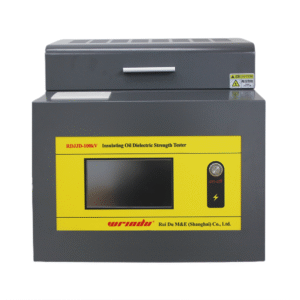
Click the image to know more about Wrindu Oil BDV Tester.
What PCB Concentration Is Considered Contaminated Transformer Oil?
PCB concentration is normally reported in mg/kg or ppm by mass.
For mass-based concentration in oil:
1 mg/kg = 1 ppm.
A frequently referenced regulatory value is 50 mg/kg. However, this value should not be treated as a universal definition of clean or contaminated transformer oil.
The applicable threshold depends on the country’s legislation, the equipment category, the purpose of testing, and the relevant regulatory framework.
For example, the Stockholm Convention controls PCBs under its provisions on persistent organic pollutants. Its requirements include specific obligations for PCB-containing equipment and environmentally sound waste management.
What Is the 50 mg/kg PCB Threshold?
The 50 mg/kg value is used in several PCB management and regulatory contexts.
It is important to understand what the threshold actually applies to.
| Item | Explanation |
|---|---|
| Measurement | PCB concentration |
| Unit | mg/kg or ppm by mass |
| Commonly referenced value | 50 mg/kg |
| Application | Depends on the relevant regulation |
| Interpretation | Must follow the applicable legal definition |
A laboratory should report the measured PCB concentration and the analytical method.
Equipment owners should not use the 50 mg/kg value without checking the applicable national requirements.
Which Standards Are Used to Test PCB in Transformer Oil?
Several standards provide analytical methods for PCB determination.
| Standard | Main application |
|---|---|
| IEC 61619 | PCB contamination in insulating liquids using capillary gas chromatography |
| ASTM D4059 | PCB analysis in insulating liquids by gas chromatography |
| SN/T 1792-2014 | PCB determination in electrical insulating oil by gas chromatography |
These standards help laboratories establish suitable analytical procedures.
The selected method should match the required PCB compounds, concentration range, and reporting requirements.
Is GC-ECD Required for PCB Testing?
GC-ECD is a commonly used analytical configuration for PCB testing in insulating liquids.
The electron capture detector is suitable for detecting many chlorine-containing compounds.
A complete analytical method also requires appropriate sample preparation, chromatographic separation, calibration standards, and quality control.
GC-MS may be used for confirmation or additional compound identification, depending on the analytical method.
What Information Should a PCB Test Report Include?
A useful PCB test report should contain sufficient information for customers and regulatory reviewers.
| Report item | Required information |
|---|---|
| Sample identification | Transformer or equipment reference |
| Sample type | Mineral insulating oil or other insulating liquid |
| Test method | Applicable standard and method |
| PCB result | Measured concentration |
| Measurement unit | mg/kg or ppm |
| Reporting limit | Method-specific detection or quantification limit |
| Laboratory information | Laboratory identity and relevant accreditation |
| Test date | Date of analysis |
The laboratory should also explain how results below the reporting limit are presented.
A result reported as not detected does not necessarily mean that the sample contains absolutely zero PCB.
Does Every Transformer Oil Laboratory Need PCB Testing Equipment?
No. PCB analysis is a specialized laboratory service.
Most routine transformer oil laboratories focus on properties such as:
- Breakdown voltage.
- Moisture content.
- Acid value.
- Dielectric dissipation factor.
- Resistivity.
- Interfacial tension.
PCB analysis requires a separate analytical configuration.
A laboratory should invest in GC-ECD or another suitable validated PCB analytical system only when its testing services require this capability.
Which Routine Oil Testing Standards Should a Laboratory Know?
PCB analysis is separate from routine oil condition testing.
The following standards are relevant to common transformer oil testing applications.
| Standard | Test item |
|---|---|
| IEC 60156 | Breakdown voltage |
| IEC 60247 | Dielectric dissipation factor and resistivity |
| IEC 60422:2024 | Supervision and maintenance of mineral insulating oils |
| IEC 60814 | Water content |
| IEC 62021 | Acidity |
| IEC 61619 | PCB contamination |
| ASTM D4059 | PCB analysis |
The standard selected for each test should match the oil type, testing purpose, and customer requirements.
Where Can You Buy Transformer Oil Testing Equipment?
Wrindu supplies routine transformer oil testing instruments for electrical laboratories, power utilities, and transformer manufacturers.
Available products include:
- Wrindu Oil Dielectric Strength Tester
- Wrindu Transformer Insulation Oil Acid Value Tester
- Wrindu New Insulating Oil Micro-Water Tester
- Wrindu Transformer Tan Delta Tester
These instruments are designed for routine oil condition testing, not PCB concentration analysis.
Contact Wrindu to discuss your laboratory requirements, test standards, and equipment configuration.
