

How to Read PCB Test Results in Transformer Oil: PPM, Detection Limits, and Classification
Learn how to interpret PCB test results in transformer oil, understand ppm and mg/kg, check laboratory reporting limits, and review concentration classifications.
What Does a PCB Test Result Mean?
A PCB test result shows the concentration of polychlorinated biphenyls in an insulating liquid.
Laboratories usually express PCB concentration in parts per million (ppm) or milligrams per kilogram (mg/kg).
For example:
| PCB concentration | Meaning |
|---|---|
| 0.5 ppm | 0.5 mg of PCB per kg of sample |
| 5 ppm | 5 mg of PCB per kg of sample |
| 25 ppm | 25 mg of PCB per kg of sample |
| 50 ppm | 50 mg of PCB per kg of sample |
| 500 ppm | 500 mg of PCB per kg of sample |
For mass-based measurements:
1 ppm = 1 mg/kg
This conversion helps engineers compare laboratory reports that use different concentration units.
However, users should confirm whether the laboratory reports concentrations on a mass basis or another basis.
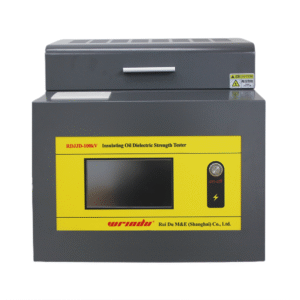
Click the image to know more about Wrindu Oil BDV Tester.
What Is the Difference Between PPM and MG/KG in PCB Testing?
For PCB concentrations reported by mass, ppm and mg/kg express the same numerical value.
For example:
-
10 ppm = 10 mg/kg.
-
50 ppm = 50 mg/kg.
-
100 ppm = 100 mg/kg.
-
500 ppm = 500 mg/kg.
Do not confuse mg/kg with mg/L.
The two units describe different concentration bases. Conversion between them requires the oil density and a clear understanding of the laboratory’s reporting basis.
For accurate comparison, always check the units shown on the laboratory report.
What Does a PCB Result Below the Detection Limit Mean?
A laboratory may report a result as:
-
Not detected (ND).
-
Below detection limit (BDL).
-
Below reporting limit.
-
Less than a stated concentration, such as less than 1 mg/kg.
These expressions do not automatically mean that the oil contains zero PCBs.
They indicate that the analytical result falls below a specified measurement or reporting threshold.
Consider the following examples:
| Laboratory report | Interpretation |
|---|---|
| ND, reporting limit 1 mg/kg | The laboratory did not report a detectable result at its stated limit |
| Less than 2 mg/kg | The result is below the stated reporting threshold |
| 0.8 mg/kg | The laboratory reported a numerical concentration |
| 12 mg/kg | The laboratory reported a concentration of 12 mg/kg |
The detection limit and reporting limit are not necessarily the same.
The detection limit relates to the method’s ability to identify an analyte. The reporting limit defines the concentration above which the laboratory reports quantitative results under its procedure.
Important: A result below 50 ppm does not automatically prove regulatory compliance in every country. The applicable limit, reporting basis, and measurement uncertainty must all be considered.
What Do 50 PPM and 500 PPM Mean for PCB Classification?
PCB concentration thresholds depend on the applicable regulations.
In the United States, the EPA Toxic Substances Control Act (TSCA) uses specific concentration categories for certain electrical equipment.
For example, the US EPA distinguishes the following liquid concentration categories:
| PCB concentration | US TSCA terminology | General meaning |
|---|---|---|
| Below 50 ppm | Non-PCB | Below the 50 ppm threshold |
| 50 ppm to below 500 ppm | PCB-contaminated | Falls within the PCB-contaminated category |
| 500 ppm or higher | PCB | Meets the PCB concentration threshold used for PCB transformer classification |
Under 40 CFR 761.3, a PCB Transformer contains 500 ppm or more PCBs. PCB-contaminated electrical equipment generally contains 50 ppm or more but less than 500 ppm in its contaminating fluid.
These categories describe US regulatory terminology. They should not be treated as universal international classifications.
Equipment classification may also depend on its history, type, and other regulatory assumptions. A laboratory result alone may not settle every compliance question.
How Does the Laboratory Reporting Limit Affect PCB Compliance?
The reporting limit must be low enough to support the intended decision.
For example, consider a project that needs to assess whether oil falls below 50 ppm.
| Reporting result | Can it support a comparison with 50 ppm? |
|---|---|
| Less than 1 ppm | Yes, subject to method validity and applicable rules |
| Less than 10 ppm | Yes, subject to method validity and applicable rules |
| Less than 40 ppm | Yes, subject to method validity and applicable rules |
| Less than 60 ppm | No, it does not establish that the concentration is below 50 ppm |
A reporting limit above the decision threshold cannot confirm that the sample meets that threshold.
Wrindu engineers recommend confirming the required reporting limit with the laboratory before sample collection.
This step can prevent unnecessary repeat testing.
Why Can Two Laboratories Report Different PCB Concentrations for the Same Oil?
Different laboratories may produce different results because they use different analytical procedures and reporting conditions.
The following factors can affect the comparison:
| Factor | Possible effect |
|---|---|
| Sample preparation | Different extraction and cleanup procedures |
| Analytical method | Different separation and detection conditions |
| PCB calibration standard | Different calibration approaches |
| PCB formulation | Different target compounds or congener coverage |
| Reporting limit | Different minimum reportable concentrations |
| Quality control | Different recovery, precision, and acceptance criteria |
| Sample handling | Changes in sample integrity or accidental contamination |
For example, one laboratory may report total PCB concentration using a specified commercial mixture calibration approach. Another may report selected PCB congeners.
These results may not be directly comparable.
When two reports disagree, check their analytical methods, calibration basis, target compounds, units, and quality-control data before deciding which result to use.
Which Information Should You Check in a PCB Laboratory Report?
A PCB report should contain enough information to support technical review and regulatory decisions.
| Report item | What should you check? |
|---|---|
| Sample identification | Does it match the transformer ID? |
| Test method | Does the method match the project requirement? |
| PCB result | What concentration did the laboratory report? |
| Measurement unit | ppm, mg/kg, or another unit? |
| Reporting limit | Is it below the required decision threshold? |
| PCB target | Does the method cover the required PCB compounds or mixtures? |
| Quality control | Are relevant recovery and calibration checks acceptable? |
| Test date | When did the laboratory complete the analysis? |
| Laboratory details | Can the laboratory demonstrate suitable technical competence? |
An accredited laboratory can provide additional confidence when its accreditation scope covers the specific PCB method and sample matrix.
Do not assume that a laboratory’s general accreditation automatically covers every PCB analytical procedure.
Should You Repeat a PCB Test When the Result Is Close to a Regulatory Limit?
A repeat test may be appropriate when the result is close to a decision threshold.
First, check the laboratory’s measurement uncertainty and quality-control information.
Then review the sample history and determine whether the original sample represents the oil inside the transformer.
Consider these situations:
| Situation | Recommended action |
|---|---|
| Result is far below the applicable threshold | Review the report and retain the records |
| Result is close to the threshold | Review uncertainty and discuss confirmation testing |
| Result exceeds the threshold | Follow the applicable management and compliance procedure |
| Result is inconsistent with previous records | Review sampling history and consider a new sample |
| Reporting limit exceeds the required threshold | Request an appropriate analytical method |
Do not average unrelated results or use dilution to make a contaminated oil sample appear compliant.
The laboratory and the responsible environmental compliance professional should determine the appropriate confirmation procedure.
What Should You Do After Receiving a PCB Test Report?
The next action depends on the result, equipment history, and applicable regulations.
-
Match the report to the correct transformer.
-
Confirm the concentration unit and analytical method.
-
Check the reporting limit and quality-control information.
-
Compare the result with the applicable local regulatory requirements.
-
Keep the report with the transformer maintenance and environmental records.
-
Arrange further testing or management action when necessary.
A PCB report should support an equipment management decision, not replace a complete assessment of the equipment.
For an overview of PCB analytical methods, sample preparation, and testing standards, read: PCB Testing in Transformer Oil: Methods, Standards, and Procedures.
Reference sources:
