

PCB in Transformer Oil: Testing, Contamination Risks, and Oil Testing Equipment
Learn how to test PCB in transformer oil, identify contamination, and choose Wrindu oil testing equipment for transformer oil condition monitoring.
PCB in transformer oil is an important concern for transformer owners, electrical maintenance teams, and power utilities. Polychlorinated biphenyls (PCBs) are toxic chemicals that were previously used in electrical insulating liquids because of their electrical insulation properties and low flammability.
Although PCB-containing insulating liquids are no longer used in many countries, older transformers and other oil-filled electrical equipment may still contain PCBs. Testing is necessary to identify contamination and determine the correct handling and maintenance procedures.
This guide explains how to identify PCB contamination in transformer oil, which testing standards apply, and how to select transformer oil testing equipment for routine oil condition monitoring.
Wrindu – China HV Testing Manufacturers provides transformer oil testing equipment for electrical laboratories, power utilities, transformer manufacturers, and maintenance teams.
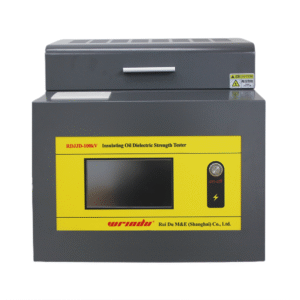
Click the image to know more about Wrindu Oil BDV Tester.
What Is PCB in Transformer Oil?
PCB stands for polychlorinated biphenyl. It refers to a group of synthetic chemical compounds containing chlorine.
PCBs were previously used in electrical insulating liquids, including some transformer oils. These liquids provided electrical insulation and had low flammability.
However, PCBs are persistent environmental pollutants. They can accumulate in living organisms and cause serious health and environmental concerns.
PCB-containing insulating liquids have been restricted or banned in many countries. Their use, handling, transportation, and disposal are subject to applicable environmental regulations.
What Are the Main Characteristics of PCB?
| Property | Description |
|---|---|
| Full name | Polychlorinated biphenyl |
| Chemical type | Chlorinated organic compounds |
| Historical application | Electrical insulating liquids, heat transfer fluids, and industrial applications |
| Electrical application | Insulation in older electrical equipment |
| Environmental behavior | Persistent and difficult to break down |
| Health concern | Toxic and associated with cancer and other health effects |
| Current status | Restricted or banned in many countries |
PCB contamination is not always visible. Transformer oil may look clear and still contain PCB.
Does Transformer Oil Contain PCB?
Not all transformer oil contains PCB.
Modern mineral transformer oil is generally manufactured without intentionally adding PCBs. However, PCB contamination may occur in older equipment or through contact with contaminated oil, storage tanks, pipelines, or maintenance equipment.
The contamination status of transformer oil cannot be confirmed by its color, smell, or appearance.
| Transformer oil source | PCB contamination concern |
|---|---|
| New mineral transformer oil | Normally not intentionally formulated with PCB |
| Older oil-filled transformers | May contain PCB, depending on equipment history |
| Reclaimed transformer oil | Requires verification of contamination status |
| Oil from unknown equipment | PCB testing is recommended before handling or reuse |
| Oil from PCB-contaminated equipment | Requires controlled sampling and analysis |
A transformer manufactured before a particular year should not automatically be classified as PCB-contaminated. Equipment history and laboratory analysis are needed to establish its status.
The Irish Environmental Protection Agency recommends oil sampling and laboratory analysis to verify PCB contamination in potentially affected equipment.
How Can You Test PCB in Transformer Oil?
PCB contamination requires a dedicated analytical test. Routine transformer oil tests cannot directly determine the PCB concentration.
Two important international methods are IEC 61619 and ASTM D4059.
| Standard | Test method | Application |
|---|---|---|
| IEC 61619 | Analysis of PCBs in insulating liquids | PCB analysis in insulating liquids |
| ASTM D4059 | Gas chromatography | Quantitative determination of PCB concentration in insulating liquids |
ASTM D4059 specifies a gas chromatography method for determining PCB concentration in electrical insulating liquids. ASTM D4059
What Is the PCB Testing Procedure?
- Identify the transformer and review its maintenance history.
- Collect an oil sample using suitable sampling equipment and procedures.
- Send the sample to a laboratory equipped for PCB analysis.
- Analyze the sample according to the applicable PCB testing standard.
- Obtain a report showing the PCB concentration and measurement units.
- Compare the result with the applicable regulatory or customer requirements.
Sampling must be performed by qualified personnel. PCB-contaminated oil requires appropriate handling and precautions to prevent cross-contamination.
What Is the Difference Between PCB Testing and Transformer Oil Testing?
PCB testing identifies a specific chemical contaminant. Routine transformer oil testing evaluates the condition of insulating oil during operation.
| Test type | Main purpose | Typical method |
|---|---|---|
| PCB analysis | Identify and quantify PCB contamination | IEC 61619 / ASTM D4059 |
| Breakdown voltage | Evaluate oil dielectric strength | IEC 60156 |
| Water content | Measure moisture in oil | IEC 60814 |
| Dielectric dissipation factor | Evaluate dielectric losses | IEC 60247 |
| Acidity | Measure the neutralization value | IEC 62021 |
| Interfacial tension | Evaluate oil-water interfacial properties | ASTM D971 |
| Corrosive sulfur | Identify corrosive sulfur concerns | IEC 62535 / ASTM D1275 |
PCB analysis and routine oil condition monitoring serve different purposes. A transformer oil testing system may include several routine oil tests without providing PCB analysis.
What Transformer Oil Tests Should You Perform?
Transformer oil testing helps maintenance teams evaluate oil condition and identify changes that may affect transformer insulation and operation.
IEC 60422:2024 provides guidance for the supervision and maintenance of mineral insulating oils and other hydrocarbon-based liquids in electrical equipment. It also includes guidance on the decontamination of PCB-contaminated oil. IEC 60422:2024
The following tests are commonly used in transformer oil condition monitoring.
| Oil test | What does it measure? | Why is it useful? |
|---|---|---|
| Breakdown voltage (BDV) | Dielectric breakdown strength | Checks the insulating performance of oil |
| Water content | Moisture concentration | Identifies moisture contamination |
| Acidity | Neutralization value | Evaluates oil oxidation and ageing |
| Dielectric dissipation factor | Dielectric loss | Helps assess oil insulation condition |
| Resistivity | Electrical resistivity | Evaluates electrical insulation properties |
| Interfacial tension (IFT) | Oil-water interfacial tension | Helps identify polar contamination |
| Corrosive sulfur | Corrosive sulfur compounds | Evaluates potential corrosion risks |
| PCB content | PCB concentration | Identifies PCB contamination |
The required test items depend on the transformer voltage level, oil type, equipment condition, maintenance schedule, and applicable standards.
Which Wrindu Oil Testing Equipment Should You Choose?
Wrindu oil testing equipment supports transformer oil condition monitoring in electrical laboratories, power utilities, transformer manufacturers, and maintenance departments.
The appropriate equipment depends on the oil properties you need to measure.
Wrindu – China HV Testing Manufacturers provides transformer testing equipment for different electrical testing applications.
Which Equipment Is Used for Transformer Oil Breakdown Voltage Testing?
The transformer oil breakdown voltage tester measures the dielectric breakdown voltage of insulating oil.
It is commonly used for:
- Transformer oil acceptance testing.
- Routine oil quality monitoring.
- Oil filtration and maintenance checks.
- Laboratory testing of insulating liquids.
The applicable test method should be selected according to the required standard.
IEC 60156 is the international test method for determining the breakdown voltage of insulating liquids at power frequency.
Which Equipment Is Used for Transformer Oil Moisture Testing?
A transformer oil moisture tester measures the water content of insulating oil.
Moisture monitoring helps maintenance teams identify water contamination and assess changes in oil condition.
Karl Fischer titration is a widely used method for determining water content in insulating liquids. IEC 60814 covers water determination in oil-impregnated paper and pressboard using automatic coulometric Karl Fischer titration.
Wrindu’s RDKF-106D Karl Fischer Titrator is a product option for customers who need water content testing.
Which Equipment Is Used for Transformer Oil Dielectric Loss Testing?
The transformer oil dielectric loss tester measures dielectric dissipation factor and related electrical properties.
These measurements help evaluate the insulation condition of oil and identify changes associated with contamination or ageing.
Wrindu’s RD6001 and RD6000C are transformer tan delta testing equipment options.
The RD6000C uses Fourier filtering and frequency conversion to reduce the influence of 50 Hz interference during testing. It is designed for dielectric loss measurements in electrical insulation applications.
Which Equipment Is Used for Transformer Oil Acidity Testing?
Transformer oil acidity testing measures the neutralization value of insulating oil.
The result helps evaluate oil ageing and oxidation.
Wrindu’s transformer oil testing equipment range can be configured around the customer’s required oil test items. Customers should confirm the required acidity test method and instrument configuration before ordering.
Which Equipment Is Used for PCB Testing?
PCB testing requires dedicated analytical equipment and an appropriate test method.
IEC 61619 and ASTM D4059 are relevant standards for PCB analysis in insulating liquids.
A routine oil breakdown voltage tester, moisture tester, or tan delta tester cannot independently confirm PCB contamination.
For PCB testing, customers should confirm whether they need:
- Laboratory PCB concentration analysis.
- On-site screening.
- A laboratory instrument for routine PCB analysis.
- A complete oil testing laboratory solution.
Wrindu’s available PCB-specific instrument models, detection limits, and standard compliance require confirmation before a product recommendation can be made.
What Are the Applications of Wrindu Transformer Oil Testing Equipment?
Transformer oil testing equipment is used in different electrical testing environments.
| Customer type | Typical testing requirement | Relevant equipment |
|---|---|---|
| Power utilities | Routine transformer oil condition monitoring | BDV, moisture, acidity, and dielectric loss testers |
| Transformer manufacturers | New oil and production quality checks | BDV and other oil property testers |
| Electrical testing laboratories | Multiple oil property measurements | Laboratory oil testing instruments |
| Transformer maintenance companies | Field and maintenance testing | Portable or suitable oil testing equipment |
| Oil laboratories | Water content and chemical property analysis | Karl Fischer and other analytical instruments |
The equipment configuration should match the required test methods, sample throughput, testing environment, and applicable standards.
How Do You Select Transformer Oil Testing Equipment?
Selecting the correct equipment requires more than comparing prices.
Customers should confirm the required test items, standards, measurement ranges, and operating environment before purchasing.
What Should You Check Before Buying?
| Selection factor | What should you confirm? |
|---|---|
| Test item | BDV, moisture, acidity, tan delta, PCB, or other oil properties |
| Standard | IEC, ASTM, or the customer’s specified method |
| Sample type | Mineral oil, ester oil, or another insulating liquid |
| Testing environment | Laboratory, factory, or field |
| Measurement range | Required range for the target oil property |
| Automation | Manual operation, automatic testing, or automatic reporting |
| Sample throughput | Number of samples tested per day |
| Calibration | Calibration requirements and available service |
| After-sales support | Technical guidance, training, and warranty |
A laboratory that tests several oil properties may require multiple instruments. A maintenance team that performs routine field testing may prioritize portability and simple operation.
What Standards Apply to Transformer Oil Testing?
The following standards are commonly referenced in transformer oil testing.
| Standard | Testing application |
|---|---|
| IEC 60156 | Breakdown voltage of insulating liquids |
| IEC 60247 | Relative permittivity, dielectric dissipation factor, and DC resistivity |
| IEC 60422:2024 | Supervision and maintenance of mineral insulating oils |
| IEC 60814 | Water determination in insulating liquids and oil-impregnated materials |
| IEC 61619 | PCB analysis in insulating liquids |
| ASTM D4059 | PCB analysis by gas chromatography |
| ASTM D971 | Interfacial tension of oil against water |
| ASTM D1275 | Corrosive sulfur testing |
The exact edition and applicability of each standard should be confirmed against the customer’s testing specification.
Why Choose Wrindu – China HV Testing Manufacturers?
Wrindu is a China OEM manufacturer and power testing equipment system solution provider.
Wrindu was established in 2014 and provides electrical testing equipment for power utilities, transformer manufacturers, electrical laboratories, and industrial customers.
Wrindu’s manufacturing and technical capabilities include:
- Product design and research and development.
- Testing equipment manufacturing.
- OEM and ODM services.
- Customized testing solutions.
- Technical guidance and after-sales support.
Wrindu has a manufacturing facility covering more than 50,000 m², with 6 production lines and more than 200 employees.
The company exports electrical testing equipment to more than 120 countries.
For transformer oil testing projects, Wrindu can help customers identify suitable instruments based on their required test items, standards, and operating conditions.
How Can You Get a Transformer Oil Testing Equipment Quote from Wrindu?
Before requesting a quotation, prepare the following information:
| Information | Example |
|---|---|
| Required test items | BDV, moisture, acidity, tan delta |
| Applicable standards | IEC 60156, IEC 60247 |
| Testing environment | Laboratory or field |
| Sample throughput | Samples per day |
| Equipment quantity | Number of instruments required |
| Special requirements | Automatic testing, data storage, or customized configuration |
If PCB analysis is required, specify the required PCB concentration range, detection limit, analytical method, and applicable regulatory requirements.
This information helps Wrindu identify the appropriate equipment configuration and confirm whether a dedicated PCB analysis solution is required.
Contact Wrindu for Transformer Oil Testing Equipment
Wrindu provides transformer oil testing equipment for electrical laboratories, transformer manufacturers, power utilities, and maintenance teams.
Contact Wrindu to discuss your testing requirements, equipment configuration, and OEM or ODM options.
