

How to Choose the Best Dielectric Dissipation Factor Tester for Insulation Quality
Learn how a dielectric dissipation factor tester measures tan delta, capacitance, and insulation loss. Discover key features, applications, and benefits for transformer, cable, and high-voltage equipment testing.
Evaluating the insulation quality of high-voltage equipment is essential for preventing costly power failures. A dielectric dissipation factor tester is the primary tool used for this diagnostic work.
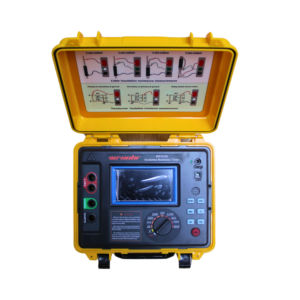
Click the image to know more about Wrindu IR Tester.
What Is a Dielectric Dissipation Factor Tester?
A dielectric dissipation factor tester is a specialized device that evaluates insulation quality in electrical systems like transformers, cables, and bushings. It works by measuring capacitance and tan delta (dielectric loss).
Modern testers, such as those from Wrindu, use variable frequency power supplies and digital filtering to provide highly accurate readings, even in environments with heavy electromagnetic interference.
How Does a Dielectric Dissipation Factor Tester Work?
The tester applies an AC voltage to the insulation material. It then uses an internal bridge circuit to measure the resulting currents.
By analyzing these currents, the device calculates the loss angle, known as tan delta. Healthy insulation typically yields a very low tan delta reading (under 0.01%). A higher reading indicates problems like moisture, aging, or internal defects.
What Key Parameters Do These Testers Measure?
To give a complete picture of insulation health, these diagnostic devices measure several critical parameters:
-
Tan delta (Dielectric Loss): Detects early insulation degradation.
-
Capacitance ($C_x$): Determines the sizing and structural integrity of the sample.
-
Voltage and Current: Simulates operational stress up to 10kV and 5A.
-
Phase Angle and CVT Ratio: Provides comprehensive data for advanced analysis.
Why Is Accurate Tan delta Measurement Critical?
Accurate measurement allows maintenance teams to find early signs of contamination, voids, or moisture before a catastrophic failure happens. Industrial plants and utility companies rely on these steady trends and “tip-up” tests to safely manage their high-voltage assets, extend equipment life, and optimize maintenance schedules.
Which Features Make a Dissipation Factor Tester Reliable?
When selecting a tester for field use or laboratory diagnostics, look for these essential features:
-
Strong Anti-Interference: The ability to bypass up to 200% electromagnetic noise ensures accurate readings in crowded substations.
-
Safety Protections: Features like grounding detection, slow voltage ramp-up, and over-current protection protect both the operator and the machinery.
-
Data Portability: Look for built-in printers, LCD screens, and USB or RS232 ports to easily export data for trend analysis.
Frequently Asked Questions (FAQs)
What accuracy should a tan delta tester have?
For reliable insulation assessments, a high-quality tester should offer an accuracy of $\pm$(1% reading + 0.0004).
How often should high-voltage insulation be tested?
Critical assets should be tested annually, or according to your specific preventive maintenance schedule, to monitor health trends effectively.
Can these testers handle strong substation interference?
Yes, advanced models equipped with digital filtering and frequency conversion can successfully handle up to 200% electromagnetic interference.
What is a tan delta tip-up test?
A tip-up test measures how dielectric loss changes as the voltage increases. A significant increase in tan delta at higher voltages indicates serious insulation defects or voids.
