

What Are the Key Factors for Achieving Reliable Micro-Ohm Measurement Accuracy?
Explore micro-ohmmeter testing principles, calibration traceability, Kelvin connections, test current selection, and best practices for reliable transformer and circuit breaker resistance measurement.
Accurate micro-ohm testing requires more than selecting an instrument with a high accuracy rating. Engineers must consider the complete measurement system, including the test method, environmental conditions, calibration status, and equipment setup.
For industrial applications such as transformer manufacturing, substation maintenance, and circuit breaker inspection, reliable measurement depends on:
- Correct test current selection
- Proper four-wire Kelvin connection
- Regular calibration
- Temperature compensation
- Stable testing procedures
A high-quality micro-ohmmeter combined with correct testing practices ensures that resistance data can be trusted for:
- Equipment acceptance testing
- Preventive maintenance
- Failure diagnosis
- International compliance reports
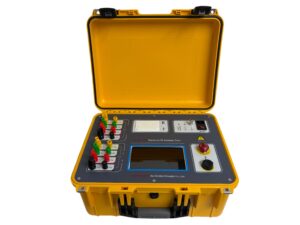
Click the image to know more about Transformer DC Resistance Tester.
Why Is Calibration Traceability Important for Micro-Ohm Testing?
Calibration traceability ensures that measurement results can be linked back to recognized national or international standards.
A traceable calibration process creates a documented chain from:
Primary resistance standards → Laboratory references → Industrial testing instruments
This process confirms that the micro-ohmmeter measurement results are accurate and legally acceptable.
For manufacturers and power utilities, traceability is important because test reports may be reviewed during:
- Customer inspections
- Government audits
- Equipment certification
- Warranty evaluations
Without a valid calibration certificate, even an advanced micro-ohmmeter cannot provide strong evidence of measurement reliability.
Regular calibration also helps detect:
- Component aging
- Internal circuit drift
- Accuracy changes caused by long-term use
Most industrial micro-ohmmeters should be calibrated every 12 months. Instruments used in harsh environments may require more frequent calibration.
What Is the Difference Between Accuracy and Resolution in Micro-Ohmmeters?
Accuracy and resolution are often confused, but they represent different performance characteristics.
Resolution
Resolution refers to the smallest change that the instrument display can show.
For example:
A display resolution of 0.01 μΩ means the instrument can display very small resistance changes.
Accuracy
Accuracy describes how close the measured value is to the actual resistance value.
An instrument may have:
- High resolution
- Low measurement accuracy
Therefore, a micro-ohmmeter with many decimal places does not always provide more reliable results.
For professional resistance testing, both resolution and accuracy must be considered.
Why Should Engineers Look Beyond a “0.2% Accuracy” Specification?
Many manufacturers advertise accuracy values such as ±0.2%, but this number alone does not represent the complete measurement error.
The actual uncertainty may also include:
- Percentage of full-scale range error
- Temperature influence
- Thermal EMF effects
- Environmental interference
For extremely small resistance measurements, range error can become significant.
For example, measuring a 10 μΩ contact on an oversized measurement range may create much larger uncertainty than expected.
Therefore, engineers should always review:
- Full accuracy formula
- Measurement range
- Temperature coefficient
- Calibration conditions
before selecting a micro-ohmmeter.
How Can Engineers Improve Micro-Ohmmeter Measurement Reliability?
To achieve stable and repeatable results, follow these best practices:
Prepare the Test Surface
Before testing:
- Remove oxidation
- Clean contact points
- Ensure stable mechanical connections
Poor contact preparation is one of the most common causes of inaccurate readings.
Use Four-Wire Kelvin Connections
Always separate:
- Current supply cables
- Voltage sensing cables
This prevents cable resistance from affecting the measurement.
Allow Measurement Stabilization
Transformer windings have inductive characteristics.
Engineers should wait until:
- Test current becomes stable
- Resistance readings stop changing
- Magnetic conditions reach equilibrium
before recording results.
Record Environmental Conditions
Important information includes:
- Ambient temperature
- Equipment temperature
- Test current
- Test duration
- Calibration date
Complete records make future comparisons more reliable.
How Does Wrindu Improve Micro-Ohmmeter Measurement Performance?
Wrindu develops micro-ohm testing equipment for transformer manufacturers, power utilities, and industrial users.
The design focuses on:
- High-current DC output
- Stable measurement circuits
- Four-wire Kelvin testing technology
- Automatic data recording
- Temperature compensation functions
- Field-friendly operation
Wrindu micro-ohmmeters are suitable for:
- Transformer winding resistance testing
- Circuit breaker contact resistance testing
- Busbar connection inspection
- Factory quality control
By combining accurate hardware with practical testing functions, these instruments help engineers obtain reliable low-resistance measurements in both factory and field environments.
Frequently Asked Questions About Micro-Ohmmeter Accuracy Testing
What causes inaccurate readings when using a micro-ohmmeter?
Common causes include:
- Dirty test connections
- Incorrect cable connection
- Temperature changes
- Thermal EMF interference
- Poor instrument calibration
- Incorrect test range selection
Proper setup and regular calibration can significantly improve accuracy.
Why is a four-wire Kelvin connection required for low resistance measurement?
A four-wire Kelvin connection removes the resistance effect of test cables and contact points.
In low-resistance testing, cable resistance may be much higher than the measured value. The Kelvin method allows the instrument to measure only the resistance of the tested component.
How often should a micro-ohmmeter be calibrated for industrial use?
Most industrial applications recommend calibration once every 12 months.
More frequent calibration may be required for equipment used in:
- Outdoor substations
- High-temperature environments
- Continuous production lines
- Heavy vibration conditions
Can temperature affect transformer winding resistance measurements?
Yes.
Transformer winding resistance changes with conductor temperature. Higher temperatures increase copper and aluminum resistance.
For accurate comparison, test results should be corrected to a standard reference temperature.
Does using a higher test current make resistance measurements more accurate?
Not always.
Higher current improves signal strength and reduces electrical noise, but excessive current can create heating effects that change the resistance value.
The best practice is to select a suitable current based on the equipment type and resistance range.
What test current is recommended for circuit breaker contact resistance testing?
Circuit breaker contact testing usually requires higher current because the contact resistance is extremely low.
Typical testing currents are:
- 50A
- 100A
- 200A
High current provides better measurement stability for micro-ohm-level contacts.
Can a micro-ohmmeter detect transformer winding problems?
Yes.
Winding resistance testing can help identify:
- Loose internal connections
- Tap changer problems
- Poor contact points
- Winding imbalance
- Manufacturing defects
However, it should be combined with other diagnostic methods such as:
- Transformer turns ratio testing
- Dissolved gas analysis (DGA)
- Insulation testing
for complete transformer condition evaluation.
Why are traceable calibration certificates important for export equipment testing?
International customers and utilities often require proof that test data is reliable.
A traceable calibration certificate shows that the instrument accuracy can be linked to recognized measurement standards, improving confidence during:
- Factory acceptance tests
- International projects
- Quality audits
Conclusion: How to Achieve Accurate Micro-Ohm Resistance Testing?
A micro-ohmmeter’s accuracy depends on much more than the specification printed on the instrument label.
Reliable low-resistance measurement requires:
- Correct testing methods
- Proper Kelvin connections
- Suitable test current
- Temperature compensation
- Regular calibration
- Complete measurement records
For transformer manufacturers, OEM suppliers, and power companies, accurate micro-ohm testing helps detect hidden connection problems, improve product quality, and prevent unexpected electrical failures.
By choosing professional testing equipment and following standardized procedures, engineers can achieve reliable, repeatable, and internationally accepted resistance measurement results.
