

How Does a Self-Excited Generator Work
Learn how a self-excited generator works, including its working principle, voltage build-up process, types (shunt, series, compound), advantages, and applications in power systems.
A self-excited generator is one of the most widely used types of DC generators in industrial and small-scale power systems. It is valued for its simple design, low cost, and ability to generate electricity without an external power source for excitation.
This article explains the working principle of a self-excited generator in a clear and practical way, helping you understand how voltage is built up and maintained.
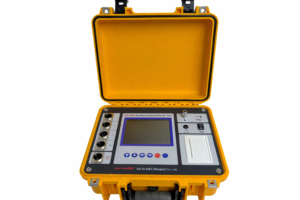
Click the image to know more about Three Phase Capacitance and Inductance Tester.
What Is a Self-Excited Generator?
A self-excited generator is a DC generator that uses its own generated voltage to supply current to the field winding.
Unlike separately excited generators, it does not require an external DC source. Instead, it relies on residual magnetism inside the generator to start the voltage generation process.
Self Excited Generator Working Principle
The working principle is based on electromagnetic induction. When the armature rotates inside a magnetic field, voltage is induced.
E \propto \Phi N
Where:
- E = generated voltage
- Φ = magnetic flux
- N = speed of rotation
In a self-excited generator, the magnetic flux (Φ) is not supplied externally. It is built internally through a feedback process.
Step-by-Step: How Voltage Builds Up
1. Residual Magnetism Starts the Process
Even when the generator is off, a small amount of magnetism remains in the poles. This is called residual magnetism.
When the generator starts rotating:
- A small voltage is induced in the armature.
2. Field Current Begins to Flow
This small voltage is fed back into the field winding.
- The field winding current increases
- Magnetic flux becomes stronger
3. Positive Feedback Effect
As flux increases:
- The generated voltage increases
- More current flows into the field winding
This creates a self-reinforcing loop.
4. Voltage Reaches Stable Level
The voltage continues to rise until:
- Magnetic saturation occurs, or
- Circuit resistance limits the current
At this point, the generator reaches its rated voltage output.
Why Residual Magnetism Is Important
Without residual magnetism, the generator cannot start building voltage.
If residual magnetism is lost, the generator will:
- Fail to generate voltage
- Require field flashing (external DC supply) to restore magnetism
Types of Self-Excited Generators
Self-excited generators are classified based on how the field winding is connected.
1. Shunt Generator
- Field winding connected in parallel with the armature
- Provides relatively stable voltage
Applications:
- Battery charging
- Lighting systems
- Small power supplies
2. Series Generator
- Field winding connected in series with the load
- Field current equals load current
Characteristics:
- Voltage increases with load
- High starting torque
Applications:
- Special industrial uses
- Boosting voltage in feeders
3. Compound Generator
- Combination of series + shunt winding
- Can be:
- Cumulative compound
- Differential compound
Advantages:
- Better voltage regulation
- Suitable for varying loads
Key Factors Affecting Performance
Several factors influence how well a self-excited generator works:
1. Speed of Rotation
Higher speed → higher voltage
2. Field Resistance
If resistance is too high, voltage may not build up
3. Load Conditions
Heavy loads can reduce voltage due to:
- Armature reaction
- Voltage drop
4. Residual Magnetism Strength
Weak magnetism → slow or failed voltage buildup
Advantages of Self-Excited Generators
- No external excitation source needed
- Simple design and wiring
- Lower cost
- Easy maintenance
Disadvantages
- Voltage stability is limited
- Depends on residual magnetism
- Poor performance under heavy load
- Difficult to control voltage precisely
Practical Applications
Self-excited generators are widely used in:
- Portable diesel generators
- Small hydroelectric systems
- Wind power systems
- Welding equipment
- Off-grid power supply
They are ideal where simplicity and cost are more important than precision.
Testing and Maintenance Tips
To ensure reliable operation:
Check Residual Magnetism
- Use open-circuit test
- Re-magnetize if needed
Measure Field Resistance
- Detect open or short circuits
Perform Load Testing
- Verify voltage stability
Inspect Brushes and Commutator
- Prevent sparking and wear
Using professional testing tools can greatly improve accuracy and safety during maintenance.
Conclusion
A self-excited generator works by using its own output to build and sustain the magnetic field needed for voltage generation. This process depends on residual magnetism and a positive feedback loop between the armature and field winding.
While it is simple and cost-effective, its limitations in voltage control make it less suitable for precision applications.
Understanding its working principle helps engineers choose the right generator and maintain stable performance in real-world systems.
