

What Is a CT Analyzer and How Does It Test Current Transformers?
Learn what a CT analyzer is, how it tests current transformers, and why CT ratio, polarity, excitation, knee point, resistance, and burden tests are important.
Why Is a CT Analyzer Important for Power System Testing?
Current transformers (CTs) play an important role in power systems. They reduce high primary current into a lower secondary current signal. This signal allows protection relays, meters, and control systems to monitor electrical equipment safely.
However, CT performance can change because of aging, incorrect installation, insulation problems, or operating conditions. If a CT provides inaccurate signals, protection and measurement systems may not work correctly.
A CT analyzer helps engineers check CT performance by measuring key electrical characteristics. It can test ratio, polarity, excitation performance, knee point, winding resistance, burden, and other important parameters.
Therefore, CT analyzers are widely used in:
- Power substations
- Electrical utilities
- Switchgear manufacturers
- Testing companies
- Maintenance teams
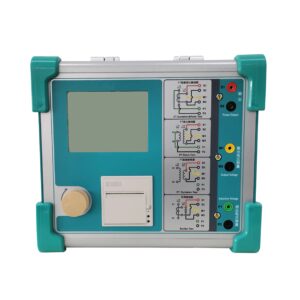
Click the image to know more about Wrindu CT and PT Analyzer.
What Is a CT Analyzer?
A CT analyzer is a multifunctional testing instrument designed to evaluate the performance of current transformers.
Unlike traditional testing methods that may require several separate instruments, a modern CT analyzer combines multiple test functions into one device.
A CT analyzer can automatically:
- Apply test signals
- Measure electrical parameters
- Calculate test results
- Store testing data
- Generate reports
This makes CT testing faster and easier, especially during field maintenance and commissioning.
How Does a Current Transformer Work?
Before understanding CT analyzer testing, engineers should understand the basic working principle of a CT.
A current transformer has:
- Primary winding
- Secondary winding
- Magnetic core
The primary side connects to the high-current power circuit. The secondary side connects to measuring devices or protection equipment.
The CT converts a high current into a smaller standard current, such as:
- 5 A
- 1 A
For example, a CT with a ratio of 1000/5 A should convert 1000 A primary current into 5 A secondary current.
If the actual output differs from the expected value, connected equipment may receive incorrect information.
Why Do Engineers Need CT Analyzer Testing?
CT testing helps confirm whether the transformer operates according to its design requirements.
A CT analyzer can help identify:
- Incorrect transformation ratio
- Wrong terminal polarity
- Core saturation problems
- Abnormal excitation characteristics
- High secondary resistance
- Excessive secondary burden
- Measurement errors
Regular testing is useful during:
- Factory inspection
- Equipment commissioning
- Preventive maintenance
- Troubleshooting
- Periodic substation testing
What Tests Can a CT Analyzer Perform?
Modern CT analyzers support several important tests.
| CT Test Item | Main Purpose |
|---|---|
| CT ratio test | Checks transformation accuracy |
| Polarity test | Confirms correct terminal connection |
| Excitation test | Evaluates CT core characteristics |
| Knee point test | Identifies CT saturation point |
| Secondary resistance test | Checks winding condition |
| Burden test | Measures secondary circuit load |
| Ratio error test | Evaluates measurement accuracy |
| Phase displacement test | Checks phase accuracy |
Each test provides different information about CT performance.
How Does a CT Analyzer Perform Ratio Testing?
What Is CT Ratio Testing?
CT ratio testing checks whether the actual transformation ratio matches the rated ratio.
For example, a CT rated at 1000/5 A should provide a secondary current that matches the expected value.
The analyzer compares the measured result with the specified ratio.
Why Is CT Ratio Testing Important?
An incorrect ratio can affect:
- Energy measurement accuracy
- Protection relay operation
- Fault current calculation
Therefore, engineers should verify CT ratio during installation and maintenance.
What Can Cause CT Ratio Errors?
Common causes include:
- Incorrect CT information
- Wiring mistakes
- Internal winding problems
- Transformer aging
A CT analyzer can help engineers find these issues quickly.
How Does CT Polarity Testing Work?
What Is CT Polarity?
Polarity describes the relationship between CT primary and secondary terminals.
Correct polarity ensures that current direction information remains accurate.
Why Is CT Polarity Testing Necessary?
Incorrect polarity may cause:
- Wrong relay operation
- Incorrect measurement direction
- Protection system errors
Therefore, polarity testing is an important step during CT commissioning.
How Does CT Excitation Testing Evaluate Transformer Performance?
What Is CT Excitation Testing?
CT excitation testing checks how the CT core responds when voltage increases on the secondary side.
During the test, the analyzer applies voltage and measures excitation current.
The result creates an excitation curve.
Why Is Excitation Testing Important?
The excitation curve helps engineers understand:
- Core magnetic performance
- Saturation behavior
- Abnormal CT conditions
This test is especially important for protection CTs because saturation can affect relay performance.
What Is CT Knee Point Testing?
What Does CT Knee Point Mean?
The CT knee point is the point where a small voltage increase causes a large increase in excitation current.
This point shows when the CT core begins to enter strong saturation.
Why Is Knee Point Testing Important?
When a protection CT saturates too early, it may not provide the correct fault current signal to protection relays.
Therefore, knee point testing helps engineers evaluate whether the CT can support reliable protection operation.
The Wrindu RDHG-E Variable Frequency Transformer Comprehensive Tester supports CT knee point testing up to 30 kV.
Why Should Engineers Measure CT Secondary Resistance?
Secondary resistance affects CT performance.
High resistance may increase voltage requirements and influence measurement accuracy.
CT resistance testing helps engineers check:
- Secondary winding condition
- Connection quality
- Circuit problems
The Wrindu RDHG-E supports resistance measurement from 0–300 Ω.
What Is CT Burden Testing?
What Does CT Burden Mean?
CT burden refers to the total load connected to the CT secondary circuit.
The burden includes:
- Protection relays
- Measuring instruments
- Secondary cables
- Other connected devices
Why Is CT Burden Testing Important?
If the burden becomes too high, the CT may not maintain accurate performance.
Burden testing helps engineers confirm whether the secondary circuit load stays within acceptable limits.
The Wrindu RDHG-E supports AC burden measurement from 0–300 VA.
How Does a Modern CT Analyzer Work?
Modern CT analyzers use digital technology to simplify testing.
For example, the Wrindu RDHG-E Variable Frequency Transformer Comprehensive Tester uses DSP and FPGA technology to control the testing process.
The general testing process includes:
Step 1: Set Test Parameters
Engineers enter:
- CT information
- Test type
- Required conditions
Step 2: Apply Test Signal
The analyzer generates the required test signal.
Step 3: Measure Electrical Data
The system collects:
- Voltage
- Current
- Resistance
- Phase information
Step 4: Calculate Results
The analyzer automatically calculates CT characteristics.
Step 5: Store and Export Data
Engineers can save results and create reports for future reference.
This automatic process reduces manual calculation work and improves testing efficiency.
What Types of CTs Can a CT Analyzer Test?
A suitable CT analyzer can support different CT applications.
Common examples include:
Protection CTs
Used in relay protection systems.
Testing focuses on:
- Excitation performance
- Knee point voltage
- Saturation characteristics
Measurement CTs
Used for current measurement.
Testing focuses on:
- Ratio accuracy
- Phase displacement
- Measurement performance
Toroidal CTs
Ring-shaped CTs used in various electrical systems.
Bar-Type CTs
Commonly installed in switchgear and power equipment.
The actual testing capability depends on the analyzer model and measurement range.
What Is the Difference Between a CT Analyzer and a CT Tester?
A CT tester usually refers to equipment that performs specific CT tests.
A CT analyzer normally provides more advanced functions.
| Item | CT Tester | CT Analyzer |
|---|---|---|
| Ratio testing | Usually available | Available |
| Polarity testing | Usually available | Available |
| Excitation testing | Limited | Available |
| Knee point testing | Some models | Available |
| Automatic calculation | Limited | Available |
| Data storage | Limited | Common feature |
For professional testing teams, a multifunctional CT analyzer can reduce the need for multiple instruments.
How to Choose a CT Analyzer?
Engineers should consider several factors before purchasing.
Does the Analyzer Support Required Tests?
First, confirm whether the equipment supports:
- Ratio testing
- Polarity testing
- Excitation testing
- Knee point testing
- Resistance testing
- Burden testing
Different projects may require different test functions.
Does the Measurement Range Match Your CT?
Important specifications include:
- Ratio range
- Resistance range
- Knee point voltage range
- Burden range
For example, the RDHG-E supports:
- CT ratio range: 1–10000
- Resistance range: 0–300 Ω
- Knee point testing: up to 30 kV
Engineers should compare these values with actual CT requirements.
Is Test Accuracy Reliable?
Accuracy directly affects the value of test results.
Important specifications include:
- Voltage accuracy
- Ratio accuracy
- Resistance accuracy
- Phase measurement accuracy
The RDHG-E provides:
- Voltage accuracy: ±0.1%
- CT ratio accuracy: ±0.2%
Is the Equipment Suitable for Field Testing?
Substation testing often requires portable equipment.
Engineers should check:
- Weight
- Size
- Power supply
- Operating temperature
- Data management functions
A portable CT analyzer can improve work efficiency in different testing locations.
What Are the Main Specifications of Wrindu RDHG-E CT Analyzer?
| Parameter | Specification |
|---|---|
| Test Object | CT |
| Output | 0–180 Vrms, 12 Arms, 36 A peak |
| Voltage Accuracy | ±0.1% |
| CT Ratio Range | 1–10000 |
| CT Ratio Accuracy | ±0.2% |
| Resistance Range | 0–300 Ω |
| AC Burden Range | 0–300 VA |
| Knee Point Test | Up to 30 kV |
| Phase Accuracy | ±3 minutes |
| Data Storage | 1000 groups |
| Power Supply | AC 220 V ±10%, 50 Hz |
| Working Temperature | -10°C to 50°C |
The RDHG-E also supports automatic testing, USB data transfer, report generation, and built-in printing functions.
Where Are CT Analyzers Used?
CT analyzers are widely used in different power applications.
Substation Maintenance
Engineers use CT analyzers to check transformer performance during maintenance.
Protection System Testing
CT testing helps confirm that protection relays receive accurate current signals.
Switchgear Inspection
CT analyzers can test CTs installed inside switchgear systems.
Transformer Manufacturing
Manufacturers use CT analyzers for quality inspection before delivery.
CT Analyzer FAQs
What is a CT analyzer used for?
A CT analyzer tests current transformer performance, including ratio, polarity, excitation, knee point, resistance, burden, and accuracy.
Why do we test current transformers?
CT testing helps confirm measurement accuracy and protection reliability.
What is the purpose of CT knee point testing?
Knee point testing checks CT saturation characteristics and protection performance.
Can a CT analyzer test protection CTs?
Yes. Many CT analyzers support protection CT testing, including excitation and knee point tests.
What is the difference between a CT tester and CT analyzer?
A CT analyzer usually provides more functions, automatic calculation, and data management compared with a basic CT tester.
How often should CT testing be performed?
The testing frequency depends on equipment condition, industry requirements, and maintenance plans.
What CT parameters should be tested during commissioning?
Common tests include ratio, polarity, excitation, knee point, resistance, and burden testing.
Can CT analyzers be used in substations?
Yes. Portable CT analyzers are commonly used for substation commissioning and maintenance.
