

What Is an Acceptable THD Level in a Power System?
Learn what an acceptable THD level is, how voltage and current THD differ, and how IEEE 519 helps evaluate harmonic distortion in power systems.
Total Harmonic Distortion (THD) is an important indicator of power quality. It shows how much harmonic distortion exists in a voltage or current waveform compared with its fundamental component.
A high THD level can increase equipment heating, cause measurement errors, affect motor performance, and reduce the reliability of electrical systems. However, there is no single THD limit for every power system. Acceptable values depend on the measurement point, system voltage, load conditions, and applicable standards.
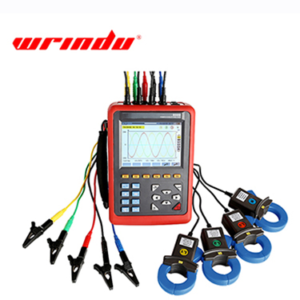
Click the image to know more about Wrindu Power Quality Analyzer.
What Is an Acceptable THD Level?
An acceptable THD level depends on whether you measure voltage or current.
Voltage THD (THD-V) describes distortion in the supply voltage. Current THD (THD-I) describes harmonic distortion in the current drawn by electrical loads.
In general, voltage THD is often used to evaluate the quality of the power supply, while current distortion helps identify harmonic emissions from connected equipment.
A low THD value usually indicates a waveform closer to a pure sine wave. A high value suggests stronger harmonic distortion, but engineers should always compare the measurement with the applicable standard and operating conditions.
What Is the Difference Between Voltage THD and Current THD?
Voltage THD and current THD measure different aspects of power quality.
| Measurement | What It Shows | Common Causes |
|---|---|---|
| Voltage THD | Distortion in the supply voltage waveform | Harmonic voltage drops across system impedance, nonlinear loads |
| Current THD | Distortion in the load current waveform | VFDs, rectifiers, UPS systems, switching power supplies |
A facility may have high current THD but relatively low voltage THD if the power supply system is strong and has low impedance.
On the other hand, harmonic currents flowing through system impedance can create voltage distortion. This can affect other equipment connected to the same electrical network.
Which Standards Define Harmonic Distortion Limits?
IEEE 519 is a widely used standard for controlling harmonic distortion in power systems. It provides recommended limits for voltage distortion and current distortion at the Point of Common Coupling (PCC).
The PCC is the point where a facility’s electrical system connects to the wider power supply network.
IEEE 519 treats voltage distortion and current distortion separately. Its current distortion limits depend on factors such as system voltage and the ratio of available short-circuit current to maximum demand load current.
IEC standards also address power quality and harmonic measurement. For example, IEC 61000-4-7 describes measurement methods for harmonics and interharmonics, while IEC 61000-4-30 addresses power quality measurement methods.
These standards serve different purposes. A measurement instrument’s ability to display THD does not automatically mean that its readings alone are sufficient to verify compliance with every standard.
Why Does THD Need to Be Evaluated at the PCC?
The Point of Common Coupling is important because harmonic distortion at this point can affect both the facility and the wider power network.
A single machine may produce considerable harmonic current, but the resulting voltage distortion depends on the electrical system’s impedance and other connected loads.
For this reason, engineers should not judge system compliance using measurements from an arbitrary point inside a facility.
A practical assessment should identify:
- The correct PCC measurement location
- The system voltage level
- The applicable voltage distortion limits
- The relevant current distortion limits
- The load conditions during measurement
- The measurement period and required statistical values
This approach provides a more reliable basis for evaluating harmonic performance.
What Problems Can High THD Cause?
High harmonic distortion can affect electrical equipment in several ways.
| Equipment or System | Possible Effects of High Harmonic Distortion |
|---|---|
| Transformers | Additional heating and increased losses |
| Electric motors | Extra heating, vibration, and reduced efficiency |
| Capacitor banks | Higher harmonic current and possible resonance |
| Circuit breakers | Unexpected operation under certain conditions |
| Power cables | Increased current and temperature |
| Measurement instruments | Incorrect readings if the instrument cannot handle distorted waveforms |
The actual impact depends on the harmonic spectrum, equipment design, operating conditions, and system impedance. THD alone cannot identify every possible fault.
How Can Engineers Reduce THD in Electrical Systems?
Engineers should identify the main harmonic sources before selecting a correction method.
Common solutions include:
1. Install harmonic filters
Passive or active harmonic filters can reduce selected harmonic components. The filter type should match the harmonic spectrum and system requirements.
2. Use low-harmonic drives
Low-harmonic variable frequency drives can reduce harmonic current generated by motor control systems.
3. Check capacitor bank conditions
Capacitor banks can interact with system inductance and create resonance. Engineers should assess the system before adding or changing capacitors.
4. Distribute nonlinear loads
Separating large nonlinear loads across different feeders may help reduce their combined impact on individual circuits.
5. Monitor power quality regularly
Repeated measurements help engineers identify changes in THD and evaluate whether corrective actions are effective.
How Can a Power Quality Analyzer Help Evaluate THD?
A power quality analyzer measures voltage and current waveforms and calculates harmonic distortion. It helps engineers identify abnormal harmonic levels and compare measurements before and after corrective actions.
The Wrindu RDCR5000 Digital Power Quality Analyzer supports:
- Four voltage and four current measurement channels
- Harmonic measurement up to the 50th order
- Voltage and current THD measurement
- Three-phase voltage and current imbalance measurement
- Transient waveform capture
- Flicker measurement
- Data recording and alarm logging
These functions help engineers assess harmonic conditions in three-phase electrical systems and monitor changes over time.
However, a THD reading alone does not establish compliance with IEEE 519. Compliance assessment may require additional parameters, measurement locations, demand-current references, and statistical evaluation.
Click the picture to learn more about the Wrindu RDCR5000 Digital Power Quality Analyzer.
Frequently Asked Questions About THD Limits
Is 5% THD considered high?
A 5% THD reading cannot be judged without knowing whether it refers to voltage or current. Engineers should compare voltage THD with the applicable voltage distortion limit and evaluate current distortion using the correct standard and measurement conditions.
Is voltage THD more important than current THD?
Neither measurement is universally more important. Voltage THD helps evaluate the quality of the supply voltage, while current THD helps identify harmonic currents produced by connected loads. Both provide useful information for power quality analysis.
Does high current THD always mean poor voltage quality?
No. A system may have high current THD but low voltage THD when its supply network has low impedance and sufficient capacity. The relationship depends on the system’s electrical characteristics.
Can a power quality analyzer measure THD?
Yes. A suitable power quality analyzer can measure voltage and current harmonics and calculate their THD values. Engineers should check the instrument’s measurement range, harmonic order, accuracy, and applicable measurement standards before selecting a device.
Conclusion
Acceptable THD levels depend on the type of measurement, system conditions, and applicable power quality standards. Engineers should evaluate voltage and current distortion separately and use the correct measurement point when checking system performance.
A power quality analyzer helps identify harmonic distortion, record changes, and evaluate the results of corrective actions. Regular monitoring can help maintain stable electrical operation and reduce harmonic-related risks.
