

Power Quality Analyzer: Working Principle, Functions, Applications, and Selection Guide
Learn how a power quality analyzer works, what it measures, common power quality problems, testing procedures, and how to select the right instrument.
A power quality analyzer is used to measure and monitor the electrical conditions of a power system. It helps engineers identify problems such as voltage fluctuations, harmonic distortion, frequency changes, and three-phase imbalance.
Unlike a standard multimeter, a power quality analyzer can measure multiple electrical parameters at the same time, display waveforms, and record changes over a long period. This makes it useful for troubleshooting, electrical maintenance, and power system testing.
This guide covers the main functions of a power quality analyzer, the parameters it measures, its applications, and how to choose the right instrument.
What Is a Power Quality Analyzer?
A power quality analyzer is an electrical testing instrument used to check the quality and stability of power supply.
It measures voltage, current, frequency, power, power factor, and harmonics. Some models can also record voltage transients, flicker, starting current, and changes in electrical parameters over time.
Engineers use these measurements to check whether a power system operates normally and to find problems that may affect electrical equipment.
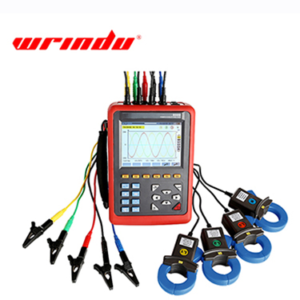
Click the image to know more about Wrindu Power Quality Analyzer.
How Does a Power Quality Analyzer Work?
A power quality analyzer collects voltage and current signals through test leads and current clamps. It then converts these signals into digital data for calculation and analysis.
The basic working process includes:
- Signal collection: Voltage leads and current clamps collect electrical signals from the tested circuit.
- Data sampling: Internal circuits sample the signals and convert them into digital data.
- Data processing: The processor calculates voltage, current, power, harmonics, and other parameters.
- Result display: The instrument displays readings, waveforms, harmonic charts, and trend curves.
- Data recording: The analyzer stores test results for later review and comparison.
Some advanced models can also capture short-duration waveform changes and generate alarms when measured values exceed preset limits.
What Does a Power Quality Analyzer Measure?
A power quality analyzer measures several electrical parameters to help engineers evaluate power system conditions.
1. Voltage and Current
Voltage and current are the basic measurements in power quality testing.
The analyzer can measure phase voltage, line voltage, and current in different phases. These readings help identify:
- Overvoltage and undervoltage
- Voltage fluctuations
- Current overload
- Phase imbalance
- Abnormal neutral current
2. Frequency
Frequency refers to the number of AC cycles per second. Most power systems use 50 Hz or 60 Hz.
Frequency measurement helps engineers check whether the power supply remains stable and identify abnormal changes in the electrical system.
3. Active, Reactive, and Apparent Power
A power quality analyzer measures three types of electrical power.
| Parameter | Symbol | Meaning |
|---|---|---|
| Active Power | W | Power used to perform useful work |
| Reactive Power | Var | Power exchanged by inductive and capacitive loads |
| Apparent Power | VA | Total power supplied to the load |
These values help engineers evaluate electrical loads and power consumption.
4. Power Factor
Power factor (PF) shows the relationship between active power and apparent power.
A low power factor means that more current is needed to deliver the same active power. This can increase cable losses and place additional demands on transformers and other electrical equipment.
Some analyzers also measure displacement power factor (DPF), which describes the phase relationship between the fundamental voltage and current.
5. Harmonics and THD
Harmonics are unwanted frequency components in voltage or current waveforms. They are commonly produced by nonlinear loads, including:
- Variable frequency drives
- Welding machines
- Switching power supplies
- LED lighting
- Industrial rectifiers
High harmonic levels can cause transformer heating, motor losses, cable overheating, and equipment malfunction.
Total harmonic distortion (THD) indicates the overall harmonic distortion relative to the fundamental component. A power quality analyzer can display individual harmonic components and THD values for each phase.
6. Three-Phase Imbalance
Three-phase imbalance occurs when the voltage or current values of the three phases are unequal.
It may result from uneven loads, loose connections, or electrical faults. Excessive voltage imbalance can cause additional heating in three-phase motors and reduce their operating efficiency.
7. Voltage Flicker and Transient Events
Voltage flicker refers to repeated changes in voltage that may cause visible lighting fluctuations.
Transient events are short-duration changes in voltage or current. Switching operations, lightning-related disturbances, and sudden load changes are common causes.
A power quality analyzer with waveform capture can record these events for further investigation.
What Are the Common Power Quality Problems?
Different power quality problems have different causes and effects.
| Problem | Common Causes | Possible Effects |
|---|---|---|
| Voltage Sag | Motor starting, short circuits, heavy loads | Equipment shutdown |
| Voltage Swell | Sudden load changes, switching operations | Insulation stress |
| Harmonic Distortion | Nonlinear loads and power converters | Overheating and increased losses |
| Voltage Flicker | Welding machines, fluctuating loads | Lighting fluctuations |
| Frequency Variation | Generation and load imbalance | Unstable equipment operation |
| Three-Phase Imbalance | Uneven phase loading, connection problems | Motor overheating |
| Transient Overvoltage | Lightning and switching events | Damage to sensitive equipment |
A power quality analyzer helps engineers record these problems and determine when they occur.
Where Are Power Quality Analyzers Used?
Power quality analyzers are used in different electrical systems.
Industrial Plants
Factories use motors, drives, welding machines, and automated production equipment. These loads may cause harmonics, voltage fluctuations, and sudden current changes.
Power quality testing helps maintenance teams investigate equipment trips, motor problems, and production interruptions.
Power Utilities and Substations
Utility engineers use power quality analyzers to check voltage stability, current conditions, harmonics, and three-phase imbalance in distribution systems.
They can also use recorded data to investigate power supply complaints.
Commercial Buildings
HVAC systems, elevators, lighting, and electronic equipment are common electrical loads in commercial buildings.
Power quality analysis helps facility managers identify abnormal voltage, harmonic distortion, and power factor problems.
Renewable Energy Systems
Solar inverters and wind power converters can introduce harmonic components into electrical networks.
Power quality analyzers help engineers check voltage and current conditions in grid-connected renewable energy systems.
Electrical Equipment Maintenance
Maintenance teams use these instruments to check starting current, monitor electrical loads, and investigate abnormal operating conditions.
How to Use a Power Quality Analyzer?
The following steps describe a typical three-phase field test.
- Check the instrument: Inspect the analyzer, test leads, current clamps, and battery.
- Select the test mode: Choose the correct three-phase measurement configuration.
- Connect voltage leads: Connect the test leads to the corresponding phase and neutral terminals according to the wiring diagram.
- Install current clamps: Place the clamps around the corresponding phase conductors. Check their direction and phase matching.
- Set recording parameters: Select the required measurements, recording interval, and alarm limits.
- Start testing: Check real-time voltage, current, power, waveforms, and harmonic values.
- Review the results: Analyze trend curves, transient records, and alarm logs.
Safety note: Only qualified personnel should perform measurements on energized circuits. Always follow the instrument’s wiring instructions and applicable electrical safety requirements.
How to Choose a Power Quality Analyzer?
Different applications require different measurement functions. Before purchasing an instrument, consider the following factors.
| Selection Factor | What to Check |
|---|---|
| Measurement Channels | Whether it supports three-phase voltage and current measurement, including neutral current |
| Voltage and Current Range | Whether the measurement range matches the tested system |
| Harmonic Analysis | Whether it measures the required harmonic orders and THD |
| Transient Capture | Whether it can record short-duration voltage and current changes |
| Data Storage | Recording capacity, storage period, and recording interval |
| Display | Whether it shows waveforms, harmonic charts, and phasor diagrams |
| Battery Life | Whether it supports long field testing |
| Safety Rating | Whether the voltage and CAT ratings match the application |
| Portability | Instrument weight, clamp size, and accessory configuration |
For long-term monitoring, data storage and trend recording are important. For fault investigation, waveform capture and alarm functions are more useful.
RDCR5000 Digital Power Quality Analyzer from Wrindu
The RDCR5000 Digital Power Quality Analyzer from Wrindu is designed for three-phase power quality testing and field measurements.
It has four voltage channels and four current channels, allowing simultaneous measurement of three-phase voltage, neutral voltage, phase currents, and neutral current.
Its main functions include:
- Voltage, current, frequency, and power measurement
- PF and DPF measurement
- Harmonic analysis from the 0th to 50th order
- THD measurement
- Three-phase imbalance analysis
- Voltage flicker measurement
- Transient waveform capture
- Starting current recording for up to 100 seconds
- Real-time waveform and phasor diagram display
The instrument supports simultaneous recording of 20 selected parameters at five-second intervals, with a maximum recording period of 300 days under the specified configuration. It also stores up to 150 transient waveform records and 12,800 alarm records.
The RDCR5000 features a 5.6-inch color LCD, a built-in 2 GB memory card, and a rechargeable lithium-ion battery. The host weighs approximately 1.6 kg with the battery.
It is suitable for engineers who need to measure three-phase electrical parameters, investigate power quality problems, and record changes during field testing.
Frequently Asked Questions
What is the difference between a power quality analyzer and a multimeter?
A multimeter mainly measures basic electrical values such as voltage and current. A power quality analyzer provides more detailed measurements, including harmonics, THD, power factor, voltage flicker, and transient events.
Can a power quality analyzer measure harmonics?
Yes. It can measure voltage and current harmonics and calculate THD. The maximum harmonic order depends on the instrument model.
Why is power quality testing important?
Power quality testing helps identify voltage problems, harmonic distortion, and phase imbalance. Early detection can reduce equipment failures, production interruptions, and unnecessary maintenance costs.
How long should power quality monitoring last?
It depends on the problem. A short test may be enough to check an immediate abnormal condition. Intermittent problems may require several days or weeks of continuous recording.
What standards are related to power quality testing?
Common standards include IEC 61000-4-30 for power quality measurement methods, IEC 61000-4-7 for harmonic measurement, and IEC 61000-4-15 for flicker measurement.
Conclusion
A power quality analyzer measures voltage, current, frequency, power, harmonics, and other electrical parameters. It helps engineers identify power supply problems and check the operating conditions of electrical systems.
When selecting an analyzer, pay attention to measurement channels, harmonic analysis, transient capture, data storage, and safety ratings. The right instrument can make electrical troubleshooting and maintenance more efficient.
