

Why Does CT Saturation Affect Power System Protection?
Learn why CT saturation happens, how it affects protection relays, and how CT testing helps engineers check current transformer performance.
What Is CT Saturation in a Power System?
Current transformers (CTs) play an important role in power protection systems. They reduce high current into a smaller signal that protection relays can measure.
However, a CT may enter a saturation condition when the magnetic core cannot follow the increasing current correctly. At this point, the secondary current waveform becomes distorted.
As a result, protection devices may receive incorrect current information.
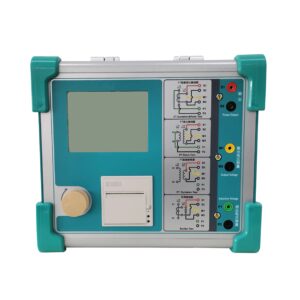
Click the image to know more about Wrindu CT and PT Analyzer.
Why Does CT Saturation Happen?
Several factors can cause CT saturation.
The first reason is a high fault current. During a short circuit, the primary current can increase significantly. Therefore, the CT core may not provide enough magnetic capacity.
Another reason is an insufficient knee point voltage. If the knee point value is too low, the CT may enter saturation earlier during high-current conditions.
In addition, a high secondary burden can increase the voltage requirement of the CT. Therefore, an overloaded secondary circuit may also affect CT performance.
How Does CT Saturation Affect Protection Relays?
Protection relays depend on accurate current signals.
When CT saturation happens, the relay may receive a smaller or distorted current signal. Therefore, the protection system may not operate as expected.
For example, incorrect CT signals may affect:
- Overcurrent protection
- Differential protection
- Distance protection
- Transformer protection
Because of this, engineers need to confirm CT performance before equipment operation.
How Can Engineers Detect CT Saturation Problems?
Engineers can use CT testing equipment to evaluate transformer characteristics.
Important tests include:
- CT excitation test
- Knee point voltage test
- CT ratio test
- Polarity test
- Secondary resistance test
- Burden test
These tests help engineers understand whether the CT can provide reliable signals under different operating conditions.
Why Is CT Knee Point Testing Important?
The knee point shows the point where the CT excitation current increases quickly.
Before the knee point, the CT can usually maintain a stable relationship between voltage and excitation current.
After reaching this point, the CT core begins to saturate.
Therefore, knee point testing helps engineers evaluate whether a protection CT has enough performance margin.
How Does Secondary Burden Influence CT Performance?
The CT secondary circuit includes cables, relays, meters, and other connected equipment.
All these components create a burden on the CT.
If the burden becomes too high, the CT needs a higher secondary voltage to maintain the required current output.
As a result, excessive burden can increase the risk of saturation.
How Can CT Testing Improve Protection Reliability?
Regular CT testing helps engineers identify performance problems before they affect the power system.
By checking CT characteristics during commissioning and maintenance, engineers can confirm that protection equipment receives accurate signals.
Therefore, CT testing is an important part of reliable protection system management.
FAQs About CT Saturation Testing
What causes CT saturation?
CT saturation can happen because of high fault current, low knee point voltage, excessive burden, or unsuitable CT characteristics.
Why is CT knee point voltage important?
Knee point voltage helps engineers understand the CT core performance and saturation behavior.
Can CT saturation cause relay problems?
Yes. CT saturation can create incorrect current signals, which may affect protection relay operation.
Which CT tests can check saturation performance?
Excitation testing and knee point testing are common methods to evaluate CT saturation characteristics.
