

What Are Power Transients and Voltage Spikes in Electrical Systems?
Learn what causes power transients and voltage spikes, how they affect electrical equipment, and how to detect and reduce transient overvoltages.
Power transients are sudden changes in voltage or current that occur over a short period. They can appear as sharp voltage spikes or oscillating waveforms in an electrical system.
Although some transients last only a very short time, they can affect sensitive electronic equipment, damage insulation, and interrupt industrial operations. Identifying their sources and recording abnormal waveforms helps engineers evaluate power quality and reduce equipment risks.
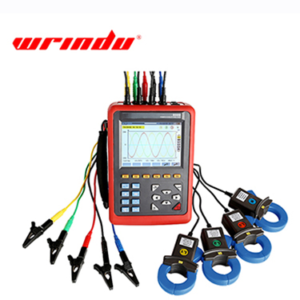
Click the image to know more about Wrindu Power Quality Analyzer.
What Are Power Transients?
A power transient is a short-duration change in voltage or current that differs from the normal steady-state waveform.
Transients usually occur when electrical systems experience sudden switching operations, lightning activity, or fault conditions. Their waveform, magnitude, and duration depend on the source and the characteristics of the electrical network.
There are two common types of power transients:
| Type | Waveform Characteristics | Common Sources |
|---|---|---|
| Impulsive transient | A sudden change in voltage or current in one direction | Lightning strikes, electrostatic discharge |
| Oscillatory transient | A sudden change followed by oscillations above or below the normal waveform | Capacitor switching, switching operations, circuit resonance |
Impulsive transients often appear as sharp spikes. Oscillatory transients contain repeated waveform changes that gradually decrease or vary in amplitude.
What Causes Voltage Spikes in Electrical Systems?
Voltage spikes can originate from external events or switching operations inside a facility.
1. Lightning strikes
Lightning can introduce high-energy transient voltages into power lines, grounding systems, and nearby electrical installations. A direct strike is not required for induced voltage transients to affect connected equipment.
2. Capacitor bank switching
Switching capacitor banks can produce oscillatory transients. The waveform depends on the system configuration, switching conditions, and electrical resonance.
3. Circuit breaker operations
Opening or closing circuit breakers can create transient voltage changes, particularly when switching inductive or capacitive loads.
4. Motor and transformer switching
Switching motors, transformers, and other inductive loads can produce transient overvoltages. The effect depends on the equipment characteristics and switching conditions.
5. Electrical faults
Short circuits and fault clearing can cause sudden changes in system voltage and current. These events may generate transient waveforms during the fault and switching process.
What Is the Difference Between Power Transients, Voltage Spikes, and Surges?
These terms are related, but they do not describe exactly the same thing.
| Term | Meaning | Typical Characteristics |
|---|---|---|
| Power transient | A general short-duration change in voltage or current | Impulsive or oscillatory waveform |
| Voltage spike | A sharp, short-duration increase in voltage | Often describes an impulsive waveform |
| Voltage surge | A temporary increase in voltage | May describe a transient or a longer overvoltage condition, depending on context |
A voltage spike is often a type of transient, while power transient is the broader term.
Engineers should also distinguish transient overvoltage from a voltage swell. A swell is a short-duration increase in RMS voltage, while a transient is a much faster waveform disturbance.
How Do Power Transients Affect Electrical Equipment?
The effects depend on transient magnitude, energy, waveform, equipment insulation, and protection design.
| Equipment | Possible Effects |
|---|---|
| PLC and control systems | Unexpected resets or control interruptions |
| Computers and electronic devices | Data loss or component damage |
| Transformers | Insulation stress |
| Electric motors | Winding insulation stress |
| Variable frequency drives | DC bus overvoltage or protection trips |
| Measurement instruments | Abnormal readings or internal component stress |
| Communication systems | Signal interference or equipment malfunction |
Repeated transient events can also weaken insulation over time. Sensitive electronic equipment may be affected even when larger electrical machines continue operating normally.
How Can Engineers Detect and Measure Power Transients?
A standard multimeter may not capture very short voltage spikes because its display updates too slowly. Engineers need an instrument with suitable waveform recording and transient measurement capabilities.
A practical testing process includes these steps:
Step 1: Identify the measurement location
Choose the electrical panel, feeder, or equipment connection where the disturbance is suspected. Follow the correct safety procedures before connecting the instrument.
Step 2: Connect voltage and current channels
Use suitable measurement leads and current clamps. For three-phase systems, check the relevant phases to determine whether the disturbance affects one phase or multiple phases.
Step 3: Configure waveform recording
Set the available transient recording or trigger functions according to the suspected event. Check the instrument’s sampling capability, trigger conditions, and recording limits.
Step 4: Monitor the electrical system
Record data during normal operation and around switching events. Repeated monitoring may be necessary because some transients occur irregularly.
Step 5: Analyze the recorded waveform
Check the waveform shape, peak voltage, event timing, and affected phases. Compare the results with normal operating conditions and equipment requirements.
Step 6: Identify the source
Review lightning activity, capacitor switching, motor starting, breaker operations, and fault records around the event time.
How Can Engineers Reduce Power Transients?
The protection method depends on the source and the sensitivity of the connected equipment.
| Protection Method | Main Purpose |
|---|---|
| Surge Protective Devices (SPDs) | Limit transient overvoltages and divert surge current |
| Proper grounding and bonding | Provide suitable paths for surge currents |
| Lightning protection systems | Reduce risks from direct and nearby lightning events |
| Switching control | Reduce disturbances caused by switching operations |
| Equipment insulation coordination | Match insulation withstand levels with expected overvoltages |
| Power quality monitoring | Identify recurring events and verify corrective actions |
SPDs should be selected according to the installation category, system voltage, expected surge current, and protection requirements. They should also be installed with suitable grounding and connection arrangements.
A protective device cannot eliminate every type of transient. Engineers should assess the actual waveform and source before selecting a solution.
How Does a Power Quality Analyzer Help Record Transients?
A power quality analyzer helps engineers monitor electrical parameters and investigate abnormal waveform events. Its recording functions can provide useful information about when a disturbance occurs and how the waveform changes.
The Wrindu RDCR5000 Digital Power Quality Analyzer supports:
- Four voltage and four current measurement channels
- Transient waveform capture with storage for up to 150 records
- Starting current measurement with a recording period of up to 100 seconds
- Harmonic measurement up to the 50th order
- Voltage and current THD measurement
- Three-phase imbalance measurement
- Flicker measurement
- Data recording and alarm logging
These functions support power quality investigations in industrial and commercial electrical systems.
The RDCR5000’s transient waveform capture function helps engineers record abnormal waveform events. However, users should confirm the instrument’s transient trigger conditions, sampling rate, measurement range, and capture time before using it for specific fast transient events. Its recording capacity does not mean it can capture every type of high-frequency impulse.
Click the picture to learn more about the Wrindu RDCR5000 Digital Power Quality Analyzer.
What Is the Difference Between a Power Quality Analyzer and an Oscilloscope for Transient Testing?
Both instruments can help engineers examine electrical waveforms, but they serve different testing purposes.
| Comparison | Power Quality Analyzer | Oscilloscope |
|---|---|---|
| Main purpose | Power quality monitoring and analysis | Detailed electrical signal analysis |
| Typical measurements | Voltage, current, power, harmonics, THD, imbalance | Voltage and current waveforms, signal timing, amplitude |
| Long-term monitoring | Usually supports data logging | Depends on the instrument and setup |
| Transient analysis | Depends on transient capture functions | Depends on bandwidth and sampling rate |
| Industrial power analysis | Designed for power system measurements | Requires suitable probes and measurement configuration |
A power quality analyzer is useful for investigating disturbances in electrical power systems over time. An oscilloscope is more suitable when engineers need detailed analysis of fast waveform changes.
For very fast transient events, instrument bandwidth, sampling rate, trigger capability, and probe specifications are critical.
Frequently Asked Questions About Power Transients
Are power transients dangerous?
Yes. High-energy transients can damage electronic components, stress insulation, and interrupt electrical equipment. The actual risk depends on transient magnitude, energy, duration, and equipment protection.
Can a multimeter detect voltage spikes?
A standard multimeter may miss short voltage spikes because it cannot capture every rapid waveform change. A suitable transient recorder, power quality analyzer, or oscilloscope is more appropriate.
Are voltage spikes and voltage sags the same?
No. A voltage spike is a rapid increase in voltage, while a voltage sag is a short-duration decrease in RMS voltage. They have different waveform characteristics and may require different protection methods.
Can a surge protector prevent all power transients?
No. A surge protective device can limit certain transient overvoltages, but its protection depends on its type, rating, installation, and the transient characteristics. It does not replace a complete power quality assessment.
How often should engineers check for power transients?
The monitoring period depends on the frequency of suspected events. For disturbances linked to switching operations, engineers should record waveforms during those operations. For intermittent events, longer monitoring may be necessary.
Conclusion
Power transients and voltage spikes are short-duration disturbances that can affect electrical equipment and insulation. Lightning, switching operations, and electrical faults are common sources.
Engineers can use suitable waveform recording instruments to identify abnormal events, investigate their sources, and evaluate protection measures. Regular power quality monitoring helps reduce the risks associated with transient overvoltages.
