

Transformer Moisture Measurement Using Frequency Domain Dielectric Response Technology
Learn how Frequency Domain Dielectric Response technology measures transformer moisture content and evaluates oil-paper insulation condition. Discover how RDGYB-JD1000 supports accurate transformer moisture diagnosis.
Moisture is one of the most important factors affecting the reliability and service life of power transformers.
Although transformer oil and cellulose insulation are designed to provide excellent electrical insulation, moisture can gradually enter the insulation system through:
- Aging of sealing materials
- Atmospheric humidity
- Oil oxidation
- Internal chemical reactions
- Improper maintenance conditions
Even a small amount of moisture inside paper insulation can significantly reduce dielectric strength and accelerate insulation aging.
For this reason, accurate transformer moisture measurement is essential for condition-based maintenance.
Traditional moisture detection methods often require oil sampling or offline laboratory analysis. However, these methods may not provide complete information about moisture distribution inside solid insulation.
Frequency Domain Dielectric Response (FDS) technology provides an advanced solution by analyzing the dielectric characteristics of transformer insulation across a wide frequency range.
The Wrindu RDGYB-JD1000 Frequency Domain Dielectric Response Insulation Diagnostic Analyzer combines FDS and PDC technologies to evaluate transformer insulation condition, including moisture content, oil conductivity, and insulation aging characteristics.
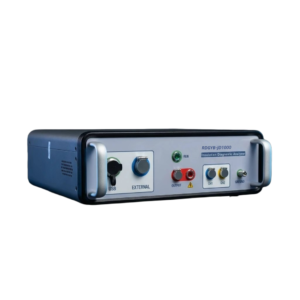
Click the image to know more about Wrindu Frequency Domain Dielectric Response Insulation Diagnostic Analyzer.
Why Is Transformer Moisture Measurement Important?
A transformer insulation system mainly consists of:
- Cellulose paper insulation
- Transformer oil
These two materials work together to provide electrical insulation and mechanical protection.
However, moisture has a negative impact on both components.
Moisture Reduces Insulation Strength
Water molecules increase the conductivity of insulation materials.
As moisture increases:
- Insulation resistance decreases
- Dielectric loss increases
- Breakdown voltage may reduce
This increases the possibility of insulation failure during high-voltage operation.
Moisture Accelerates Paper Insulation Aging
Cellulose paper is highly sensitive to moisture.
High moisture levels accelerate:
- Hydrolysis reactions
- Paper polymer chain breakdown
- Loss of mechanical strength
Once paper insulation becomes severely degraded, transformer life can be significantly reduced.
Moisture Influences Transformer Maintenance Decisions
Accurate moisture information helps engineers decide:
- Whether transformer drying treatment is required
- Whether continued operation is acceptable
- When maintenance should be scheduled
Therefore, reliable moisture measurement is a key part of transformer asset management.
Where Does Moisture Exist Inside a Transformer?
Moisture distribution inside a transformer is not uniform.
It can exist in:
Cellulose Insulation
Paper insulation usually contains the majority of transformer moisture.
During temperature changes, moisture can migrate between oil and paper.
Transformer Oil
Oil contains dissolved moisture that changes depending on:
- Temperature
- Insulation condition
- Operating environment
Because moisture moves between oil and cellulose, measuring only oil moisture does not always represent the actual insulation condition.
What Are Traditional Transformer Moisture Measurement Methods?
Several methods are commonly used for transformer moisture evaluation.
Oil Sampling and Karl Fischer Titration
Karl Fischer titration is a laboratory method used to measure water content in transformer oil.
Advantages:
- High laboratory accuracy
- Direct oil moisture measurement
Limitations:
- Requires oil sampling
- Does not directly evaluate moisture in cellulose insulation
- Results depend on sampling conditions
Insulation Resistance Measurement
Insulation resistance testing is widely used for transformer maintenance.
However, the result can be affected by:
- Temperature
- Humidity
- Surface contamination
It provides general insulation information but cannot accurately determine moisture distribution.
Traditional Tan Delta Testing
Tan delta testing measures dielectric loss at a specific frequency.
It is useful for:
- Insulation quality evaluation
- Detecting abnormal dielectric loss
However, moisture-related problems may require deeper frequency analysis.
How Does FDS Improve Transformer Moisture Measurement?
Frequency Domain Dielectric Response technology evaluates moisture by analyzing how insulation responds to different frequencies.
The basic principle is:
Moisture changes insulation polarization behavior.
When moisture increases, the dielectric response curve changes, especially in the low-frequency region.
FDS analysis evaluates:
- Frequency-dependent dielectric loss
- Capacitance variation
- Polarization characteristics
By comparing measured results with insulation models, the system can estimate moisture content inside cellulose insulation.
Why Is Low Frequency Important for Moisture Detection?
Different frequency ranges reveal different insulation information.
High-frequency measurements mainly reflect:
- Geometric capacitance
- Immediate dielectric response
Low-frequency measurements reveal:
- Polarization processes
- Moisture influence
- Conductivity changes
Because moisture strongly affects polarization behavior, low-frequency dielectric response is especially valuable for transformer moisture diagnosis.
The RDGYB-JD1000 supports measurements from 0.1mHz to 10kHz, enabling detailed analysis of insulation characteristics across a broad frequency range.
How Does RDGYB-JD1000 Measure Transformer Moisture?
The RDGYB-JD1000 follows a professional dielectric response testing process.
Step 1: Collect Dielectric Response Data
The analyzer applies AC voltage signals and measures insulation response characteristics.
Collected parameters include:
- Capacitance
- Dielectric loss factor
- Frequency response data
Step 2: Analyze Insulation Polarization Characteristics
The system evaluates how insulation materials respond to frequency changes.
Moisture affects:
- Polarization speed
- Dielectric loss
- Current response
Step 3: Calculate Moisture Condition
Using advanced analysis models, the system evaluates:
- Cellulose moisture content
- Oil conductivity
- Moisture distribution condition
The RDGYB-JD1000 supports moisture evaluation based on dielectric response analysis and advanced insulation models.
What Factors Affect Transformer Moisture Measurement Accuracy?
Accurate moisture diagnosis depends on several conditions.
Transformer Temperature
Temperature significantly affects dielectric characteristics.
Higher temperatures increase moisture migration between oil and paper.
Therefore, temperature correction is important for reliable analysis.
Insulation Aging Condition
Aged insulation may show dielectric behavior similar to moisture influence.
Advanced analysis helps distinguish between:
- Moisture problems
- Aging problems
Oil Conductivity
Oil conductivity affects dielectric loss measurements.
The RDGYB-JD1000 can analyze oil conductivity as part of insulation condition evaluation.
Transformer Moisture Measurement Using FDS vs Other Methods
| Method | Moisture Detection Capability | Main Limitation |
|---|---|---|
| Oil Sampling | Measures oil moisture | Cannot directly evaluate paper moisture |
| Karl Fischer Test | High laboratory accuracy | Requires sampling |
| Insulation Resistance | Basic insulation evaluation | Limited moisture information |
| Tan Delta Test | Detects dielectric loss changes | Limited frequency information |
| FDS Technology | Evaluates moisture distribution and insulation behavior | Requires specialized analyzer |
FDS provides a more complete understanding because it evaluates the entire dielectric response behavior of the insulation system.
Case Study: Moisture Evaluation of 220kV Transformer Bushing
A field comparison test was performed on a 220kV transformer bushing at Hongtang Substation.
The test object used:
- Oil-paper insulation bushing
- Test voltage: 200V
- Frequency range: 1mHz–1000Hz
The evaluation included:
- Capacitance measurement
- Dielectric loss analysis
- Cellulose moisture assessment
- Oil condition evaluation
The comparison results showed consistent conclusions between different testing systems, confirming the reliability of dielectric response analysis for insulation condition assessment.
Advantages of Using RDGYB-JD1000 for Transformer Moisture Diagnosis
Comprehensive Insulation Analysis
The analyzer combines:
- FDS measurement
- PDC testing
- Moisture evaluation
- Dielectric analysis
Accurate Measurement Performance
Technical specifications include:
- Frequency range: 0.1mHz–10kHz
- Capacitance measurement range: 100pF–1μF
- Capacitance accuracy: ±0.5% of reading + 1pF
Portable Field Application
With compact dimensions and lightweight construction, RDGYB-JD1000 is suitable for on-site transformer diagnosis.
Size:
320mm × 340mm × 110mm
Weight:
6.2kg (excluding test leads)
FAQs
Why is moisture dangerous for transformers?
Moisture reduces insulation strength, increases dielectric loss, and accelerates cellulose aging.
How can transformer moisture be measured?
Transformer moisture can be evaluated through oil analysis, laboratory testing, and advanced methods such as Frequency Domain Dielectric Response testing.
Can FDS detect moisture inside paper insulation?
Yes. FDS analyzes dielectric response behavior to estimate cellulose moisture content.
Why is FDS better than oil moisture testing?
Oil testing only measures moisture dissolved in oil, while FDS evaluates the overall insulation system response, including solid insulation influence.
What equipment is used for transformer moisture diagnosis?
A professional dielectric response analyzer such as Wrindu RDGYB-JD1000 is used for advanced transformer moisture assessment.
Conclusion
Transformer moisture measurement plays a critical role in preventing insulation failure and extending transformer service life.
While traditional methods provide valuable information, they may not fully reveal moisture distribution inside oil-paper insulation systems.
Frequency Domain Dielectric Response technology provides a more complete diagnostic approach by analyzing insulation behavior across multiple frequencies.
With integrated FDS and PDC technology, advanced moisture evaluation models, and portable field design, the Wrindu RDGYB-JD1000 Frequency Domain Dielectric Response Insulation Diagnostic Analyzer helps power companies accurately evaluate transformer moisture condition and make better maintenance decisions.
